Long before cinemas learned to speak, Thomas Edison believed moving pictures ought to be heard. His first motion-picture proposal in 1888 compared the camera to the phonograph, and an experimental film later showed W. K. L. Dickson playing a violin while a cylinder recorded nearby. Yet when Edison finally sold a talking-picture system in 1913, the machinery was large, the synchronisation uncertain and the moment already slipping away.
The Kinetophone was not one invention but two different attempts separated by nearly twenty years. The first let a single Kinetoscope viewer hear a phonograph. The second tried to fill a theatre with sound while a film ran on the screen. Both exposed the same hard truth: recording sound and pictures was easier than keeping them together.
The idea before the apparatus
Edison’s 1888 caveat imagined an instrument that would reproduce a visual scene as the phonograph reproduced voices. The laboratory programme passed to Dickson, William Heise and other assistants. By the early 1890s they had a workable Kinetograph camera and Kinetoscope peephole viewer.
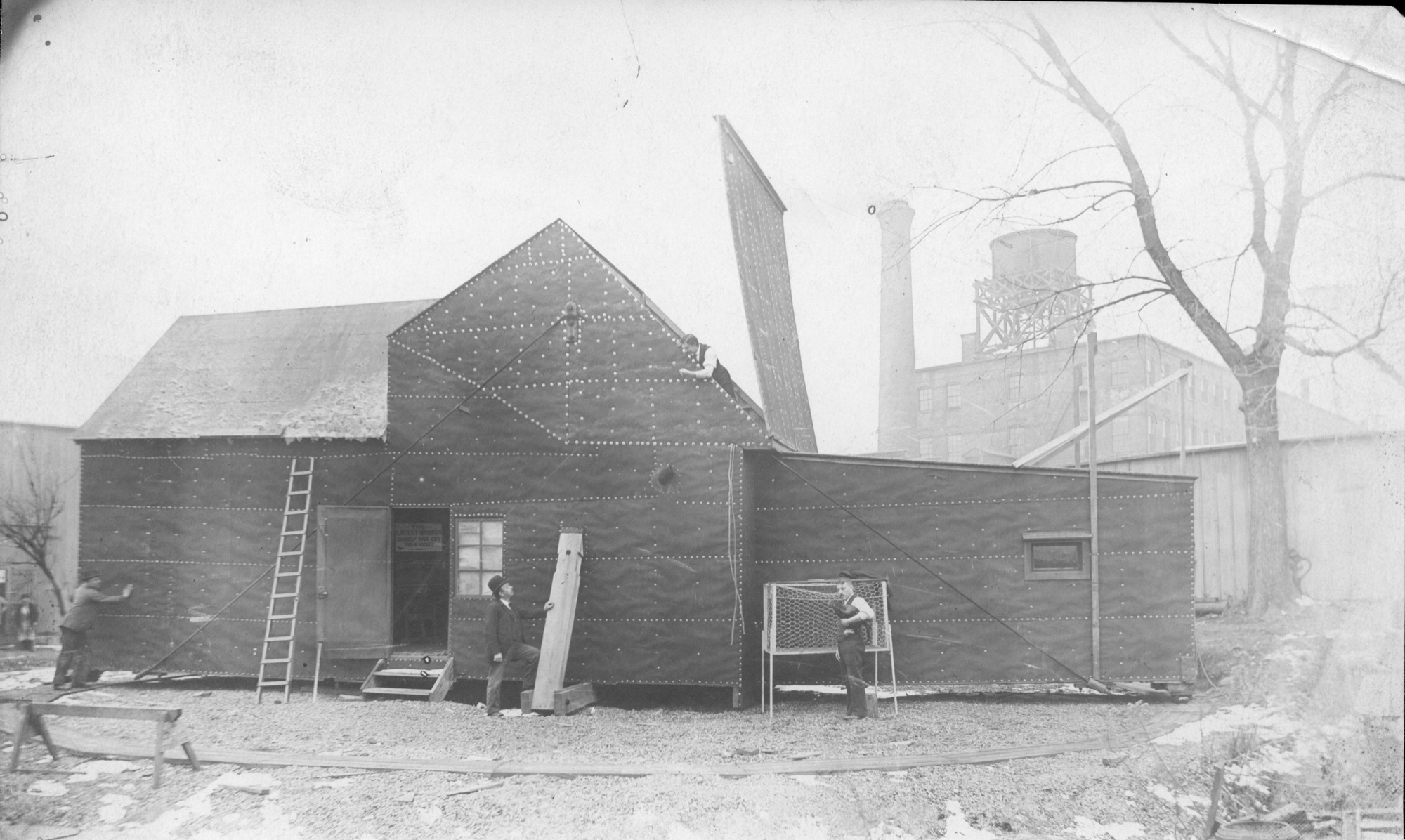
Sound seemed a natural addition. The phonograph was already Edison’s most uncanny invention; a moving face accompanied by a voice promised an even stronger illusion of presence. Around 1894 Dickson played violin into a recording horn while two men danced. The camera photographed them against a pale background.
The surviving film and recovered cylinder are often called the first sound film. They were produced for an experiment, but there is no evidence that Edison’s laboratory achieved exact commercial synchronisation between this particular image and recording at the time. Their importance is that sight and sound were deliberately created together.
The first Kinetophone
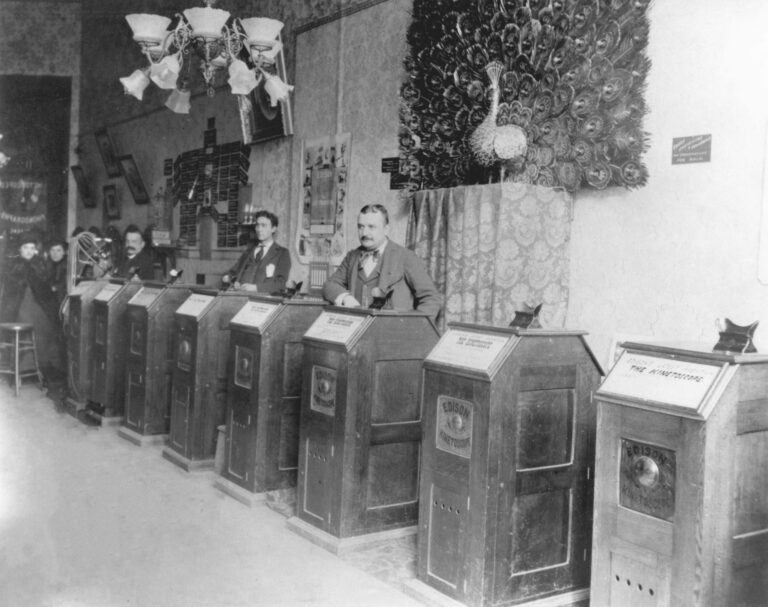
The Kinetophone offered commercially in 1895 combined a Kinetoscope with a cylinder phonograph. Rubber listening tubes carried sound to the viewer’s ears. A belt linked the mechanisms, but the film and recording were not necessarily performances of the same event. Music could accompany a motion-picture subject without matching visible lips or actions.
Only one person watched, so the arrangement avoided the problem of making sound loud enough for a theatre. It remained expensive and awkward. Few machines were sold, and projected motion pictures soon made the peephole business look limited.
Projection changes the problem
Projected films could entertain hundreds of people, but sound from an acoustic phonograph was not loud enough to match. There were no electronic amplifiers or loudspeakers. A large horn had to distribute the vibration mechanically.
Synchronisation was equally troublesome. Film could tear, slip or be repaired with frames missing. A projectionist might start late or alter speed. A cylinder or disc continued independently. A tiny error at the beginning became an obvious disagreement between mouth and voice.
Other inventors attempted solutions. Léon Gaumont demonstrated synchronised sound systems in France; Oskar Messter worked in Germany; producers employed live lecturers, musicians and sound-effects men. Silent cinema was rarely silent, but its sound was usually performed in the auditorium rather than mechanically locked to the film.
The 1913 theatre Kinetophone
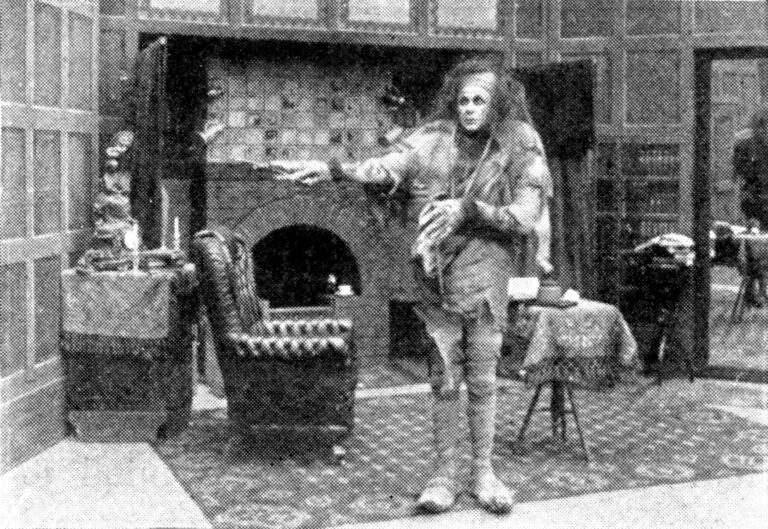
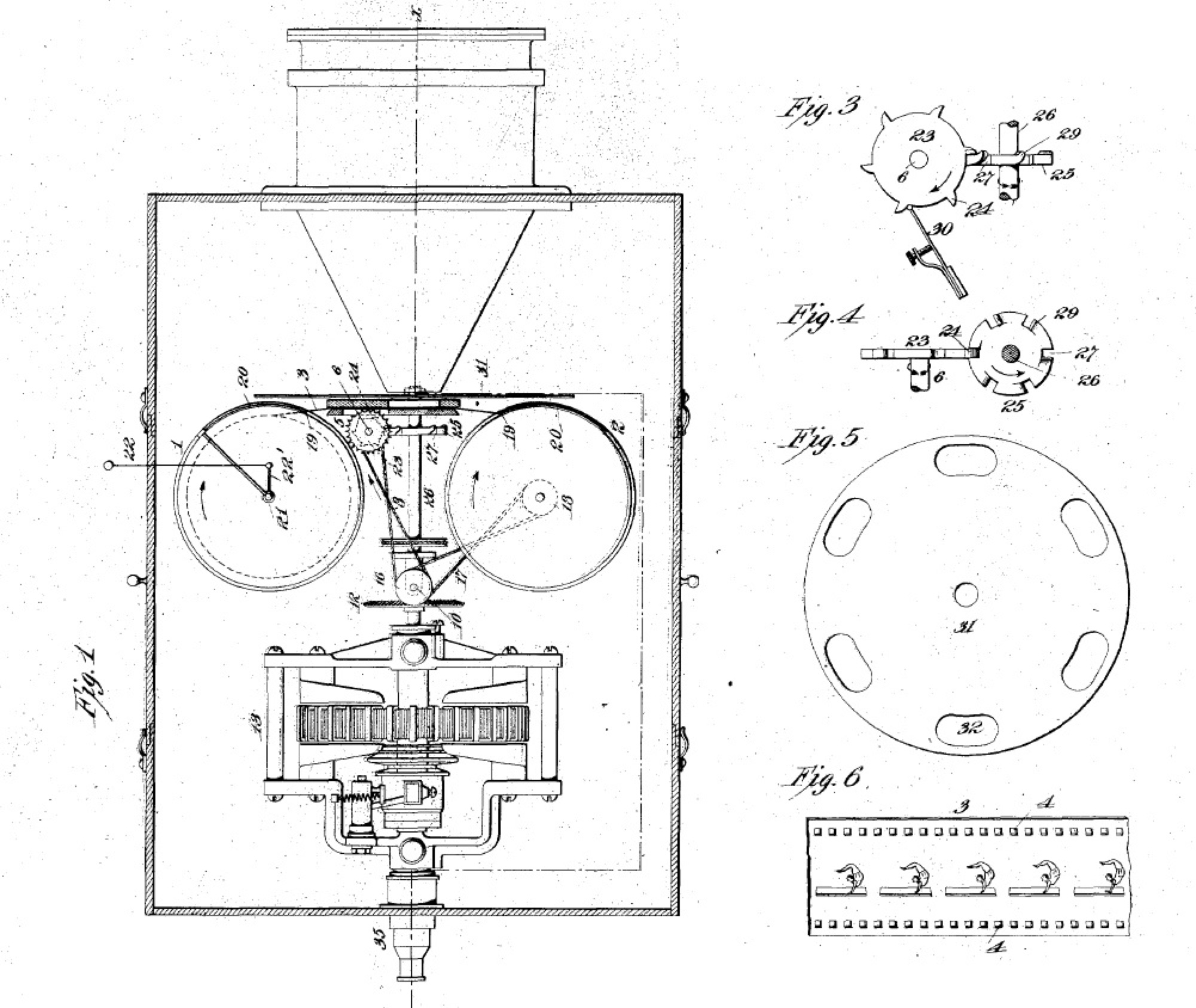
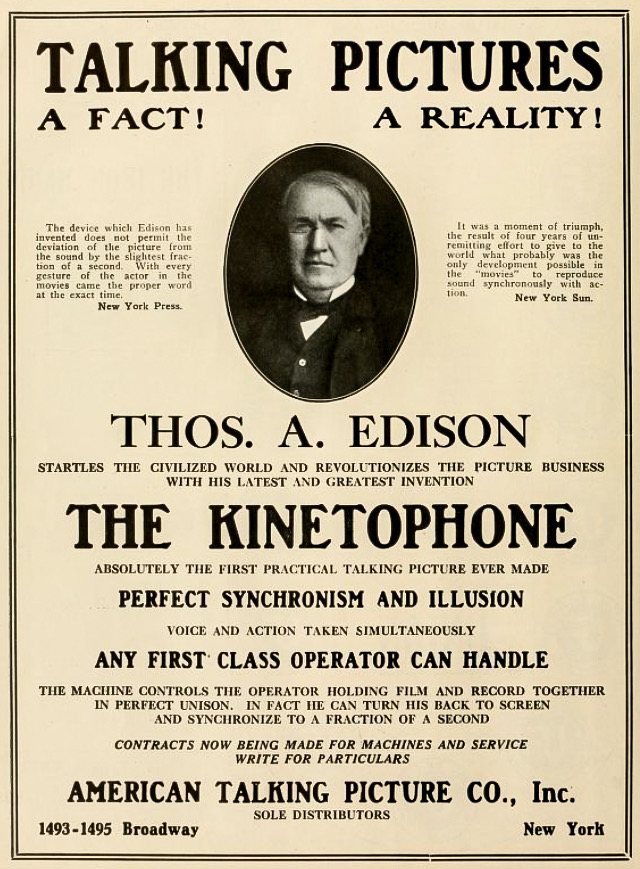
Edison returned to talking pictures with a system introduced publicly in 1913. A celluloid cylinder phonograph stood near the screen and used an enormous horn. A long mechanical connection ran to the projector at the rear of the theatre. The operator used a telephone to communicate with the stage attendant and align the machines.
The films were specially rehearsed. Performers had to stay close enough to the recording horn, and scenes favoured songs, speeches, comedy routines and simple dramatic exchanges. The camera and phonograph were driven in a planned relationship during recording. Exhibition attempted to repeat it.
Making a performance for two machines
The performers could not act with the freedom associated with later film. They had to remain intelligible to the recording horn and visible within a camera’s fixed frame. Dialogue needed measured pacing, because pauses and overlaps that worked on stage might blur on an acoustic cylinder.
Recording and filming together also made correction expensive. If the sound was weak or the picture faulty, the complete performance might have to be repeated. Editing threatened synchronisation, so the system favoured continuous scenes rather than the increasingly flexible cutting of silent cinema.
These artistic restrictions mattered as much as gears. By 1913 filmmakers were learning to build stories through close views, cross-cutting and changes of scene. The Kinetophone pulled performance back towards a stage arranged around hidden apparatus.
What a theatre had to do
An exhibitor received film, recording and instructions that had to remain associated. The projector at the back and phonograph at the screen were connected over the length of the auditorium. Staff had to start them together and recognise a drift before the audience did.
Ordinary film damage became catastrophic. Silent-film projectionists routinely trimmed broken frames and joined the strip. A Kinetophone print altered by even a short repair became shorter than its unchanged cylinder. Restoring synchronism required a deliberate compensating adjustment.
The system therefore asked every theatre to reproduce laboratory discipline night after night. A single successful premiere could generate headlines; a touring machine had to survive shipping, hurried installation and operators of uneven experience.
When everything worked, audiences heard voices emerge with the moving figures. Reports describe applause and genuine amazement. The Kinetophone was not a fraudulent display. It was a functioning system with very little tolerance for ordinary theatre mishaps.
Why it fell out of step
A projectionist could adjust synchronisation, but repairs posed a deeper problem. If a damaged section was cut from the film, the soundtrack did not lose the corresponding seconds. The mismatch might continue for the rest of the reel.
The mechanical linkage was laborious to install and operate. Acoustic reproduction limited volume and clarity. Recording horns constrained actors and staging. The equipment was costly, while exhibitors already knew how to supply music and effects to silent films with local performers.
A fire at Edison’s West Orange complex in December 1914 damaged Kinetophone materials, but it did not single-handedly kill a flourishing system. Commercial momentum had already weakened. European war disrupted markets, and the Edison company abandoned the process.
The missing electrical chain
Successful talking pictures required more than a better synchronising belt. Microphones had to convert sound into electrical signals; amplifiers had to strengthen them; loudspeakers had to fill a theatre; recording had to preserve a stable relationship with film.
By the 1920s vacuum-tube amplification and improved electrical recording made those steps possible. Sound-on-disc systems such as Vitaphone still faced synchronisation risks, but used electrically amplified discs. Sound-on-film systems recorded an optical track alongside the image, so both remained physically linked through cuts and projection.
Edison had pioneered components of the older mechanical world. The commercial talkies belonged to the electronic one.
Was Edison first?
Claims that Edison invented sound film need careful limits. He proposed synchronised sight and sound very early, his laboratory made a remarkable experimental film and his companies marketed two Kinetophone systems. Inventors in Europe and America pursued comparable ideas, and the systems that transformed cinema in the late 1920s did not descend from Edison alone.
Nor was the Kinetophone merely a comic failure. It demonstrated audience appetite and revealed practical faults with unusual clarity. A machine that succeeds only under laboratory control teaches precisely what an industry must solve.
The sound of an unfinished future
In the restored Dickson experiment, the violinist leans towards a recording horn while two men circle in a dance. It is not a polished talking picture. It is a scene arranged around the limitations of separate machines.
That limitation followed Edison’s sound-film work from the peephole Kinetophone to the theatre system of 1913. He saw the destination before technology could travel there reliably. The eventual talkies fulfilled his early comparison between phonograph and camera, but they did so with amplification and recording methods his system never possessed.
The failure also shows why priority is a poor measure of technological importance. Edison’s laboratory joined sound and image early, but the system that reorganised cinema arrived only when many other technologies and companies converged. Seeing the future first did not mean owning its practical route.
The Kinetophone belongs between prophecy and product: too complete to be dismissed as an idea, too fragile to become an industry.
How audiences judged the illusion
Viewers did not require modern fidelity to be astonished. A recognisable voice associated with a moving mouth was new enough to overcome hiss, limited volume and stiff staging. Novelty helped the first demonstrations; familiarity made later faults less forgivable.
Synchronization errors had an almost comic visibility. A singer’s mouth could close while the phrase continued, or a blow could be heard before it landed. Silent cinema allowed audiences to imagine voices; a faulty Kinetophone supplied the wrong one at the wrong time.
Exhibitors therefore carried reputational risk. A mechanical failure did not merely stop a machine. It broke the illusion the programme had advertised as Edison’s latest wonder.
What survives
The National Park Service preserves Kinetophone soundtracks and motion-picture material, but matching them can be difficult. Films and cylinders were separated, catalogued differently or lost. A soundtrack without its image may preserve dialogue whose action has vanished.
Modern restoration can align surviving elements digitally, doing in software what the theatre attempted with shafts and careful starting. The result lets us judge the performance while reminding us how vulnerable the original pairing was.
Survival is therefore uneven evidence. The small number of viewable examples should not be mistaken for the system’s entire repertoire, yet it also prevents confident claims about every programme’s quality.
Sources and further reading
- Library of Congress, “Early Edison Experiments with Sight and Sound” – Dickson experiment and early Kinetophone.
- Thomas Edison National Historical Park, “Motion Picture Soundtracks and Actor Auditions” – surviving soundtrack and audition records.
- Library of Congress, “Decline of the Edison Company” – the 1913 Kinetophone and company context.