The life
From a young railway newsboy and telegraph operator to the head of an industrial research enterprise, Edison’s career was built through curiosity, persistence and collaboration.
Explore his life →Life, inventions and legacy of Thomas Edison
Thomas Alva Edison · 1847–1931
Discover the experiments, ambitions, rivalries and breakthroughs behind one of history’s most famous inventors.
From a young railway newsboy and telegraph operator to the head of an industrial research enterprise, Edison’s career was built through curiosity, persistence and collaboration.
Explore his life →The phonograph, practical electric-light system and early motion-picture work mattered because they helped create entire systems and industries around new technologies.
See the inventions →Edison’s story includes bold achievements, commercial rivalry and the often-overlooked contribution of laboratory assistants. The most useful history makes room for all three.
Our research approach →A concise route through eight decades of experiments, businesses and public fame.
Edison’s influence was often greatest when a single device became part of a complete practical system.
The first machine able to record sound and reproduce it.
Read the story →A practical lamp supported by generators, wiring, switches and distribution.
Explore the inventions →Laboratory teamwork helped turn moving images into a new form of entertainment.
Visit the film archive ↗Readable history about the man, the laboratory and the inventions that changed everyday life.
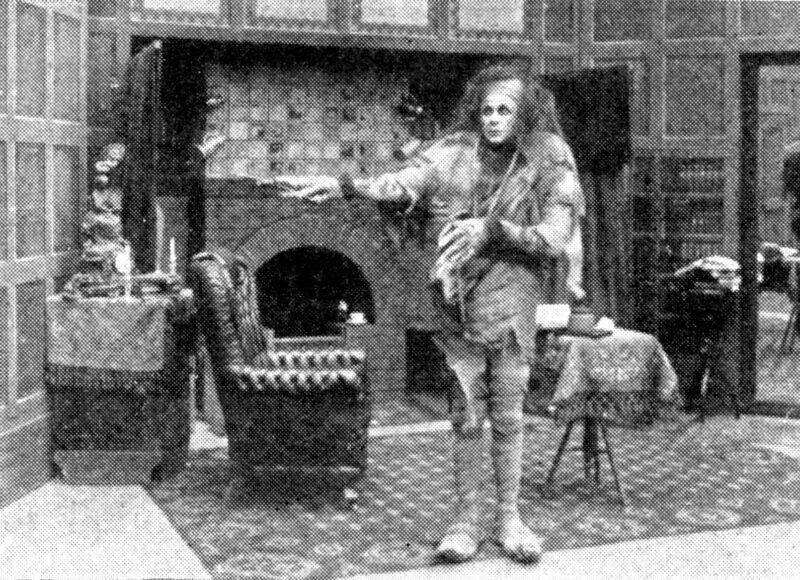
In January 1910, an Edison film crew photographed a monster taking shape in a vat of burning chemicals. The sequence was achieved by filming a constructed figure as it burned and collapsed, then running the images backwards. Bones appeared to gather flesh; rags and wild hair assembled into a…
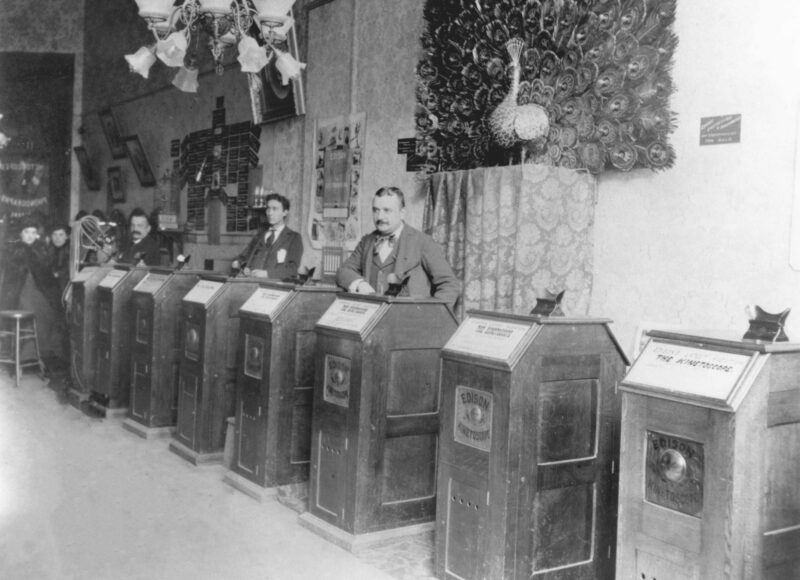
Some of the most fragile years in film history survived because early producers printed their moving pictures onto paper. The rolls could not be projected. They were made to satisfy the Copyright Office, one frame after another, as though a film were an exceptionally long photograph. Edison’s…
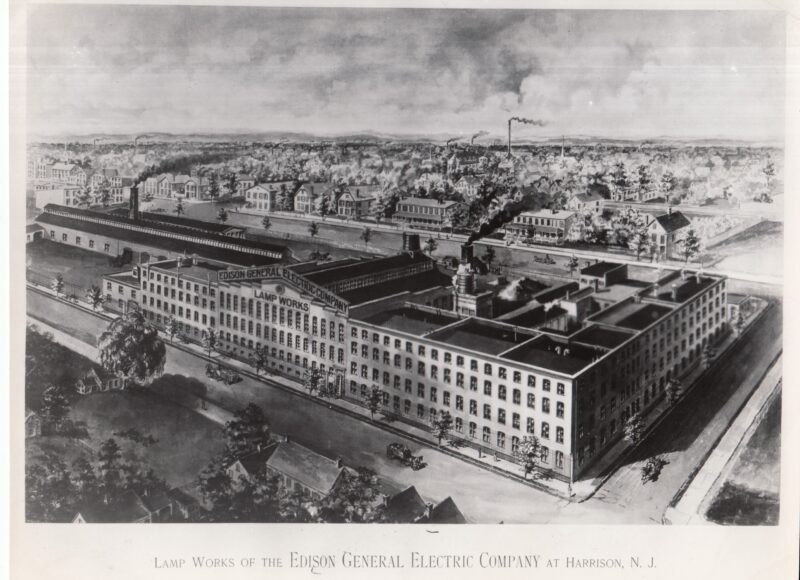
Joseph Swan demonstrated an incandescent lamp before Thomas Edison announced his own electric-light experiments. Edison did not invent the general idea of passing current through a material until it glowed. Swan did not build the complete commercial system that Edison’s organisation developed at…
On 23 April 1896, an audience at Koster and Bial’s Music Hall in New York watched moving pictures thrown onto a screen. The machine was advertised as “Edison’s Vitascope”, and Edison’s name gave the event the authority of America’s most famous inventor. The projector itself had not been invented…
Thomas Edison’s notebooks are frequently described as the private record of a genius at work. They are something more useful and less romantic. They are the surviving paperwork of an organisation. Across pocket books, hardbound volumes, loose sheets, scrapbooks, test records and factory files,…
When the battleship Maine exploded in Havana harbour on 15 February 1898, motion pictures were still a novelty. Within months, Edison’s company was selling films of troops, ships, burials, camp life and supposed battles. Some had been photographed near the events. Others were staged in New…
On the evening of 21 October 1929, Thomas Edison returned to a reconstruction of his Menlo Park laboratory and joined two wires. A replica lamp glowed. Across the United States, radio listeners who had dimmed their homes were invited to switch on their electric lights. Henry Ford had designed…
When Thomas Edison arrived at the Paris Exposition in August 1889, he was received less like a visiting engineer than a head of state. Crowds followed him, officials entertained him and reporters described his movements. His exhibits occupied more than a third of the space allocated to American…
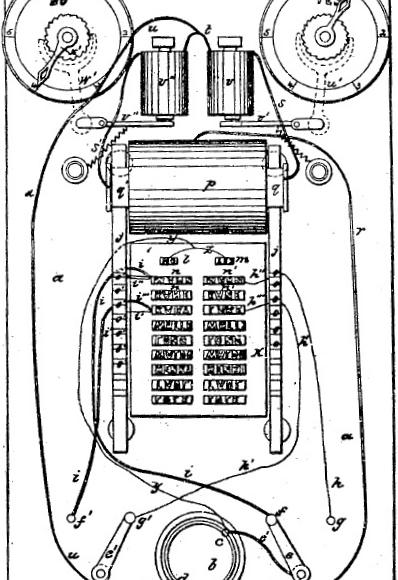
Thomas Edison did not invent the stock ticker. That credit belongs to Edward A. Calahan, who devised a practical instrument for the Gold and Stock Telegraph Company in 1867. Edison entered the story afterwards. He repaired, redesigned and eventually produced a stock printer that was easier to…
Before Thomas Edison recorded a voice or illuminated Menlo Park, he attacked a problem measured in copper wire. Telegraph companies wanted to send more traffic without erecting more poles and stringing more lines. A circuit that carried one message at a time was an expensive road with a single…
Research and context