Thomas Edison’s first patent was not for a lamp, a phonograph or a telegraph. It was for a machine designed to make legislators vote more quickly. The electrical vote recorder worked. That was precisely why politicians did not want it.
The familiar story is often told as a neat lesson: a young inventor creates an ingenious device, Washington rejects it, and he vows never again to invent anything without a market. The patent and the failed sales attempt are real. The polished moral was strengthened by later recollection. The episode is more useful when treated as the beginning of Edison’s education in power, customers and the difference between solving a technical problem and changing an institution.
A young telegrapher’s opportunity
In 1868 Edison was twenty-one and working within the telegraph industry. He had learned to send, receive, repair and modify electrical equipment through years as an itinerant operator. Telegraphy taught him that a circuit could carry decisions as well as words.
Legislative voting appeared slow and inefficient. Clerks called names; members answered; results had to be counted and recorded. An electrical system could transmit every vote from a desk to the clerk’s station and produce totals almost immediately.
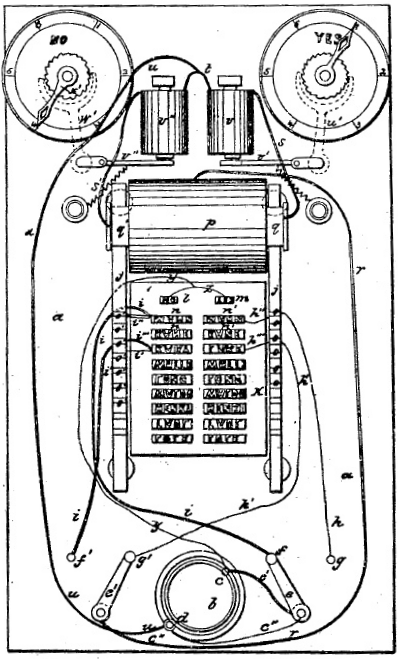
Edison filed his application on 13 October 1868. US Patent 90,646 was granted on 1 June 1869. The title was “Electrographic Vote-Recorder”.
How the machine worked
Each legislator operated a switch indicating yes or no. The position completed one of two electrical circuits. At the clerk’s desk, a chemically prepared sheet moved beneath metal type. Current passing through the selected circuit marked the member’s name in the appropriate column.
The machine could record votes individually and deliver the result without a lengthy roll call. The patent also described a device at the presiding officer’s desk that prevented late changes after voting closed.
The chemistry of an electrical record
Edison called the machine electrographic because electricity produced a visible chemical mark. Telegraph engineers already used prepared paper in recording instruments. His proposal adapted that principle so the signal did not merely indicate yes or no; it printed the identity of the member in the correct list.
This detail separated the invention from a pair of totalising counters. Legislative accountability required a roll as well as a result. Constituents, parties and newspapers might need to know how each representative voted. Edison designed for a permanent official record.
The apparatus would nevertheless have depended on clean contacts and disciplined procedure. A faulty switch or conductor could misrecord a vote. Adoption would require testing, rules for disputes and a trusted manual check. The political problem was larger than reluctance to save time.
Slow voting as political power
A roll call can give leaders time to count uncertain members while voting proceeds. A legislator may delay an answer, observe colleagues or be persuaded. In an age before instant communication from every desk, the minutes themselves carried strategic value.
Minorities also use procedure to draw attention and postpone a decision. The machine treated delay as waste because Edison approached the chamber as an information system. Legislators understood it as part of bargaining and representation.
Modern electronic voting did not arrive simply because later machines became better. Legislative rules and political expectations changed, and institutions developed methods for verifying results. Technology succeeded once it was incorporated into authority rather than merely offered to it.
Nothing about the design was absurd. Modern legislatures use electronic voting systems based on the same broad objective: rapid, attributable recording. Edison had identified a process that electricity could accelerate.
The visit to Washington
Edison later recalled taking the invention to Washington, where a political figure told him that it was the last thing legislators wanted. Minority tactics depended partly on delay. A slow roll call allowed time for persuasion, bargaining or obstruction. Instant results would remove a useful feature of the existing procedure.
Accounts vary in detail. Some name the man as a congressional committee chairman; others place greater emphasis on Edison’s associate Dewitt Roberts, who had interests in the machine. The central point is consistent: technical speed did not match the customer’s political incentives.
The rejection was not proof that politicians irrationally hated efficiency. A legislature is not a factory line. Delay can be tactical, but it can also permit debate and protect a minority from a majority determined to move too quickly. Edison had designed for the visible process without fully understanding the institution’s hidden purposes.
The famous promise
In later interviews Edison said the experience taught him not to waste time inventing things people did not want. He is often quoted as resolving to invent only where commercial demand existed. The principle fits his subsequent career, but the exact words differ among retellings.
It would be wrong to imagine that he never again pursued an impractical scheme. His ore-milling venture consumed a fortune; the poured-concrete house struggled to become a business; the talking doll failed quickly. Edison learned to ask about markets, but optimism repeatedly overruled the answer.
What changed was his method of selecting and financing work. Telegraph companies already paid for faster communication. Electric-light investors could see a vast market. Recorded sound, motion pictures and storage batteries addressed recognisable desires even when the final product remained uncertain.

What the patent reveals
The vote recorder contains several habits that later became characteristic. Edison did not merely propose counting electricity. He designed a system joining the member’s switch, the wiring, the clerk’s register and the presiding officer’s control. The useful invention was an arrangement of parts around a working procedure.
It also shows how early his attention turned towards automation. The machine translated a human choice into an electrical signal and then into a durable record. Stock tickers, printing telegraphs and automatic telegraphy would develop the same interest in making information move and register with less manual handling.
A patent is not a product
Edison received legal protection, but no meaningful market followed. This distinction is easily lost when patent totals are used as a measure of genius. A patent recognises a claimed invention; it does not guarantee that the device is manufacturable, profitable or desired.
The vote recorder failed at the stage between technical operation and adoption. Legislatures would have needed to purchase equipment, wire desks, change rules and surrender some procedural flexibility. The benefit of speed was obvious to the inventor, while the political cost fell on the users.
Edison’s later successes often came from controlling more of that path. At Menlo Park he developed not only a lamp but a lighting system. At Pearl Street his interests had to generate and sell electricity. Laboratories, factories, companies and demonstrations connected patent to practice.
Was Edison the first to imagine electronic voting?
He was an early patentee of an electrical legislative voting system, not the originator of every idea about mechanical or rapid voting. Proposals for recording votes had appeared before, and other inventors later produced different machines. The safest claim is the precise one: US Patent 90,646 was Edison’s first United States patent and described his electrographic vote recorder.
The device has sometimes been called a failure as though it were badly designed. Its failure was commercial and institutional. That difference is why the story survives.
The right machine for the wrong customer
Edison arrived in Washington believing that speed was self-evidently valuable. He left understanding that users may benefit from what an inventor calls inefficiency. The lesson was not “give the public anything it asks for”. Edison would repeatedly try to create demand. It was that invention begins with machinery but succeeds inside a social system.
The vote recorder deserves more than a comic place before the great inventions. It introduced the problem that would occupy Edison throughout his career: a device has to work, but the world around it has to be ready—or be persuaded—to work differently.
His later publicity made the rejection sound like a single decisive conversion to market-led invention. Careers rarely turn so cleanly. Yet the memory remained important enough for Edison to repeat because it explained the practical identity he wanted the public to see: not an inventor of clever toys, but a man determined to attach invention to use.
The first patent never earned that use. It did give Edison a durable question. Who wants the change, who pays for it and whose power is reduced when the machine works exactly as intended?

The patent as a beginning, not a prophecy
It is tempting to find the mature Edison inside every feature of Patent 90,646. The young telegrapher had not yet created a research laboratory, managed a major factory or developed a central station. He was learning how to move from technical employment towards ownership of ideas.
The patent fee and application also represented risk. An inventor with little capital could spend time and money securing a right that no manufacturer purchased. Edison’s early partnerships attempted to spread that risk while sometimes entangling ownership.
Soon his stock-ticker and printing-telegraph work found customers whose needs he understood directly. Brokers valued faster price information because delay cost money. The contrast with legislators was not simply demand versus no demand; it was a benefit that aligned with the buyer’s incentive.
Electronic voting eventually arrives
Twentieth-century legislatures adopted electrical and electronic systems after rules, verification and chamber design evolved around them. Modern equipment displays totals quickly and records individual votes, much as Edison proposed in broad outline.
That later success does not make the 1869 machine commercially premature in a simple technological sense. Its chemistry and wiring could have operated. What was premature was the institutional agreement to treat speed, finality and automatic recording as desirable.
An invention can wait nearly a century for the customer to redefine the problem.
Sources and further reading
- Thomas A. Edison Papers, “Vote Recorder” – design, patent and rejection.
- US Patent 90,646, “Electrographic Vote-Recorder” – complete patent specification and drawings.
- Thomas A. Edison Papers, “Edison’s U.S. Patents, 1868–1879” – patent chronology.
- Thomas A. Edison Papers, “1847–1870” – Edison’s telegraph career and early invention.