The first phonograph had no record shop, no catalogue of singers and no convenient record that could be played again and again. It was a hand-cranked machine wrapped in tinfoil. A short spoken message could be impressed into the metal and heard immediately, but the foil creased, tore and lost its sound after a few playings.
That fragile demonstration of 1877 nevertheless altered what people believed a machine could do. A voice no longer had to disappear as soon as the speaker fell silent. Over the next half-century, Edison, his employees, his rivals and a new class of performers turned that possibility into recorded entertainment. Tinfoil became wax; individual cylinders became moulded records; spring motors replaced awkward hand cranks; horns grew into cabinets; and Edison eventually abandoned the cylinder he trusted for a thick disc of his own design.
The story is not simply one of steady progress. Edison left the phonograph just when rivals were improving it, returned to a market he did not control, resisted the disc after customers preferred it, and finally produced a technically impressive format that was incompatible with most records in American homes. Recorded sound began with an astonishing invention. The recording business was harder.
What the tinfoil phonograph changed
Sound had been recorded before Edison. In 1857 the French printer and bookseller Édouard-Léon Scott de Martinville patented the phonautograph, which traced sound waves on soot-blackened paper. Scott intended the traces to be studied, not played back. Digital researchers recovered recognisable sound from surviving phonautograms in 2008, so he now deserves credit for the earliest known recording of airborne sound. Charles Cros described a method of recording and reproducing sound in France in 1877 but did not build a working machine.
Edison’s decisive step was to combine recording and playback. Work on automatic telegraphy had shown him that a message could be stored as indentations and repeated. Experiments with the telephone suggested that the vibrations of a diaphragm might make a physical record of speech. Late in November 1877, he drew a cylinder wrapped in tinfoil with a diaphragm and stylus. John Kruesi, the Menlo Park machinist, built the machine.
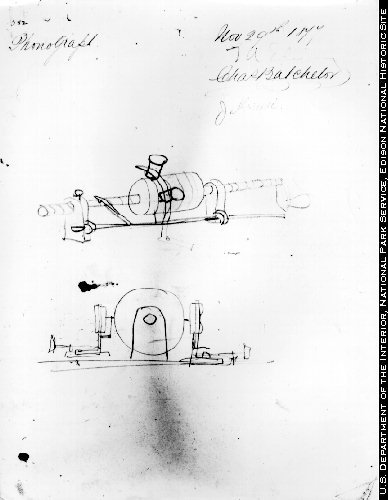
For many years the invention was dated to 12 August 1877. Laboratory records point instead to the first days of December. The familiar account says that Edison spoke “Mary had a little lamb” and heard the words return. It is plausible and appears in early recollections, but no original tinfoil recording survives. What can be proved is that the machine was demonstrated at the office of Scientific American in early December and reported in the magazine’s issue of 22 December 1877. Edison applied for a patent on 24 December and received United States Patent 200,521 on 19 February 1878.
If you want the laboratory sequence and mechanism in detail, see how Edison invented the phonograph. The important point here is what followed. The tinfoil machine created a sensation before anybody knew what it was for.
A famous machine in search of a use
Edison proposed a remarkable list of applications in 1878: letter writing and dictation, talking books for blind people, lessons in elocution, music boxes, speaking clocks, preserved family voices and a connection with the telephone. Many later became real. None immediately produced a dependable business.
The Edison Speaking Phonograph Company sent exhibition machines on tour. Paying audiences listened through tubes while an operator recorded and replayed voices. The novelty was compelling, but the machine demanded skill. The cylinder had to turn at something close to the original speed; the stylus had to press with the right force; and a sheet of foil could not be removed and stored like a modern record without damage. Speech emerged faintly beneath a rasp of mechanical noise.
Edison’s attention moved to the electric-light system. That decision was understandable. Electric light promised a large industrial network, while the phonograph appeared to be an ingenious curiosity. It also left the field open to other experimenters.
Bell, Tainter and the wax cylinder
At Alexander Graham Bell’s Volta Laboratory in Washington, Bell, his cousin Chichester Bell and Charles Sumner Tainter tried to make sound recording more durable and intelligible. Their Graphophone cut a groove into a wax-coated cardboard cylinder rather than embossing tinfoil. A floating stylus, treadle drive and listening tubes improved control. The wax surface could be shaved smooth and used again, an obvious advantage for office dictation.
The Volta associates approached Edison about combining their work. He refused, returned to sound recording in late 1886 and began an intensive programme at his new West Orange laboratory. His Improved and Perfected Phonographs used solid wax cylinders and electric motors. Edison’s version adopted the essential advantage of cutting into wax but followed its own mechanical and material path. Priority became the subject of patent claims and business rivalry rather than a simple case of one inventor replacing another.
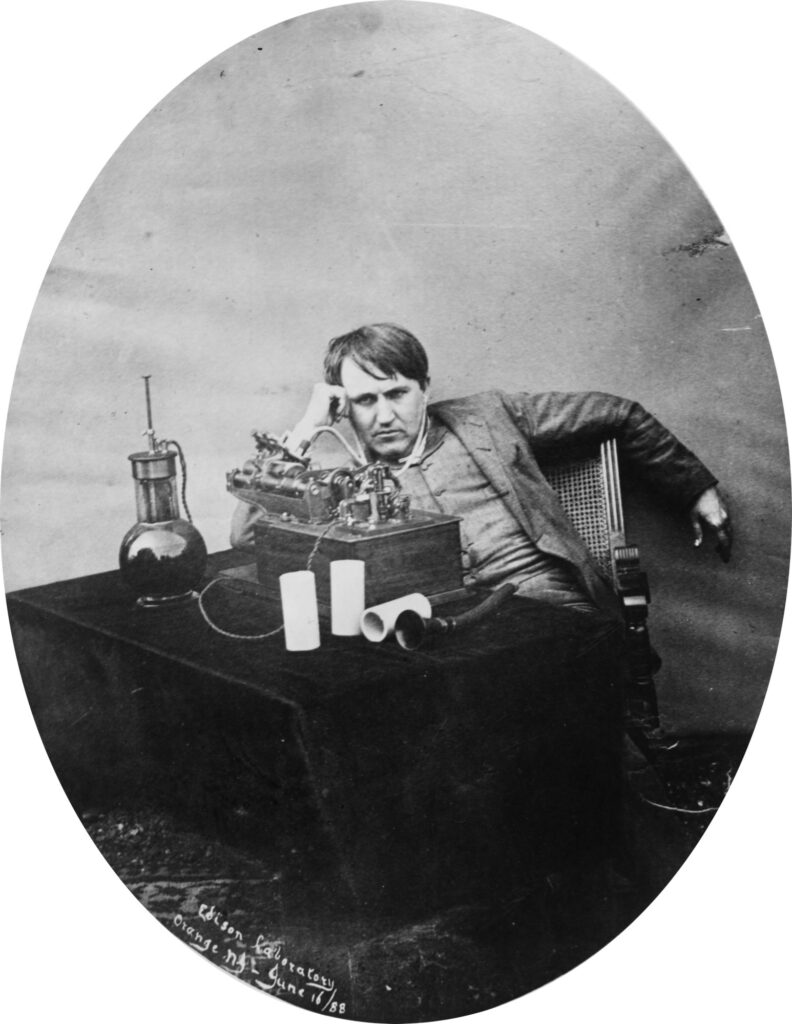
A famous photograph from June 1888 shows Edison bent towards the listening tubes of a wax-cylinder machine. It captures both the progress and the limitation. Recorded sound had become clearer and reusable, yet it remained private and technical. There was no loudspeaker. Listeners usually pressed rubber tubes to their ears, while the apparatus still looked like laboratory equipment.
The dictation scheme that nearly buried the phonograph
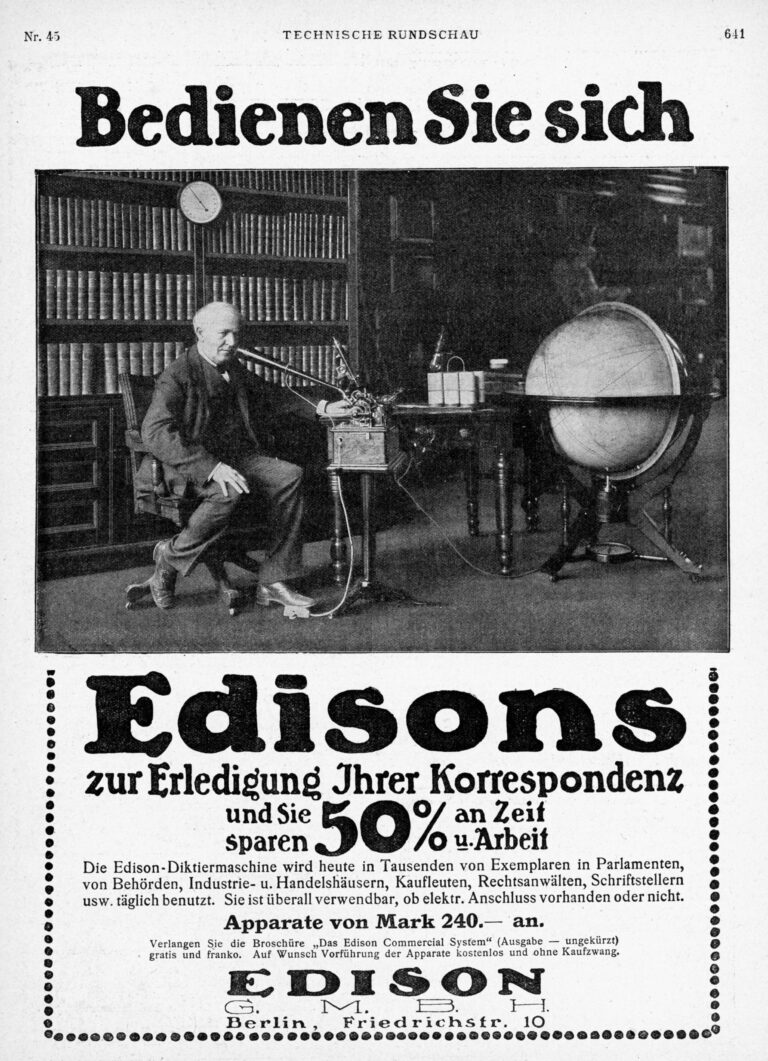
Financier Jesse H. Lippincott attempted to consolidate the business. In 1888 he acquired control of the Edison Phonograph Company and became the sole licensee of the American Graphophone Company, bringing them under the North American Phonograph Company. The plan was to lease machines through regional companies, mainly as office dictation equipment.
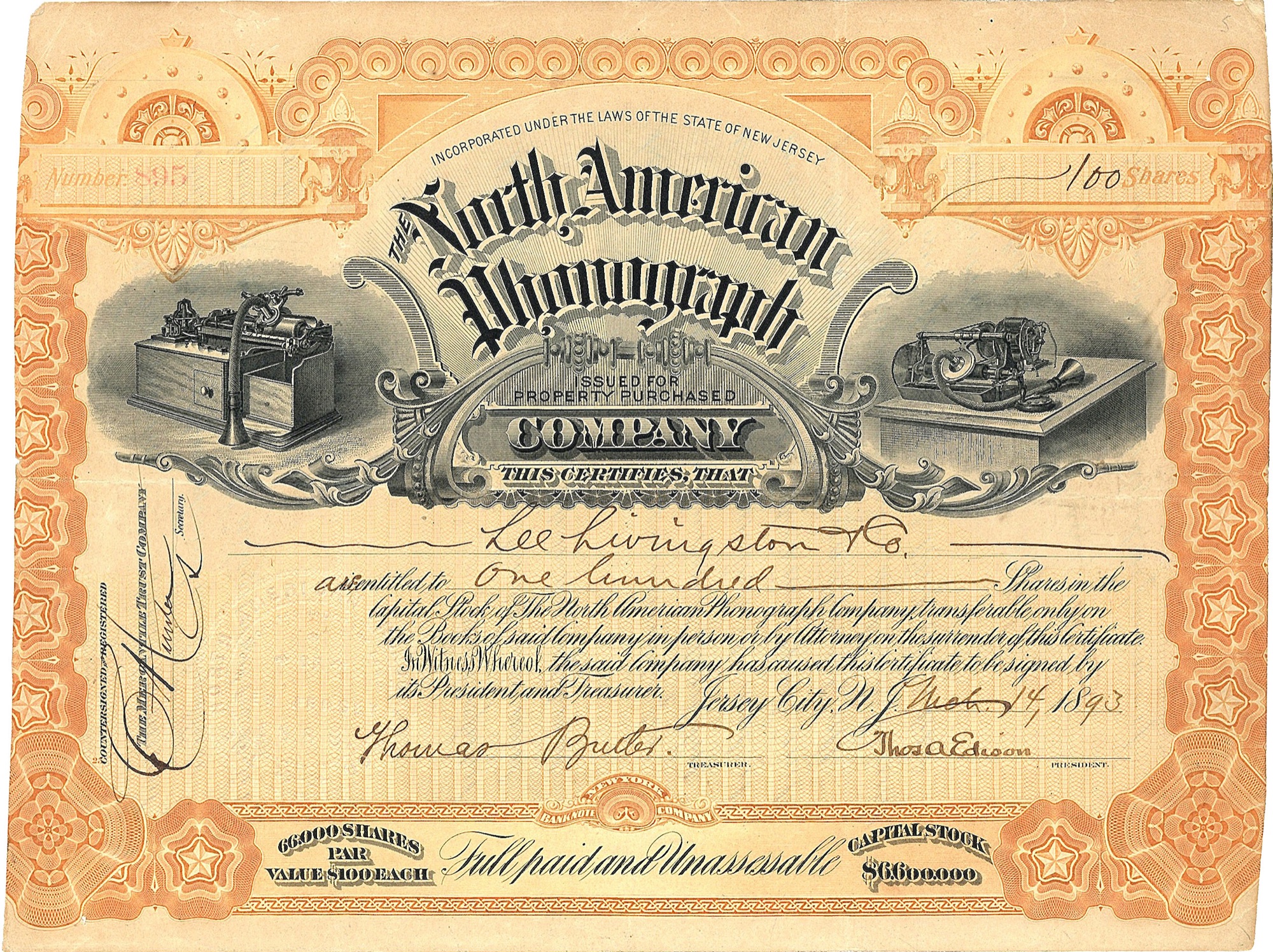
The office market disappointed. Machines were expensive, managers were reluctant to reorganise their work and stenographers had good reason to see mechanical dictation as a threat. The regional structure was costly, Lippincott became ill, and the company entered financial trouble. The depression that followed the Panic of 1893 made matters worse. Edison eventually regained important rights and reorganised his phonograph interests.
Entertainment had meanwhile supplied a more persuasive use. Coin-operated phonographs appeared in public places from 1889. A customer inserted a nickel and listened through tubes to a short recording. Several people could gather around a machine, each with an earpiece. These early “phonograph parlours” revealed that audiences might pay for music, comic routines and novelty performances even when they had no desire to dictate a letter.
How a performance became a record
Early cylinder recording was brutally direct. A singer or instrumentalist performed into a large horn. Sound waves moved a diaphragm and cutting stylus, which carved a vertical, or “hill-and-dale”, groove into a rotating wax master. There was no microphone, electrical amplifier or mixing desk. Loud performers and instruments recorded best. Musicians crowded around the horn; quieter instruments moved closer, and balance was achieved by physical position.
Making copies was the greater problem. In the earliest commercial system, a performer repeated the selection while several phonographs recorded at once. Multiple masters could be made, and pantograph mechanisms could duplicate one cylinder onto another, but output was limited and quality deteriorated. A popular selection might require the artist to perform it again and again.
Gold-moulding changed the economics around 1901. A wax master was coated with metal to create a negative mould, and duplicate cylinders could then be formed from it in much larger numbers. “Gold” referred to a thin conductive coating used during electroplating, not to a gold record in the modern sense. The process separated the saleable copy from the single live performance and allowed Edison’s catalogue to grow.
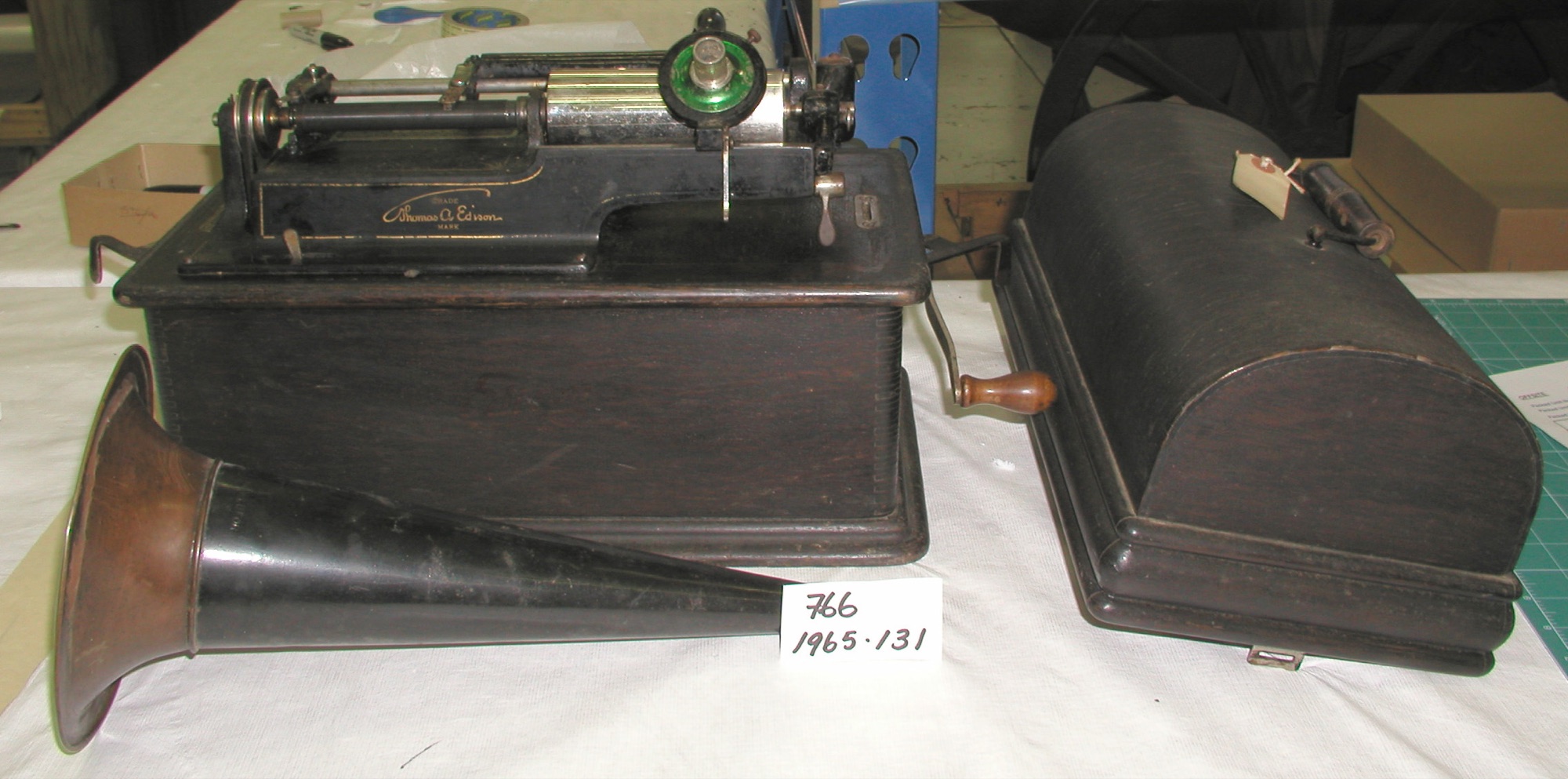
Spring-driven Home and Standard models made the phonograph less dependent on batteries or hand-cranking. Removable cylinders could be bought in boxes and stored on a shelf. The owner fitted a record, wound the motor, lowered the reproducer and listened through a horn. The machine was becoming furniture and family entertainment rather than an operator’s apparatus.
The people inside the cylinders
The recording catalogue broadened the phonograph’s meaning. Marches, popular songs, comic monologues, minstrel material, religious music, speeches and instrumental solos entered the home. Much of the surviving catalogue reflects the prejudices and commercial conventions of its period. Racist dialect routines and stereotypes were sold alongside performances of considerable historical and musical value. A responsible history cannot treat every old record as innocent nostalgia.
Some cylinders preserved voices that would otherwise be silent. George Gouraud, Edison’s representative in Britain, recorded public figures and musicians in 1888 and 1890. William Ewart Gladstone addressed Edison; Arthur Sullivan commented on the invention; a performance of Handel at the Crystal Palace in June 1888 became one of the earliest surviving recordings of a large musical group. Later Edison catalogues carried campaign speeches, vaudeville, opera, popular song and material in several languages.
The recording, however, was not a transparent window on the performer. Acoustic horns favoured certain voices and instruments. Short cylinder duration forced cuts. Catalogue managers selected what they believed would sell, and record-company descriptions shaped the listener’s expectations. Recorded sound preserved a performance while also transforming it into a repeatable product.
Longer playing cylinders — and a material that did not break
Standard cylinders generally played for about two minutes. Edison’s Amberol, introduced in 1908, doubled the playing time by placing twice as many grooves in each inch. The greater density demanded a finer stylus and a different feed mechanism, so older machines needed conversion parts. Wax Amberols were still vulnerable to wear and breakage.
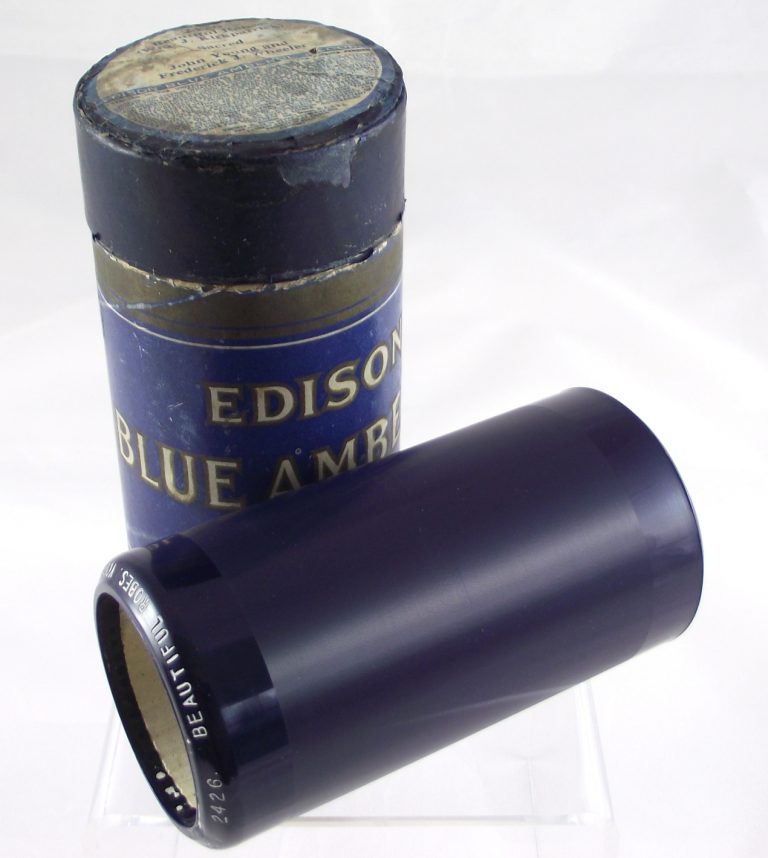
The Blue Amberol of 1912 used a celluloid surface over a plaster core. It was tougher, lasted longer and offered impressive acoustic sound. Edison promoted it as nearly indestructible. The claim was reasonable compared with brittle wax, though celluloid cylinders could split or shrink and plaster cores could swell. “Unbreakable” was advertising, not a guarantee against a century of storage problems.
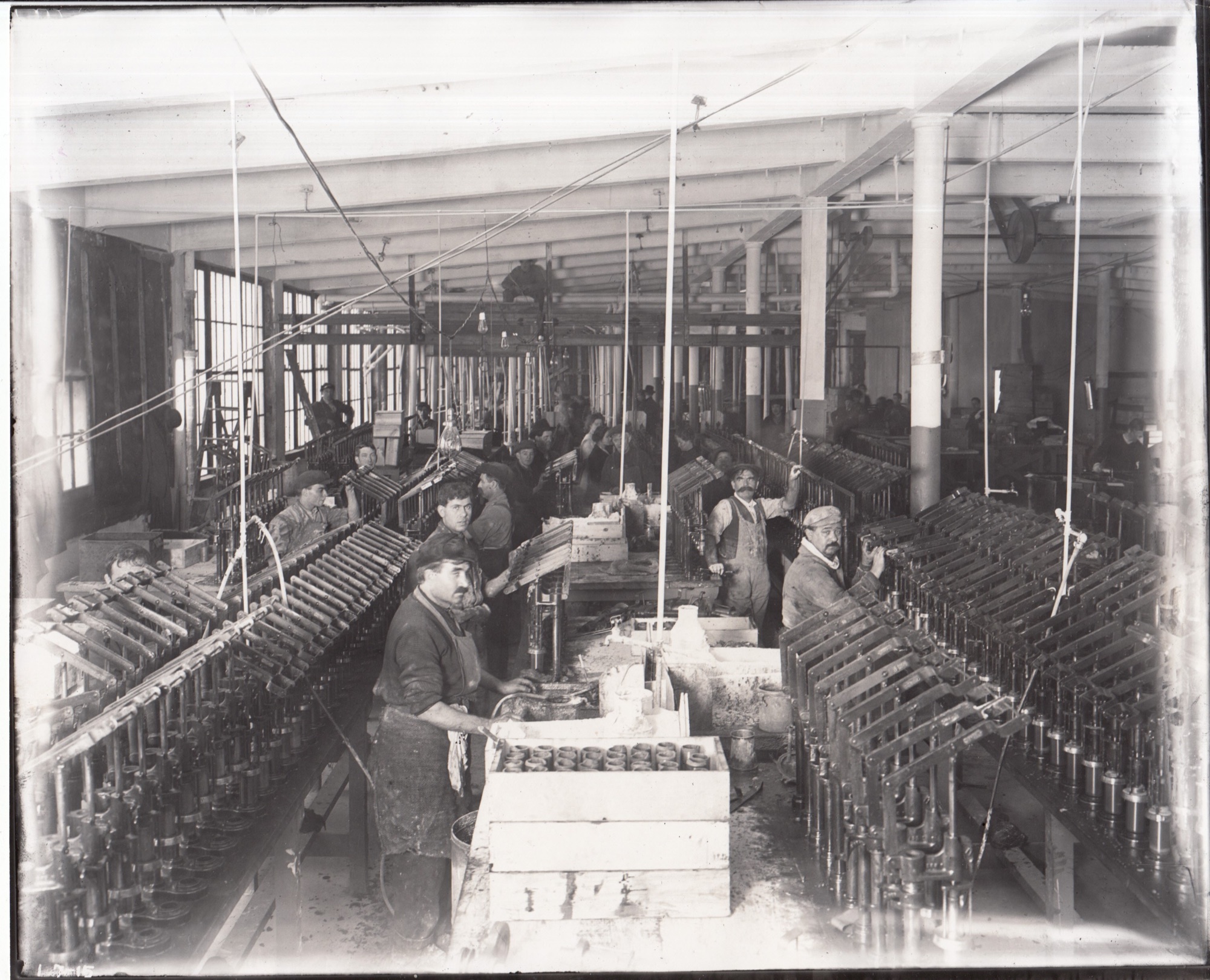
Production required specialised machinery and considerable manual work. After a fire swept through part of the West Orange works in December 1914, employees restored equipment and resumed manufacture with notable speed. A January 1915 photograph shows women operating Blue Amberol machinery labelled as having survived the fire. It reminds us that “Edison records” were physical factory products made by a workforce, not merely ideas from the laboratory.
Why the cylinder lost to the disc
Emile Berliner’s Gramophone placed a lateral groove on a flat disc. The format was not automatically superior in every acoustic measure, but it offered decisive commercial conveniences. Discs were easier to press, label, stack, mail and browse. Two sides could carry separate selections. Victor and Columbia built strong catalogues, attractive cabinet machines and recognisable recording stars.
Cylinders reached their peak around 1905. Edison continued to argue that the constant surface speed of a cylinder offered better reproduction, and the Blue Amberol could indeed sound excellent. Customers nevertheless preferred the flat record. By 1907 disc sales were passing cylinders; Columbia stopped marketing cylinders in 1912. Edison’s commitment to the older format protected existing customers but delayed his response to the market.
This was not simple blindness. Edison cared deeply about sound quality and distrusted the noisy shellac discs sold by competitors. The difficulty was that a format succeeds through compatibility, convenience, price, repertoire and distribution as well as engineering. A technically admirable cylinder could not compel customers to ignore the shelves of discs already available.
The Diamond Disc: Edison’s late answer
Associates began disc experiments around 1910, initially without drawing Edison’s full attention to how far the work had advanced. Chemist Jonas Aylsworth developed a hard plastic playing surface. The Edison Disc Phonograph was demonstrated in 1911 and sold from 1912. Its Diamond Disc was unusually thick and used a vertically cut groove read by a permanent diamond point.
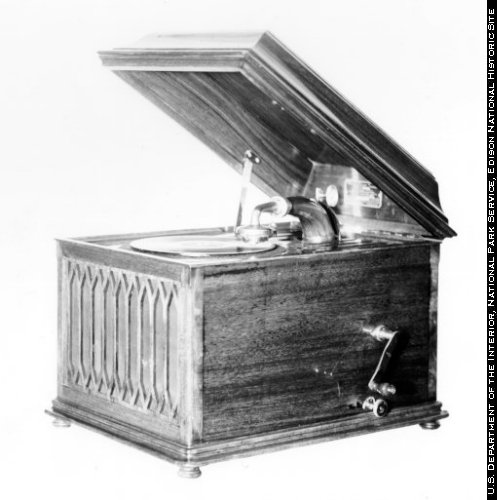
The system could reproduce music with low surface noise and impressive presence. It was also incompatible with the standard lateral-cut discs that dominated the trade. Playing an Edison disc on the wrong machine could damage it; playing ordinary records on an Edison machine required a special adaptor. Owners were being asked to enter a separate Edison world.
Edison promoted the machine through “tone tests”. A singer performed beside a concealed or visible Diamond Disc phonograph, and publicity challenged the audience to distinguish the living voice from its recorded “re-creation”. The tests were carefully arranged and served advertising rather than blind scientific comparison, but they conveyed the company’s central promise: fidelity, not celebrity, justified the price.

Edison personally auditioned performers and could be dismissive of famous singers whose tone he disliked. His insistence on judging voices apart from reputation sometimes uncovered excellent lesser-known artists, but it also weakened the catalogue’s appeal. Victor customers could buy Caruso; Edison wanted the machine’s reproduction to be the star. In a popular-music business, technical authority could not substitute for names and songs listeners wanted.
Electrical recording, radio and the end in 1929
During the mid-1920s, microphones and electrical amplification transformed recording. Victor and Columbia adopted electrical systems in 1925, producing a wider frequency range and allowing performers to work at a more natural distance. Edison introduced electrically recorded discs later and experimented with long-playing formats. His long-playing discs of 1926 offered extended duration but demanded exceptionally accurate tracking and did not establish a lasting market.
Radio created another challenge. It delivered music, speech and news without requiring the listener to buy a new record for every programme. Edison’s companies entered radio late and continued trying portable machines and standard lateral-cut records. In October 1929, orders were given to end the Edison disc business. The decision came before the Wall Street crash could fully affect sales, though the economic collapse ensured there would be no easy return.
The closure did not make the phonograph a failure. Edison’s West Orange archive now preserves about 11,000 cylinders and 39,000 discs, the majority made between 1888 and 1929. The business had lasted long enough to document musical taste, political speech, comedy, advertising, changing technology and the voices of people born before recorded sound existed.
From a disappearing voice to a recorded culture
Edison’s original achievement was not the first trace made by sound. It was the first practical union of recording and playback. The invention gave a voice a physical afterlife. Everything that followed — wax composition, moulding, motors, horns, catalogues, performers, factories and shops — determined whether that afterlife could be sold and heard.
The later history also corrects the idea of Edison as an inventor who always recognised the future first. He misjudged dictation, surrendered years of development to the Volta Laboratory, defended the cylinder after the public chose discs and delayed electrical recording. Yet he kept returning to sound for half a century. The phonograph was not simply one item on a list of Edison inventions; it was a continuing argument about what listeners valued.
Modern recorded sound inherited both sides of that argument. Fidelity matters, but so do convenience, compatibility, performers and the ability to make copies cheaply. The tinfoil phonograph proved that the past could speak. The recording industry began when inventors, workers, artists and customers decided what they wanted it to say.
Sources and further reading
- Thomas Edison National Historical Park: The Origins of Sound Recording — Scott’s phonautograph and the distinction between tracing sound and reproducing it.
- Thomas Edison National Historical Park: Origins of Sound Recording — Thomas Edison — laboratory development, surviving notes and the late-1877 chronology.
- Library of Congress: History of the Cylinder Phonograph — tinfoil, the Volta Laboratory, Lippincott, entertainment uses, moulding and Blue Amberol cylinders.
- Library of Congress: History of the Edison Disc Phonograph — Diamond Disc materials, tone tests, cylinder decline and the later business.
- Library of Congress: Recorded Sound Timeline — Scott, Edison, the Graphophone, Berliner’s disc and the transition to electrical recording.
- Thomas Edison National Historical Park: Listen to Edison Sound Recordings — Edison formats, dates, genres and selected recordings from the West Orange archive.
- Thomas A. Edison Papers: Disc Phonograph — Edison’s resistance to discs, fidelity aims, incompatibility and catalogue choices.
- Andre Millard, America on Record: A History of Recorded Sound, 2nd ed. (Cambridge University Press, 2005) — scholarly history of recording technology, formats, business and listening.