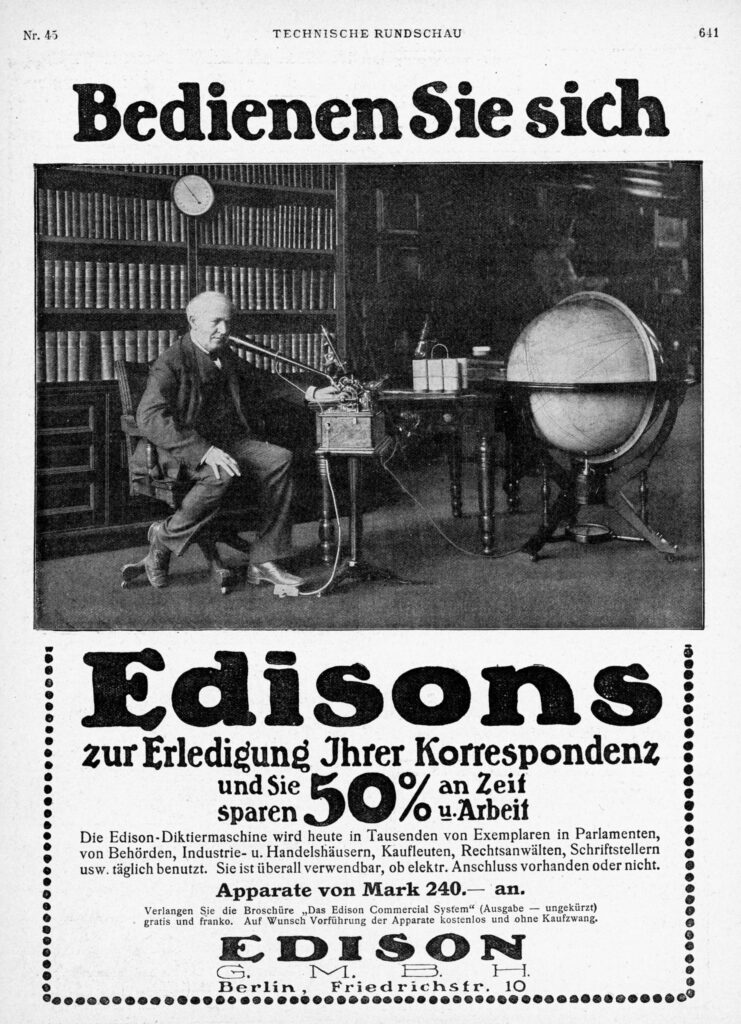
Thomas Edison’s phonograph promised music, family voices and books read aloud. Its steadiest early business use was less romantic: dictation. A manager spoke a letter into a machine; a typist listened later and produced the document. Under the name Ediphone, Edison tried to make this routine as ordinary as the typewriter.
The office phonograph was not an early tape recorder. It used wax cylinders, speaking tubes, foot controls and trained operators. Its history reveals how an invention changes when placed between employer and employee. The machine saved a manager from waiting for a stenographer, but transferred timing and repetition to the typist.
Dictation in Edison’s first list
After inventing the phonograph in 1877, Edison published a list of possible uses. Letter writing and dictation came before recorded entertainment. A business machine offered an obvious customer: offices already paid for correspondence, shorthand and copying.
The tinfoil phonograph was too fragile and awkward for dependable use. When Edison returned to recorded sound in the late 1880s, improved wax cylinders could be shaved and reused. Competing Columbia machines found a market in stenographic work, while Edison companies developed their own business phonographs.

How an Ediphone worked
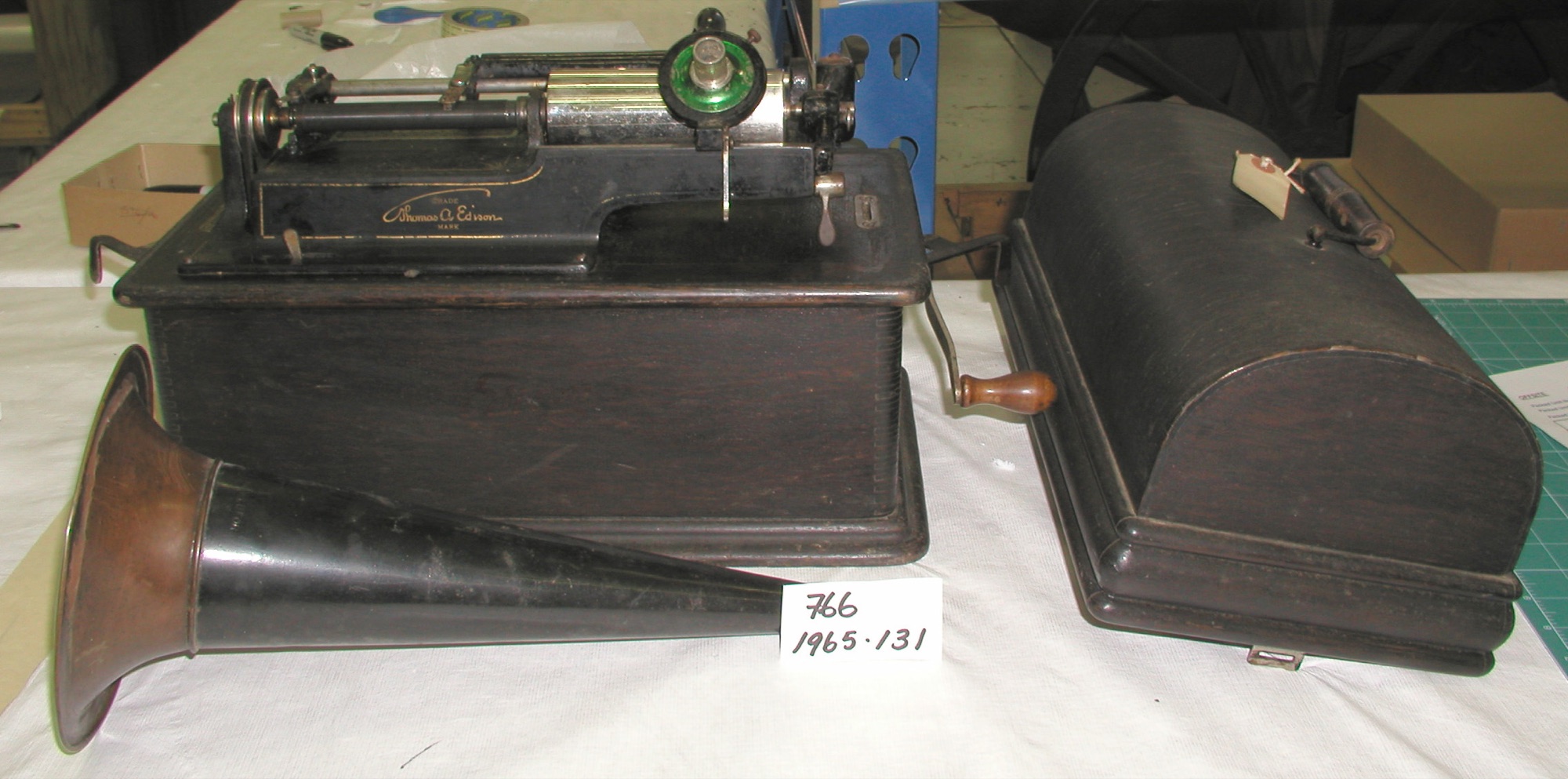
The dictator spoke through a tube into a recording head. Sound vibrated a diaphragm and stylus, cutting a modulated groove into a rotating wax cylinder. The cylinder was then taken to a typist’s machine. Listening tubes carried the playback to her ears while a foot treadle or control allowed stopping and repetition.
After transcription, a shaving machine removed the recorded surface so the blank could be used again. Offices needed cylinders, machines, power, maintenance and a work routine. Edison sold a system rather than a single box.
The life of a wax cylinder
A dictation blank travelled through several hands. It had to be labelled, protected from heat and dust, matched to the right correspondent and erased only after the typed letter had been checked. The recording itself became a temporary business record.
Wax could crack or collect shavings. A cylinder worn thin by repeated shaving was discarded. Offices ordered supplies and depended on dealers or service staff to keep motors and reproducers adjusted. The apparent convenience moved maintenance out of the manager’s sight rather than abolishing it.
Because cylinders were reusable, they suited confidential routine better than commercial music media designed for permanent libraries. Reuse also erased evidence. Countless ordinary voices disappeared beneath the shaver after their words became paper.
Training the dictator
Companies produced guides teaching executives to compose aloud. The speaker had to identify the letter, dictate addresses, announce punctuation and spell unusual names. Rambling thought created expensive typing and correction.
Some users discovered that shorthand had hidden the labour of organisation. A stenographer could ask a question, expand an abbreviation or recognise a familiar correspondent. The cylinder obeyed exactly and clarified nothing.
Successful adoption therefore depended upon discipline from the better-paid person as well as skill from the operator. Advertising often concealed this symmetry because it sold the executive freedom from waiting.
The trade name Ediphone was adopted for Edison’s dictating equipment in the early twentieth century. Competitor Dictaphone became so familiar that it was sometimes used generically, but it belonged to a rival lineage associated with Columbia.
The office without shorthand?
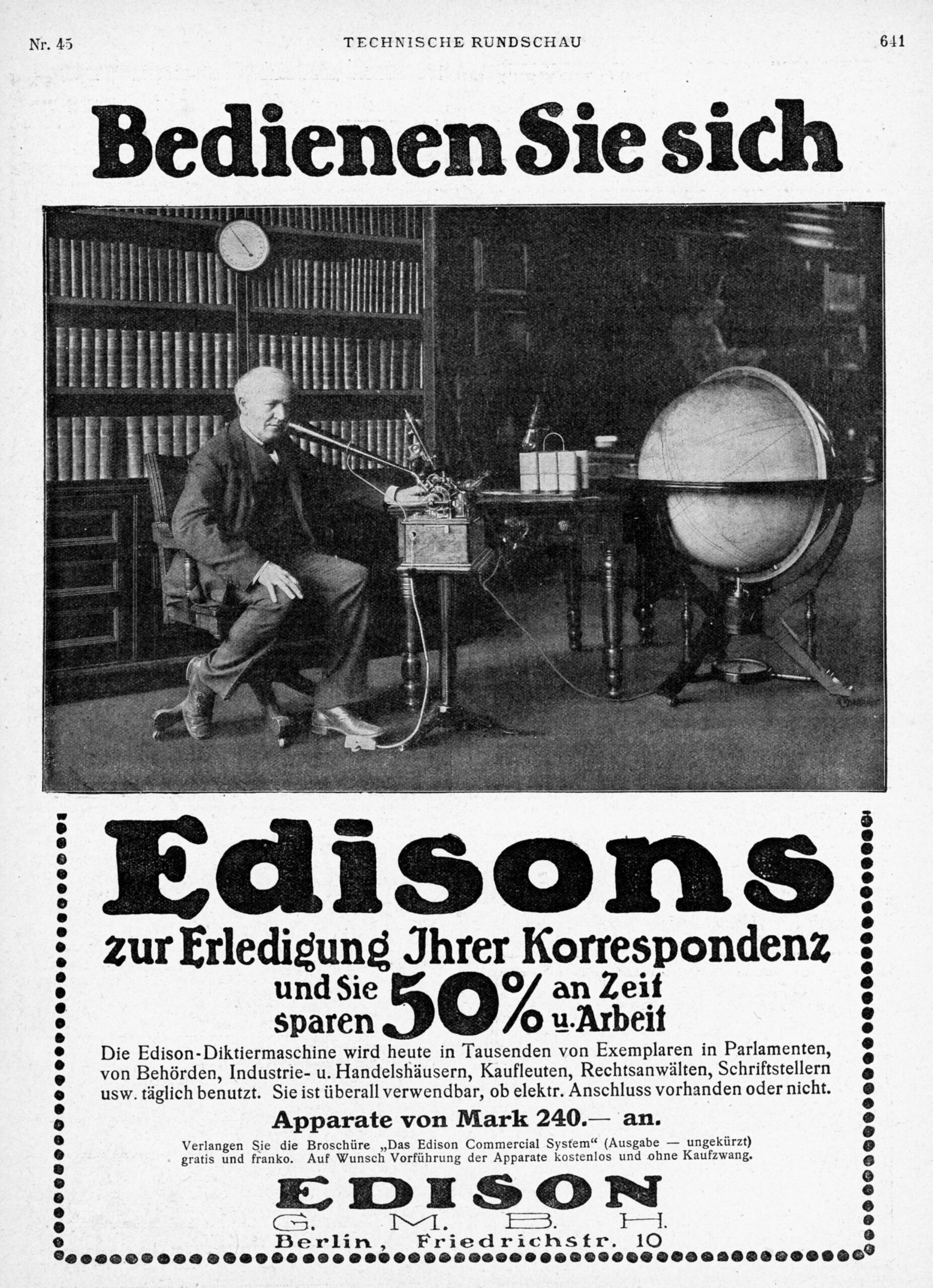
Advertising suggested that a busy executive could dictate whenever convenient, without summoning a stenographer. He might speak after normal hours or clear a pile of correspondence in one session. The recording waited until a typist was available.
This did not eliminate skilled labour. The typist had to interpret names, punctuation and uncertain speech, operate the machine and format the letter. Dictators were instructed to speak clearly and supply punctuation. A badly organised speaker could make transcription slower than shorthand.
The Ediphone changed where coordination occurred. Instead of two people being present together, the cylinder carried speech between them. That separation foreshadowed later office recording, voicemail and digital transcription.
Gender and the mechanised office
Clerical work was becoming feminised as typewriters and large corporate offices expanded. Advertisements often pictured a male executive dictating and a female typist transcribing. The machine embodied an office hierarchy as clearly as it embodied sound.
For employers, recorded dictation promised measurable output and continuous workflow. For operators, it could provide skilled employment but also repetitive isolation. Listening through tubes for hours placed the typist inside someone else’s pace, stopping and replaying difficult passages.
It would be too simple to describe the Ediphone only as oppression or liberation. Office technology opened paid work to many women while reinforcing lower-paid supporting roles. Its consequences depended on wages, training, supervision and opportunity for advancement.
Selling a habit
Many managers preferred the familiar presence of a stenographer. Edison dealers therefore had to demonstrate not just sound quality but a new routine. Companies offered training, trials and advice on organising a central transcription department.
Noise and privacy presented practical questions. Multiple dictators and typists could not all work comfortably in one open room without tubes and enclosures. Confidential material existed on removable cylinders. A cylinder could be misfiled, damaged or overheard.
These details explain why office automation advances unevenly. A device can perform its core task and still fail unless people redesign the surrounding work.
Improvements and rivals
Electric motors replaced some hand or foot power and made speed steadier. Controls became easier, shaving machines improved and wax compositions changed. Edison continued the business even as recorded music moved from cylinder to disc.
The distinction made commercial sense. A dictation cylinder needed to be recordable and reusable; a music record needed inexpensive duplication and a broad catalogue. The flat disc defeated the cylinder in entertainment without immediately making it unsuitable for the office.
Dictaphone and other competitors fought for the same institutional customers. Later machines used belts, magnetic tape and electronic amplification. Each generation promised to remove friction while creating a new set of procedures.
Why the Ediphone faded
The cylinder dictating machine survived for decades but gradually lost ground to electrical recording and easier media. Telephones altered communication, while office organisation changed. Magnetic recording allowed simpler erasure, longer duration and more convenient storage.
Edison’s broader companies also changed after his death. The Ediphone name belonged to a mechanical-acoustic solution increasingly surrounded by electronic equipment.
Its disappearance should not be confused with immediate failure. Unlike the talking doll, the business phonograph found a real, persistent use. It became obsolete because it had helped establish the very practice newer machines could serve better.
The voice in the workflow
The Ediphone rarely appears among Edison’s famous inventions because it did not dazzle a public audience. It sat on an office desk and converted speech into pending work. That modest function was historically important.
The machine separated composition from transcription in time. It made a human voice into a document that could wait, be replayed and routed. Today’s dictated message or automatic transcript performs the same organisational trick with almost invisible technology. The wax cylinder and its listening tubes belong to the beginning of that change.
The modern comparison also exposes a continuity. Speech recognition still struggles with names, accents and ambiguous punctuation; someone checks the output. Automation redistributes clerical judgement more often than it eliminates it.
The Ediphone deserves attention because its mechanical complexity surrounded a simple promise that remains alive: speak now, turn the voice into text later and let the office continue without requiring two people to share the same moment.
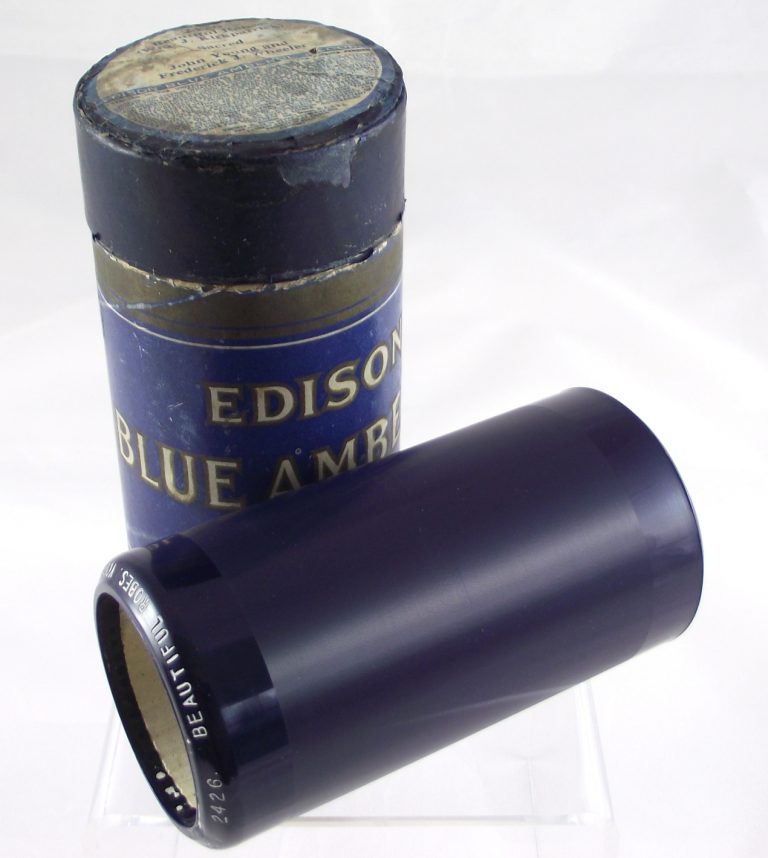 An Edison Blue Amberol cylinder. Entertainment cylinders became durable commercial recordings while office cylinders remained temporary and reusable. Photographer unknown; CC BY-SA 3.0.
Architecture shaped by sound
A busy transcription room contained several voices trapped in listening tubes, but dictation rooms required acoustic separation. Offices could install booths or place machines where executives did not disturb one another. The technology altered furniture and floor plans as well as correspondence.
Power supply mattered. Spring or treadle mechanisms offered independence but demanded effort; electric motors delivered steadier rotation where current was available. A machine sold nationally had to fit offices at different stages of electrification.
Manufacturers offered stands, cabinets and cylinder storage so the Ediphone appeared as an organised workstation. Selling accessories helped turn a novel recorder into a department.
Accuracy, evidence and responsibility
A recorded instruction could be replayed when a typist disputed wording. That seemed to create an objective source, but acoustic recording lost consonants and names. The authoritative voice might remain ambiguous.
Managers could correct a letter after transcription, while the cylinder was eventually shaved. Responsibility for errors therefore moved among dictator, operator and machine. Office rules had to decide when a document was final.
In legal or medical settings, those questions became serious. A temporary audio record could improve accuracy only if it was labelled, protected and retained until checked.
Business recording apart from entertainment
The Ediphone explains why cylinders did not vanish the moment music moved to discs. A format can lose one market and remain appropriate in another. Recording directly, erasing cheaply and handling one speaker at a time mattered more than mass duplication.
Edison’s company could therefore continue improving cylinder equipment while selling Diamond Discs for the parlour. The technologies shared ancestry but served different measures of success.
Only when magnetic and electronic systems performed dictation’s particular tasks more conveniently did the wax cylinder’s advantages disappear.
Even then, office habits outlived the medium. Lawyers, doctors and executives continued to dictate; transcription pools remained; equipment was judged by the minutes of speech it could hold and the ease with which an operator could stop, reverse and resume. The cylinder established the workflow against which its replacements competed.
Sources and further reading
- National Museum of American History, “Ediphone Voicewriter” – object description and office use.
- Thomas Edison National Historical Park, accessibility and sound history timeline – business phonograph and Ediphone context.
- Thomas Edison National Historical Park Archives, Ediphone records – machines, advertisements and operating material.
- Library of Congress, Edison sound-recording collection – broader phonograph history.