Thomas Edison’s notebooks are frequently described as the private record of a genius at work. They are something more useful and less romantic. They are the surviving paperwork of an organisation.
Across pocket books, hardbound volumes, loose sheets, scrapbooks, test records and factory files, Edison and his employees recorded sketches, measurements, costs, failures, instructions and sudden ideas. The archive now preserved at Thomas Edison National Historical Park contains approximately five million pages. No reader could reduce it to a single method or voice.
The notebooks matter because they show invention before the story became neat. A famous machine appears among abandoned arrangements, repeated trials and entries in several hands. They also explain why Edison kept such records: not simply to remember, but to manage work and defend patents.
“Keep a full record”
Edison did not begin his career with a perfect filing system. In Newark, he later recalled, drawings were made on scraps of paper and thrown into a drawer. A pocket notebook from October 1870 ends with a resolution that he would thereafter keep a full record of new inventions.
The timing was practical. Edison was entering contracts and a competitive patent world. A dated, signed and witnessed drawing might help prove when an idea had been conceived. Memory and reputation were not enough when companies disputed valuable rights.
From 1871 he kept technical notebooks in a variety of sizes. Many entries were dated and witnessed, though the practice was not perfectly consistent. Loose papers continued to accumulate. Some were later pasted into scrapbooks; others were separated from related material or lost.
The phonograph on paper
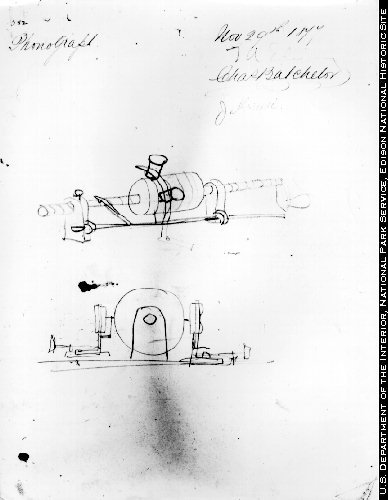
The most celebrated Edison drawing is the sketch from which John Kruesi constructed the tinfoil phonograph in December 1877. A cylinder wrapped in foil turned beneath a stylus attached to a diaphragm. Sound vibrations indented the foil; retracing the groove moved the diaphragm and reproduced the sound.
The sheet is powerful because it sits close to the moment a principle became a machine. Yet it can also mislead. Kruesi’s workmanship, Charles Batchelor’s assistance and the telephone and telegraph experiments that preceded the drawing do not fit inside the image. Nor does the long sequence of improvements required after the first astonishing playback.
A notebook page is evidence, not the whole event. It can establish a design at a particular stage, identify a hand and reveal a line of thought. It cannot by itself assign every contribution.
Hardbound books for electric light
By the autumn of 1878, electric-light work was producing so many notes and drawings that Edison adopted a standard-sized hardbound notebook. Keeping pages together created a more permanent record than scattered sheets.
The lamp programme required careful comparison. Filaments, vacuum methods, circuit arrangements and materials were tested under changing conditions. An experiment that failed could prevent the laboratory from repeating an unpromising route—or suggest which single variable should be altered next.
One famous entry from 22 October 1879 records early carbon-filament work in the hand of Charles Batchelor. That detail is important. The books were not Edison’s diary. Assistants drew, wrote, signed and witnessed experiments because invention at Menlo Park was collaborative.

Notebooks all over the laboratory
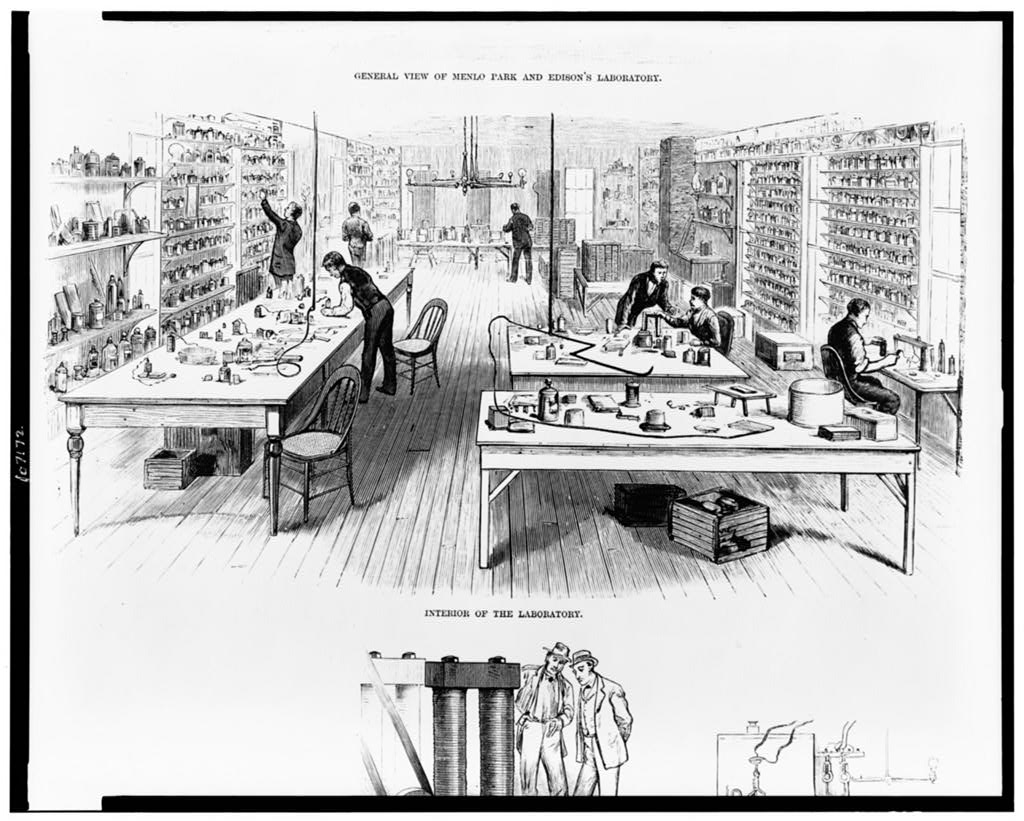
Edison later said that he placed notebooks throughout Menlo Park and ordered assistants to draw and sign every experiment. The aim was both technical and managerial. As projects multiplied, he could not stand beside every bench.
Books were assigned to particular projects or test series. Office staff maintained a daily record so that Edison could follow progress. Employees completed timesheets showing how many hours they had spent on each project. Bookkeepers tracked labour and material costs so that the appropriate company or financial backer could be charged.
This was an early research-management system. A notebook linked the experiment to people, time and money. It allowed Edison to move between projects while preserving enough continuity for the work to continue.
Failure in ink
Popular accounts celebrate notebooks as repositories of brilliant ideas. Their deeper value lies in the failed trials. An experimental programme advances by learning which material burns, which circuit drifts, which recording wears out and which result cannot be repeated.
Edison’s laboratory style was empirical and expansive. Rather than rely upon a single calculation, he might test a family of materials and modify apparatus while results accumulated. That approach generated a great deal of paperwork. The record gave partial failures a place in the next decision.
It would be wrong, however, to imagine every experiment entered cleanly at the moment it occurred. Some dates were reconstructed, scraps were pasted later and connected notes became separated. Historians compare handwriting, paper, sequence, correspondence and patent files rather than treating a bound volume as an infallible transcript.
From notebooks to patents
The legal purpose of record keeping was never far away. Edison expected contract and patent disputes. Witnessed drawings could support priority, while test data helped attorneys describe an invention and distinguish it from previous work.
Some early patent materials survived only because copies or transcripts were introduced in litigation. Conversely, original drawings could be lost after being sent to lawyers or courts. The Edison archive and the National Archives patent files therefore complement one another.
A patent presents a finished legal argument. A notebook shows alternatives that were rejected, claims that had not yet been formulated and employees whose work might disappear from the final document. Reading both prevents the tidy patent from becoming the entire history.
How historians read a notebook page
A page is most useful when it can be placed beside other records. A sketch may correspond with a dated letter ordering material, a timesheet showing who worked on the experiment, a later test report and a patent application that selected only part of the design. Together those documents reveal movement from question to apparatus and from apparatus to legal claim.
Handwriting matters. The presence of Edison’s signature does not necessarily mean that he wrote every line above it, while an assistant’s hand may record an experiment Edison directed. Editors of the Edison Papers compare ink, pagination, witnesses and related correspondence before assigning dates or authorship. Blank pages and missing leaves can be evidence too: a supposedly continuous account may have been assembled after the work.
This caution protects the notebooks from two opposite myths. They are not proof that Edison personally performed every act in his laboratories, and they are not evidence that he contributed nothing because another employee held the pen. They document a hierarchy in motion—ideas proposed, orders given, tests conducted and results circulated among people with different authority.
The West Orange record machine
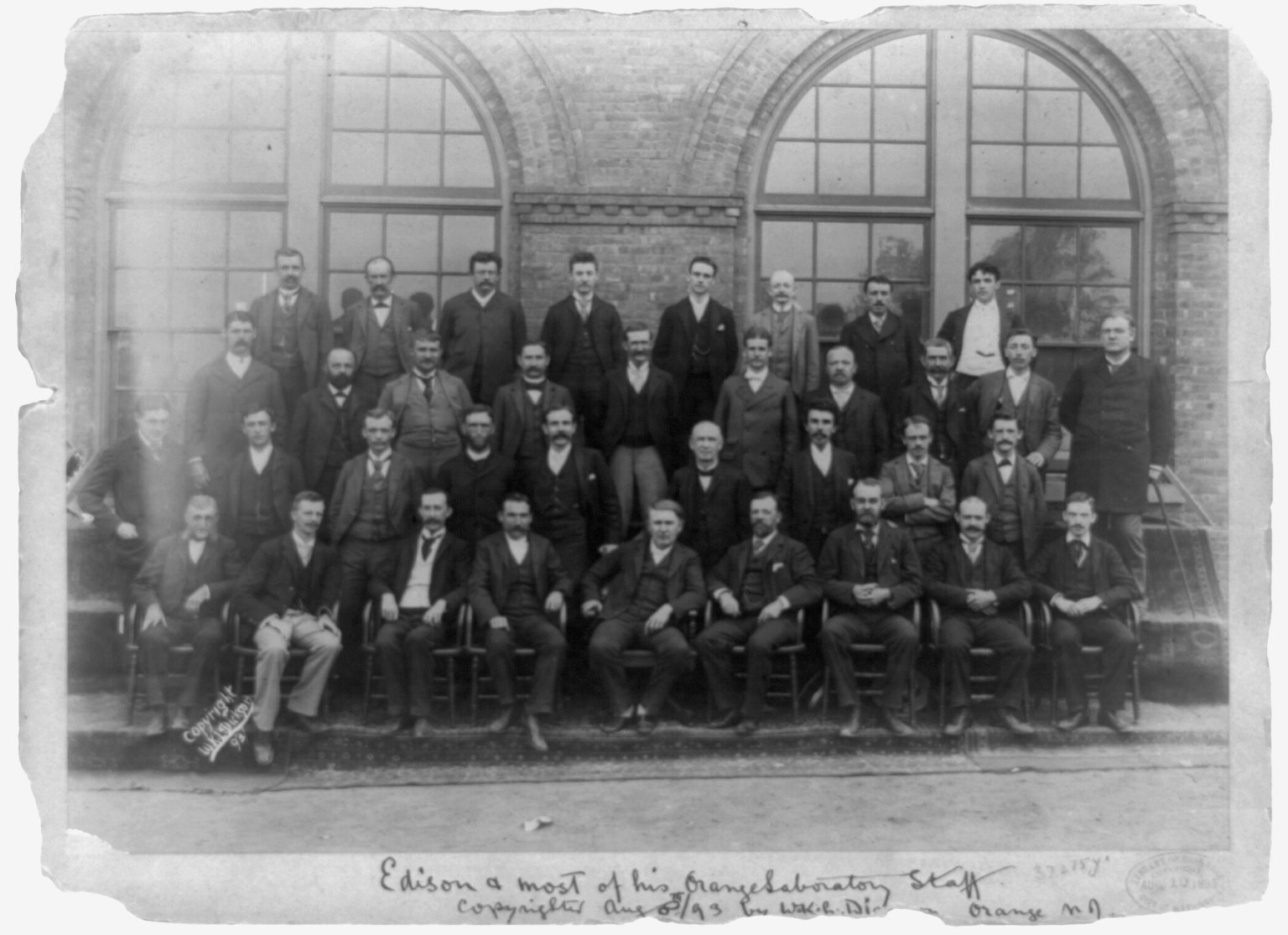
When the new West Orange laboratory opened in 1887, Edison’s organisation was much larger. Standard books remained, but pocket notebooks, memoranda, blueprints, laboratory reports and departmental files multiplied. By the twentieth century the archive increasingly documented businesses as well as experiments.
Several hundred notebooks contain evaluations of phonograph recordings and storage-battery tests. These are not dramatic “Eureka” pages. They document endurance: repeated listening, charging, discharging, inspection and comparison.
The companies also generated correspondence, advertising records, patent folios, inspection reports, factory test runs and labour files. Invention had become one department within an industrial empire, and the paper trail changed accordingly.
Scrapbooks and the management of reputation
Edison and his staff kept scrapbooks of technical articles and press coverage. Francis Upton and William Carman began a standard series during the electric-light campaign. About 150 Menlo Park scrapbooks survive, and the original series may have exceeded two hundred.
These volumes helped the laboratory follow scientific and competitive developments. They also preserved the public story being told about Edison. Technical information and reputation sat close together because press attention attracted investors, customers and political interest.
At West Orange, later scrapbooks increasingly became albums or collections of published interviews. The archive thus records not only what Edison’s organisation did, but how it wished to remember and present what it had done.
A fireproof vault and an overflowing archive
Edison understood the financial value of his early papers. Before moving to West Orange, documents from Newark, Menlo Park and New York were gathered into eighteen wooden packing cases. In 1912 he built a fireproof concrete vault near the laboratory for early notebooks and important legal records.
Preservation remained uneven. Later papers filled shelves, cabinets, crates and rooms. A Vault Service Department was created in 1918 to identify and store obsolete company records. Even so, the archive became too large for one orderly scheme.
After Edison’s death, staff and archivists spent decades gathering and indexing notebooks scattered through the complex. The Thomas A. Edison Papers project later made major portions available on microfilm, in printed volumes and digitally.
What the notebooks say about genius
The books do not make Edison less inventive. They make invention visible as sustained work. His ability lay partly in framing projects, choosing promising directions, demanding records, connecting results and keeping many kinds of specialist working towards a commercial object.
They also restore other people to the story. An entry in Batchelor’s hand, a machinist’s drawing or a signed series of tests prevents the laboratory from collapsing into the familiar photograph of Edison alone.
The archive’s gaps are equally instructive. Not every conversation was recorded; not every idea can be assigned; not every retrospective story agrees with the contemporary page. Good history sometimes ends with a range of possibilities rather than a verdict.
Edison’s notebooks are not a book of secrets waiting to yield 1,093 inventions. They are the working memory of an invention factory—messy, incomplete and indispensable.
Sources and further reading
- Thomas A. Edison Papers, “Thomas Edison and His Papers” – archive size, notebook chronology, scrapbooks, patent records and later preservation.
- Thomas A. Edison Papers, “Operating the Laboratory” – notebooks, daily records, costing and employee responsibilities.
- Thomas A. Edison Papers, Document Sampler – representative notebook entries, including the carbon-filament record.
- Thomas Edison National Historical Park, museum collections – surviving laboratory, archive and object collections.
- Thomas A. Edison Papers, “Edison’s Patents” – relationship between inventive activity, execution dates and Patent Office records.