Thomas Edison arrived at Menlo Park in the spring of 1876 with an unusual idea. Instead of waiting for inspiration in a small workshop, he would create a place where invention could be pursued continuously. Machinists, experimenters, draughtsmen and scientists would work close to one another. A sketch made upstairs could become a metal mechanism in the machine shop below, be tested the same night and be altered again before breakfast.
The plan changed more than Edison’s career. During the next six years, the quiet New Jersey site produced the carbon telephone transmitter, the tinfoil phonograph and the practical electric-light system. It also produced a new picture of invention itself. The public saw Edison as the “Wizard of Menlo Park”, but the wizard’s most important instrument was not a mysterious flash of genius. It was an organised laboratory filled with skilled people, tools, books, chemicals and an extraordinary appetite for experiment.
Menlo Park is sometimes described as the world’s first industrial research laboratory. That claim needs care: commercial laboratories and organised scientific workshops existed before 1876. Edison’s establishment was nevertheless an important early model of research directed towards a succession of practical, patentable products. Its real novelty lay in bringing many kinds of work together and keeping them focused on invention as a business.
Why Edison left Newark
Edison was twenty-nine when he moved from Newark to Menlo Park. He had already made money from improvements to telegraph equipment and had run workshops that combined invention with manufacturing. Newark gave him access to customers, employees and suppliers, but it also brought interruptions and commercial disputes. He wanted more room, greater control over his working day and some distance from the people who regularly arrived at his door.
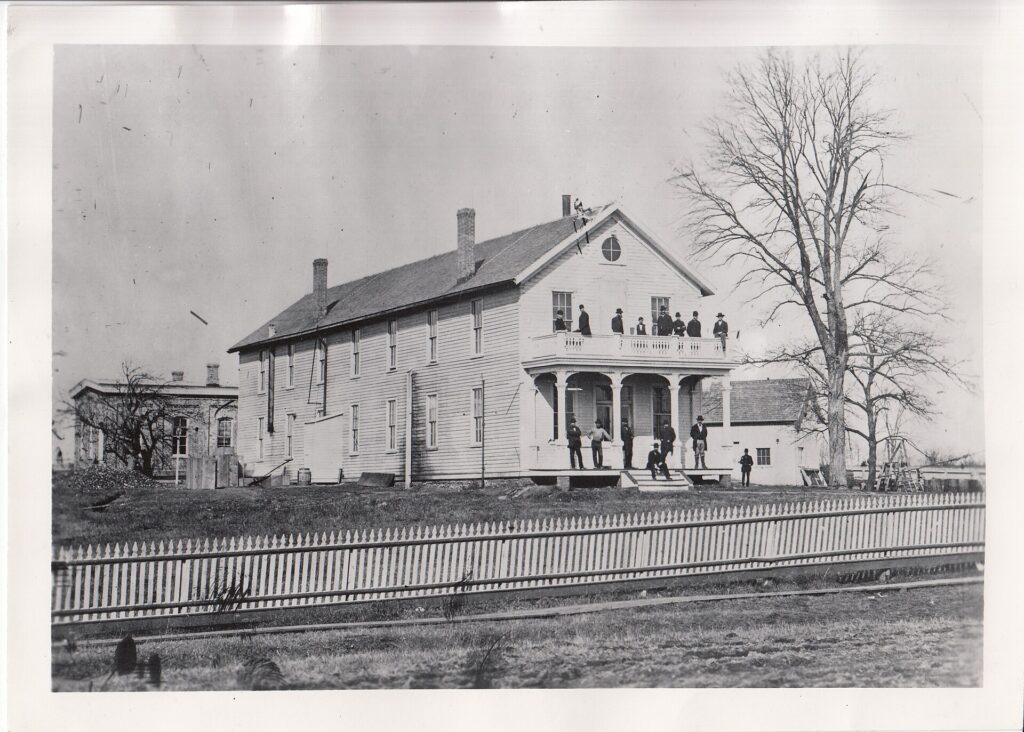
The new site lay beside the Pennsylvania Railroad in what was then Raritan Township, now Edison, New Jersey. It was rural enough to provide seclusion but close enough to New York for investors, reporters and materials to reach it by train. Edison’s father, Samuel, supervised construction. The main two-storey laboratory was joined by a machine shop and, as the establishment grew, a chemistry laboratory, carpentry facilities, office, library and smaller experimental buildings.
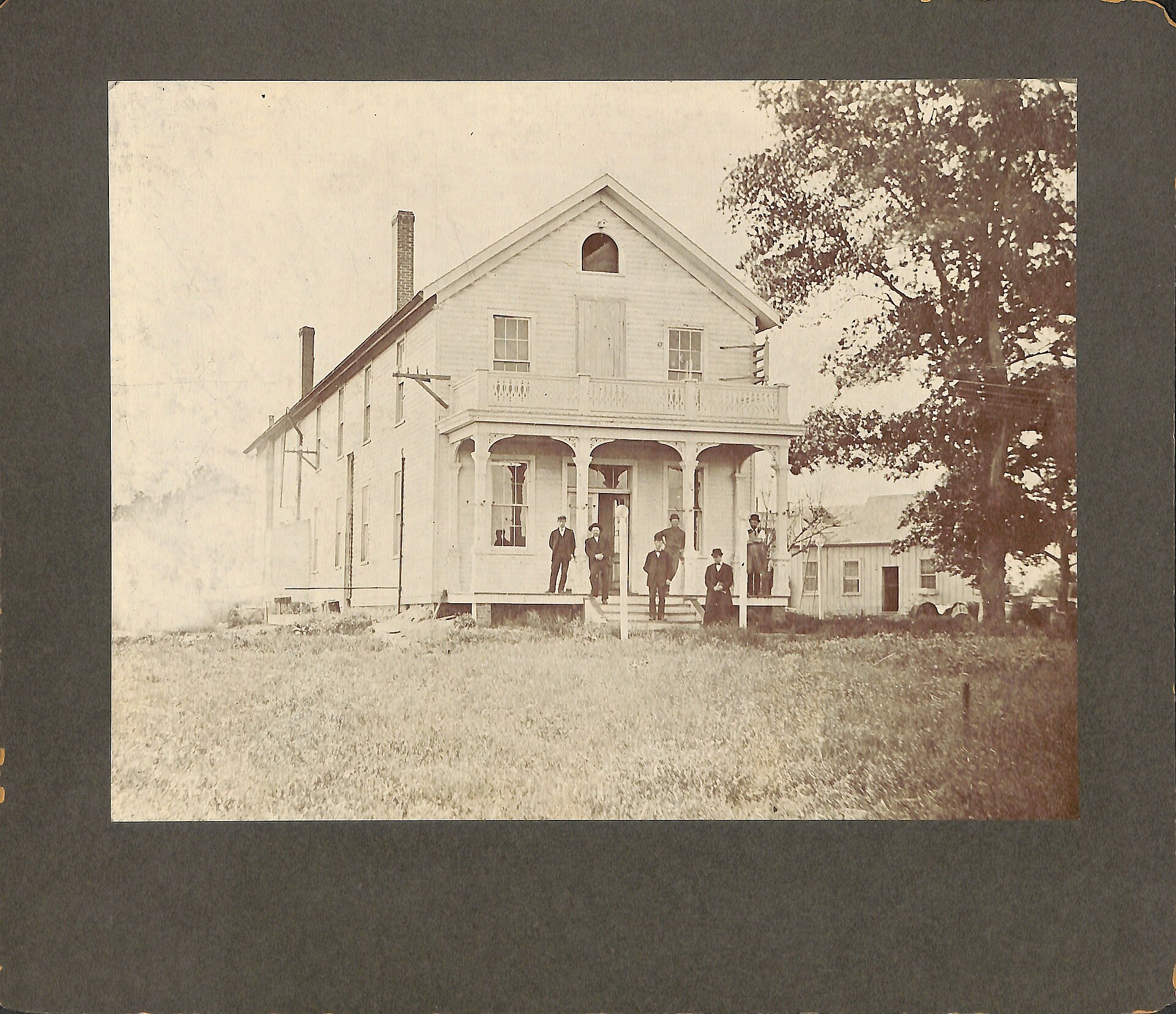
The arrangement mattered. In a conventional nineteenth-century workshop, an inventor might have to send drawings to an outside machinist, wait for a part to be made and then discover that it did not behave as expected. At Menlo Park, ideas and objects travelled a few yards. The delay between thinking, making and testing became much shorter. Failed experiments did not have to end a project; they supplied information for the next version.
Edison was not seeking peace in the ordinary sense. The railroad rattled past, machinery ran for long hours and experiments often continued through the night. What he wanted was freedom from somebody else’s timetable. Menlo Park allowed him to establish his own demanding rhythm.
Inside the invention factory
A visitor entering the main laboratory would have found little of the order associated with a modern clean room. Workbenches were crowded with wire, batteries, glassware and partly assembled devices. Shelves held chemicals, minerals and samples of natural materials. Books and technical journals stood ready for consultation. Belts driven by a steam engine powered lathes and other machine tools downstairs, while experimental electrical apparatus occupied the floor above.
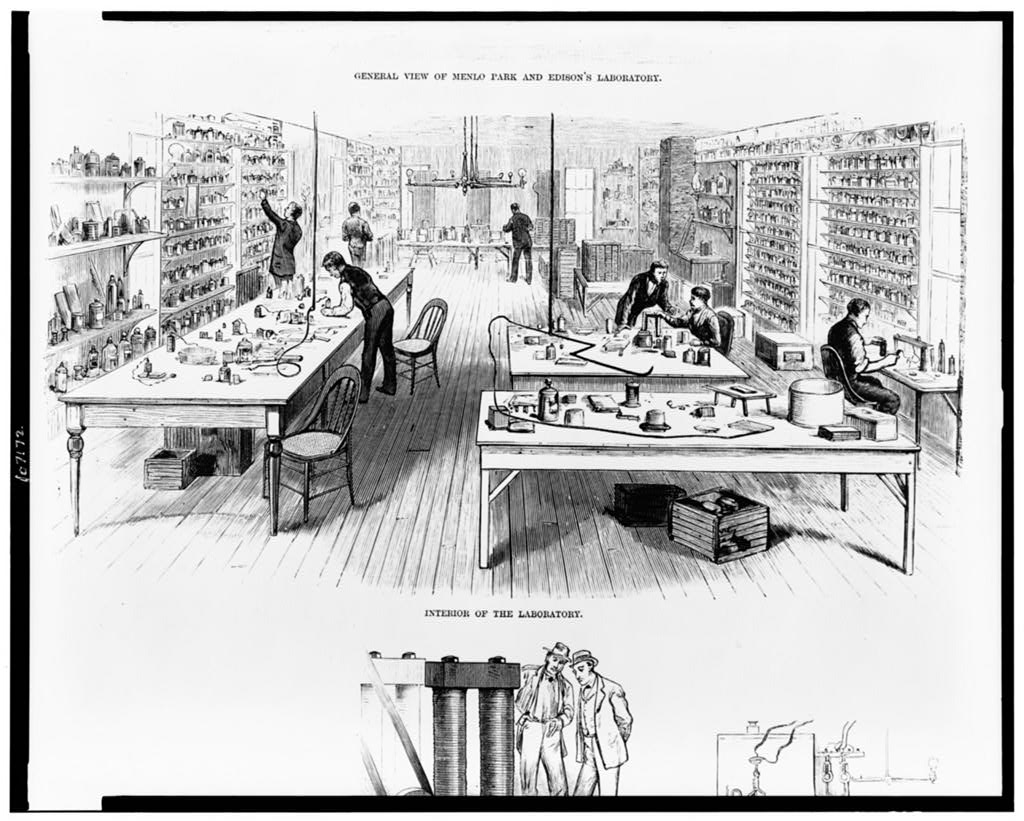
The apparent disorder served a purpose. Edison wanted a wide range of materials within reach because a problem in telegraphy might be solved by a substance borrowed from chemistry, while a lamp filament might begin as a fibre more commonly found in a hat, fishing line or piece of card. The laboratory could make precision mechanisms, evacuate glass vessels, measure electrical behaviour and search published knowledge without sending every question elsewhere.
This did not mean that experiment was merely frantic trial and error. Menlo Park’s surviving notebooks contain sketches, measurements, lists of materials, test results and calculations. Some pages are hurried and difficult to interpret; others record a carefully controlled series. The value of the notebooks was cumulative. A failed receiver, broken filament or unsatisfactory vacuum could be compared with an earlier attempt rather than simply forgotten.
Edison moved constantly between projects. He proposed the direction of work, drew mechanisms, listened to test results and decided which problems deserved more time. He could be impatient with theory when it seemed detached from a useful device, but he increasingly employed people who supplied mathematical and scientific knowledge he did not possess. Menlo Park worked because practical skill and formal analysis could meet at the same bench.
The men behind the Wizard
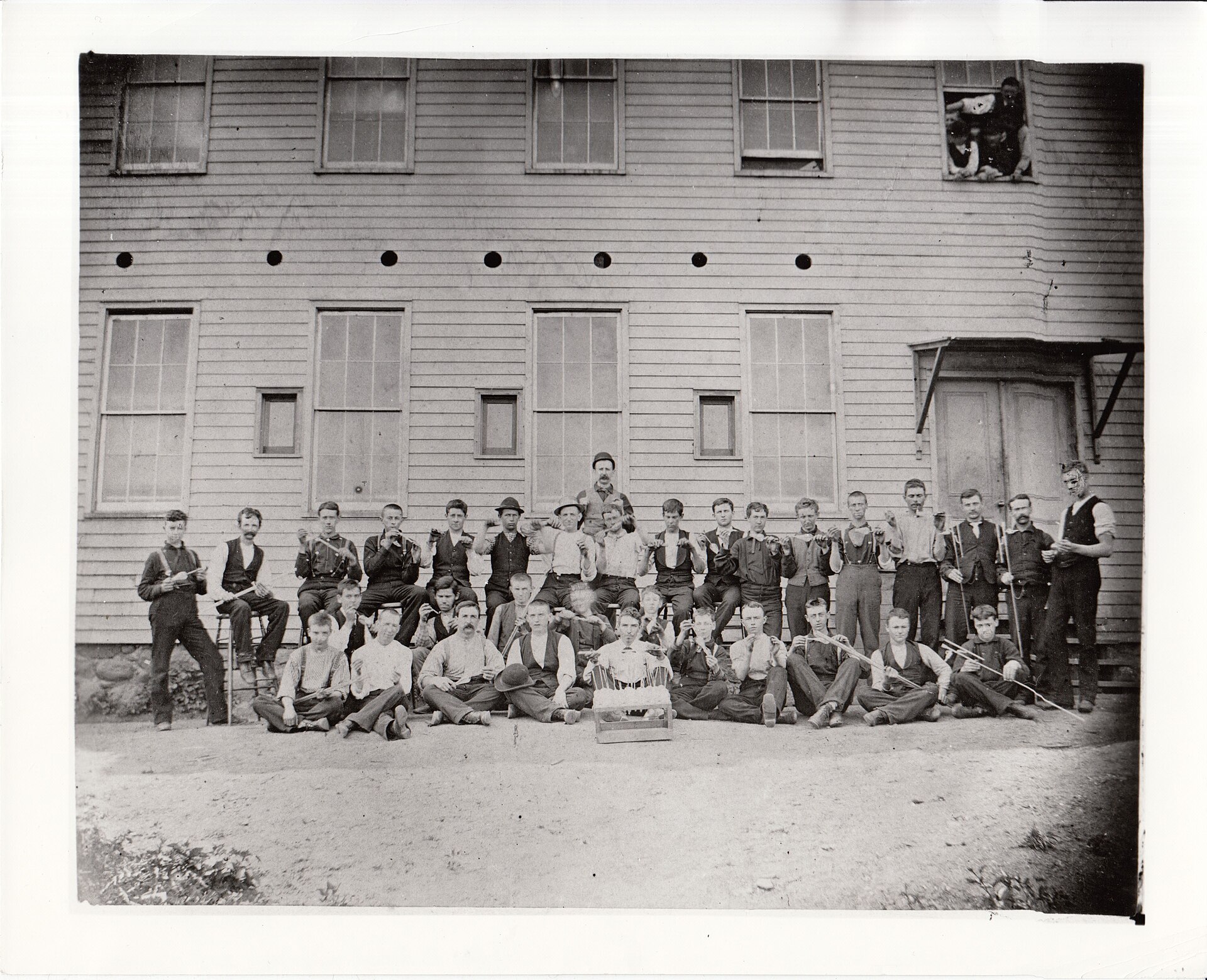
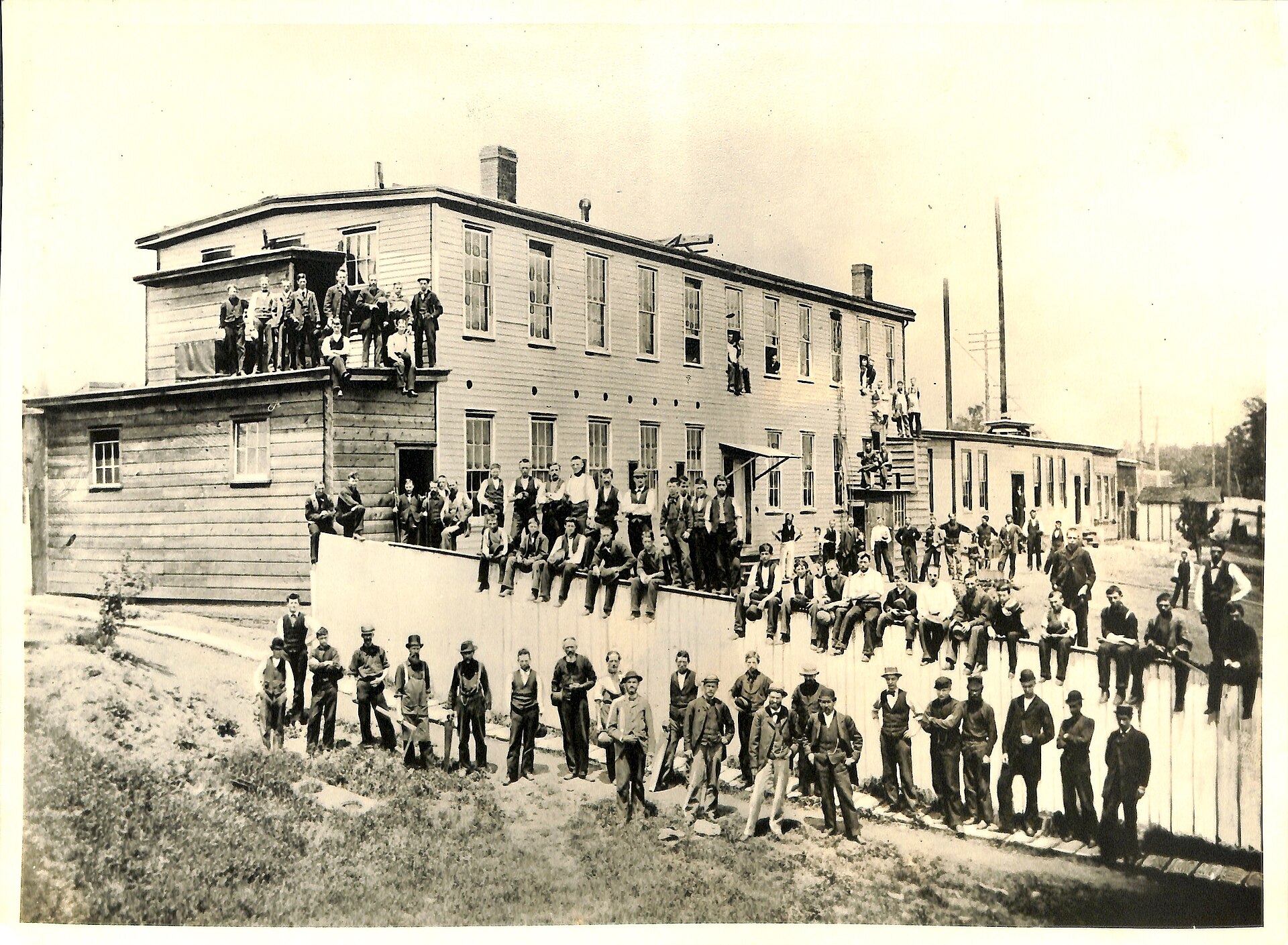
The laboratory was always identified with Edison, and he made the final decisions. Yet the familiar image of one man inventing alone is impossible to reconcile with the evidence. The staff rose from about twenty-five in the spring of 1878 to roughly fifty or sixty at its busiest. Some stayed for years; others were hired for a particular need. Later accounts often called them Edison’s “muckers”, a useful nickname so long as it does not turn a varied workforce into a band of anonymous assistants.
Charles Batchelor was Edison’s most trusted experimental colleague. An English-born textile mechanic, he had worked with Edison in Newark and combined mechanical judgement with an ability to turn an uncertain suggestion into a testable device. John Kruesi, a Swiss-trained machinist, directed the machine shop and built mechanisms from Edison’s sketches. When a new apparatus had to exist in metal rather than on paper, Kruesi was often the man responsible.
Francis Upton brought a different kind of expertise. Educated at Bowdoin and Princeton and trained further in Germany, he used mathematics to analyse generators, resistance and the proposed electric-light network. Ludwig Boehm and other glassblowers made the evacuated bulbs on which lamp experiments depended. John Ott, James Adams, Charles Clarke, William Carman and many more appear in laboratory records, photographs and payroll documents. Their jobs ranged from experimental work and drawing to machining, carpentry and plant operation.
The hierarchy remained real. Patents were generally taken in Edison’s name, investors backed Edison’s reputation and newspapers wanted Edison’s story. Employees could be named on patents for work that was distinctly their own, but their contributions were easily absorbed into the public phrase “Edison invented”. Recognising the team does not require pretending that Edison was merely a manager. He set audacious targets, crossed technical boundaries and maintained the pressure that held the enterprise together. It does require understanding that his inventive power included an ability to recruit, direct and combine the work of other people.
Life at Menlo Park could be exhilarating and exhausting. The laboratory’s culture prized endurance. Meals and sleep were fitted around an experiment, especially when a promising result appeared close. Edison’s deafness sometimes insulated him from surrounding noise, while his habit of working at irregular hours forced employees to adjust to his schedule. Memoirs recall jokes and camaraderie as well as long nights. They were written years later and often polished the laboratory into legend, but the notebooks confirm the intensity and the number of hands involved.
The phonograph makes Menlo Park famous
The invention that first turned the laboratory into a public destination was not electric light. In 1877 Edison was working on ways to record telegraph and telephone signals when he considered whether the vibrations of speech might be impressed into a surface and played back. He sketched a machine in which a diaphragm and stylus acted upon tinfoil wrapped around a rotating cylinder. Kruesi made the mechanism.
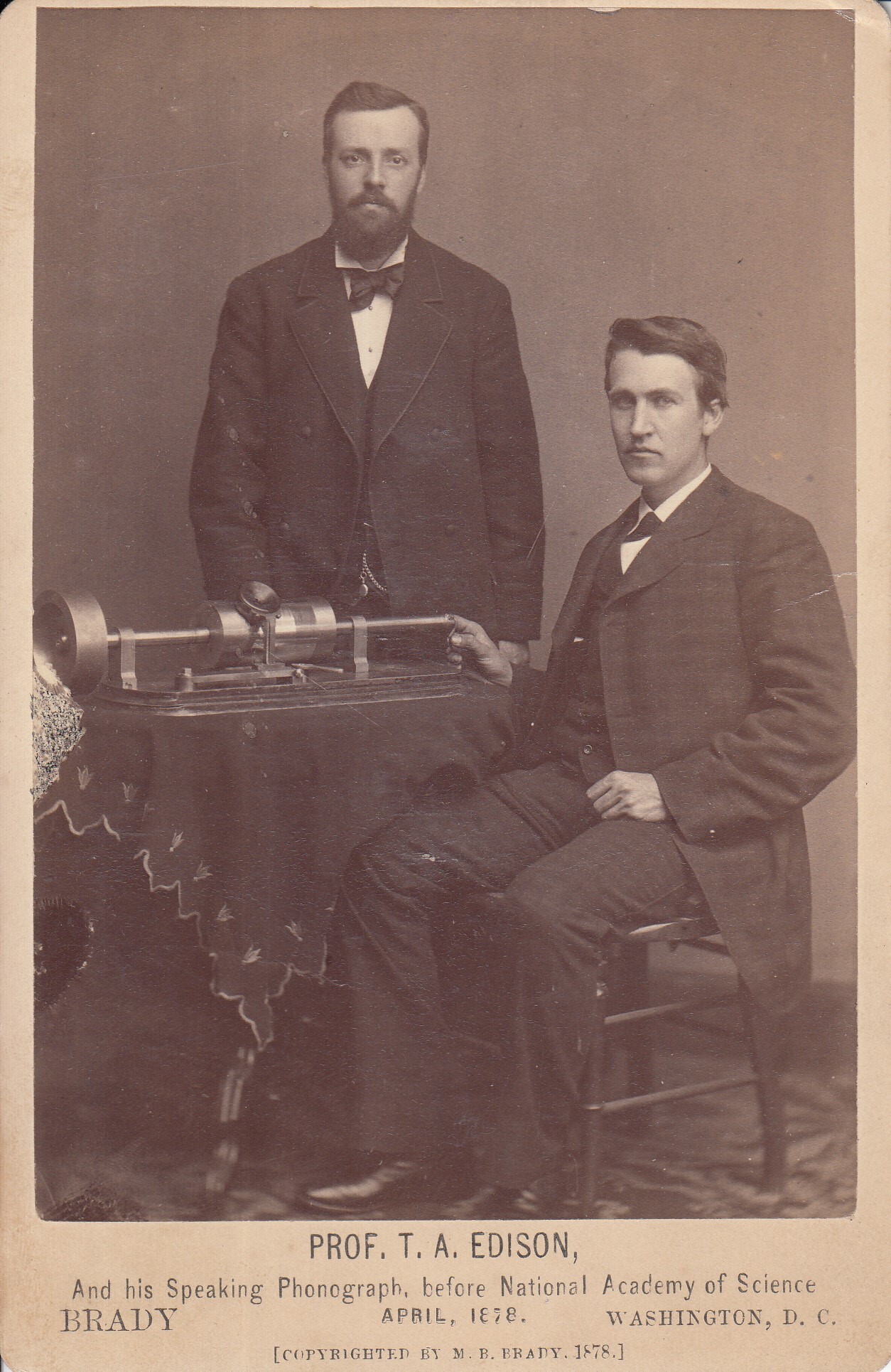
The result was the first machine that could record and reproduce sound. Its voice was faint and the foil wore out quickly, but the effect seemed almost supernatural. Telephones transmitted a voice that still belonged to a living speaker; the phonograph separated a voice from its source and repeated it later. Scientific visitors, newspaper correspondents and paying audiences crowded around demonstrations. Edison took the machine to Washington in April 1878 and showed it to members of the National Academy of Sciences, Congress and President Rutherford B. Hayes.
The phonograph gave Edison more than fame. It created the “Wizard of Menlo Park”, a public character who appeared capable of making matter speak. That reputation helped him attract capital for later projects. It also established a pattern: work carried out by a team became attached in the public mind to Edison alone, while Edison used press attention to turn a technical demonstration into a national event.
Electric light tests the whole laboratory
Electric light was a larger and more difficult undertaking. When Edison announced in 1878 that he would produce a practical alternative to gas, several forms of electric light already existed. The challenge was to create a small, durable lamp and the complete generating and distribution system needed to operate many lamps economically.
The project drew on nearly every Menlo Park facility. Upton calculated electrical losses and costs. Batchelor supervised repeated filament trials. Boehm and the glassblowers produced bulbs. Kruesi’s machinists built generators, meters and experimental apparatus. Chemical staff prepared carbon materials. Edison coordinated the effort and revised its direction as results came in. The successful high-resistance carbon-filament lamp of October 1879 was therefore a laboratory achievement rather than a lucky flash at one bench.
At the end of December, special trains brought visitors to see the buildings and grounds illuminated. The demonstration was theatre, but it was theatre backed by working machinery. Individual lamps could be switched without putting out the rest, offering a glimpse of electricity as a controllable household service. For a fuller account of the earlier lamps, the October experiments and the Pearl Street station, see how Edison changed the world with electric light.
The light project also changed Menlo Park. A laboratory could make a handful of experimental bulbs; a commercial system required lamps by the thousand. In 1880 the Edison Lamp Works began production nearby. Workers had to turn a delicate laboratory object into a repeatable product, inspect it and lower its cost. The border between research and factory work became increasingly important.
More than two famous inventions
The phonograph and electric light dominate the Menlo Park story, but they were not isolated triumphs. Edison’s carbon transmitter made the telephone signal louder and more practical, although it emerged from a crowded field of telephone experiments and patent disputes. He and his staff worked on automatic and multiplex telegraphy, ore separation, electric measuring devices and an experimental electric railway. They improved dynamos and developed components needed to connect lamps into a system. Several appear among the site’s account of Edison’s best-known inventions.
The same experimental culture also produced the tasimeter carried to the great solar eclipse of 1878.
Not every project succeeded. The laboratory spent time and money on devices that remained unreliable or found no market. Even the phonograph was set aside while Edison concentrated on light, then returned in an improved form years later. Menlo Park’s significance lies partly in its ability to survive failure. Investors did not expect every experiment to become a business; the possibility of a major patent justified a continuing programme of work.
This was a decisive departure from the legend of the lone inventor staking everything on one inspiration. Edison’s laboratory could carry several projects at once, transfer a technique from one to another and preserve the results in its records. An organisation, rather than a single pair of hands, developed an inventive memory.
Invention, patents and business
Menlo Park was never a university department devoted to knowledge for its own sake. Edison wanted useful devices that could be patented, manufactured and sold. The laboratory studied existing technology closely, bought equipment, read patents and examined competitors’ products. It then sought a design that was technically different enough to protect and commercially practical enough to attract capital.
That commercial purpose sometimes sharpened the work and sometimes distorted its public history. A patent records legal claims, not every conversation or contribution behind them. A newspaper profile rewards a memorable hero, not a payroll. A company name places Edison at the centre even when other men designed, machined and tested essential parts. Menlo Park helped create modern team research, yet its publicity continued to sell the older story of one exceptional individual.
Edison was exceptionally effective at joining these worlds. He could discuss a contact point with a machinist, persuade a financier that an electrical network would replace gas and give a reporter a demonstration worth describing. Many inventions fail not because the basic principle is wrong but because nobody solves the surrounding problems of cost, manufacture, maintenance and adoption. Menlo Park was designed to attack those surrounding problems.
Why the Menlo Park years ended
The laboratory’s success made its original form inadequate. After 1880, Edison spent increasing amounts of time in New York, where his electric-light companies, financiers and first central station demanded attention. Manufacturing operations moved closer to transport, labour and customers. Menlo Park became quieter, and by 1882 its great period of continuous invention was effectively over.
Edison’s first wife, Mary, died in 1884. Two years later he married Mina Miller, and in 1887 he opened a far larger laboratory complex at West Orange, New Jersey. West Orange included specialised buildings, a research library, machine shops and manufacturing facilities on a scale Menlo Park could never accommodate. It was Menlo Park’s principle made industrial.
The original Menlo Park buildings did not become a carefully preserved shrine. Some were moved or reused and the site deteriorated. Henry Ford, an admirer and friend of Edison, later reconstructed the main laboratory and related buildings at his historical village in Dearborn, Michigan. The reconstructed complex opened in 1929 during celebrations of the electric light’s fiftieth anniversary, with Edison himself present.

Ford’s Menlo Park preserves the appearance of the laboratory, but it is a reconstruction shaped by memory and commemoration rather than an untouched building frozen in 1879. The New Jersey location is marked today by the Thomas Edison Center at Menlo Park and its memorial tower. Each site tells part of the story: one recreates the rooms, while the other fixes the work to the ground where it occurred.
What Menlo Park changed
Menlo Park did not invent organised research from nothing, and modern corporate laboratories did not all descend from a single building beside the railway. Its importance is more precise. Edison demonstrated that a business could maintain a permanent, multidisciplinary staff whose product was a stream of inventions. Tools, scientific knowledge, skilled manufacture, record-keeping, patents, investment and publicity were made parts of the same process.
The model spread because the problems of the electrical age were becoming too complicated for one person to solve alone. A lamp depended upon a vacuum pump, a generator, a distribution calculation, a glassblower, a carbon specialist and a factory. The system demanded co-operation even when the patent and the publicity carried one name.
That is the lasting lesson of Menlo Park. Edison’s reputation was made there, but so was a new kind of workplace. The great inventions were not simply objects that left the building. They were evidence that invention itself could be organised.
Sources and further reading
- Thomas Edison National Historical Park: Edison Biography — chronology of the move to Menlo Park, the phonograph, electric light and the later West Orange laboratory.
- Thomas Edison National Historical Park: Frequently Asked Questions — the laboratory’s status in the history of organised industrial research and the preservation of the Menlo Park story.
- Thomas A. Edison Papers: Expanding the Laboratory — growth of the staff and the recruitment of specialists including Francis Upton.
- Thomas A. Edison Papers: Operating the Laboratory — notebooks, division of work and Edison’s management of experimental projects.
- Thomas A. Edison Papers: Menlo Park Employees — documented employee names, dates and roles.
- Smithsonian National Museum of American History: 19th Century Invention — Menlo Park’s working environment and the electric-light research programme.
- Library of Congress: Interior of the Laboratory — 1880 contemporary engraving and catalogue record.
- Paul Israel, Edison: A Life of Invention (John Wiley & Sons, 1998) — scholarly biography of Edison’s collaborative laboratory practice and business career.