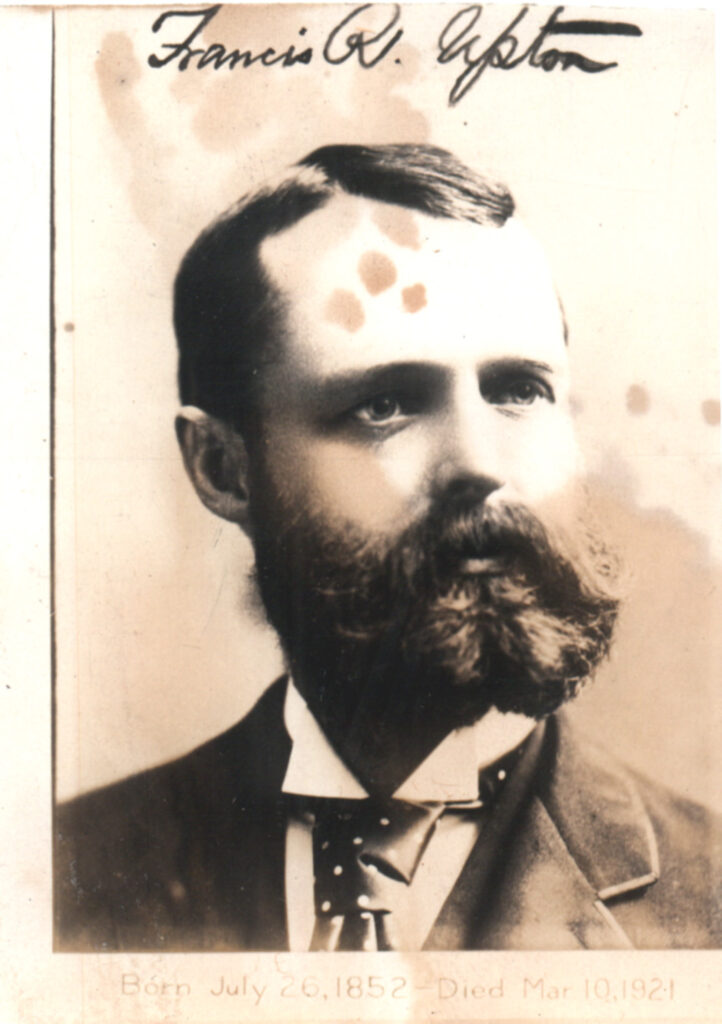
When Thomas Edison began work on electric lighting, he possessed energy, practical electrical experience and confidence in experiment. What he did not possess was advanced mathematical training. Francis Robbins Upton did. The young physicist arrived at Menlo Park in 1878 and became the man who translated measurements into calculations while Edison’s staff tried to build an entire lighting system.
Upton’s story is often reduced to the line that he did the maths for Edison. He did far more: experiments, generator design, lamp development, factory management and technical advocacy. Yet the simple phrase contains an important truth. Menlo Park’s celebrated trial-and-error method depended on theory as well as testing.
A different kind of recruit
Upton was born in 1852 and studied at Bowdoin College before completing graduate work at Princeton. He then went to Germany, where he studied under Hermann von Helmholtz, one of the leading physicists of the age.
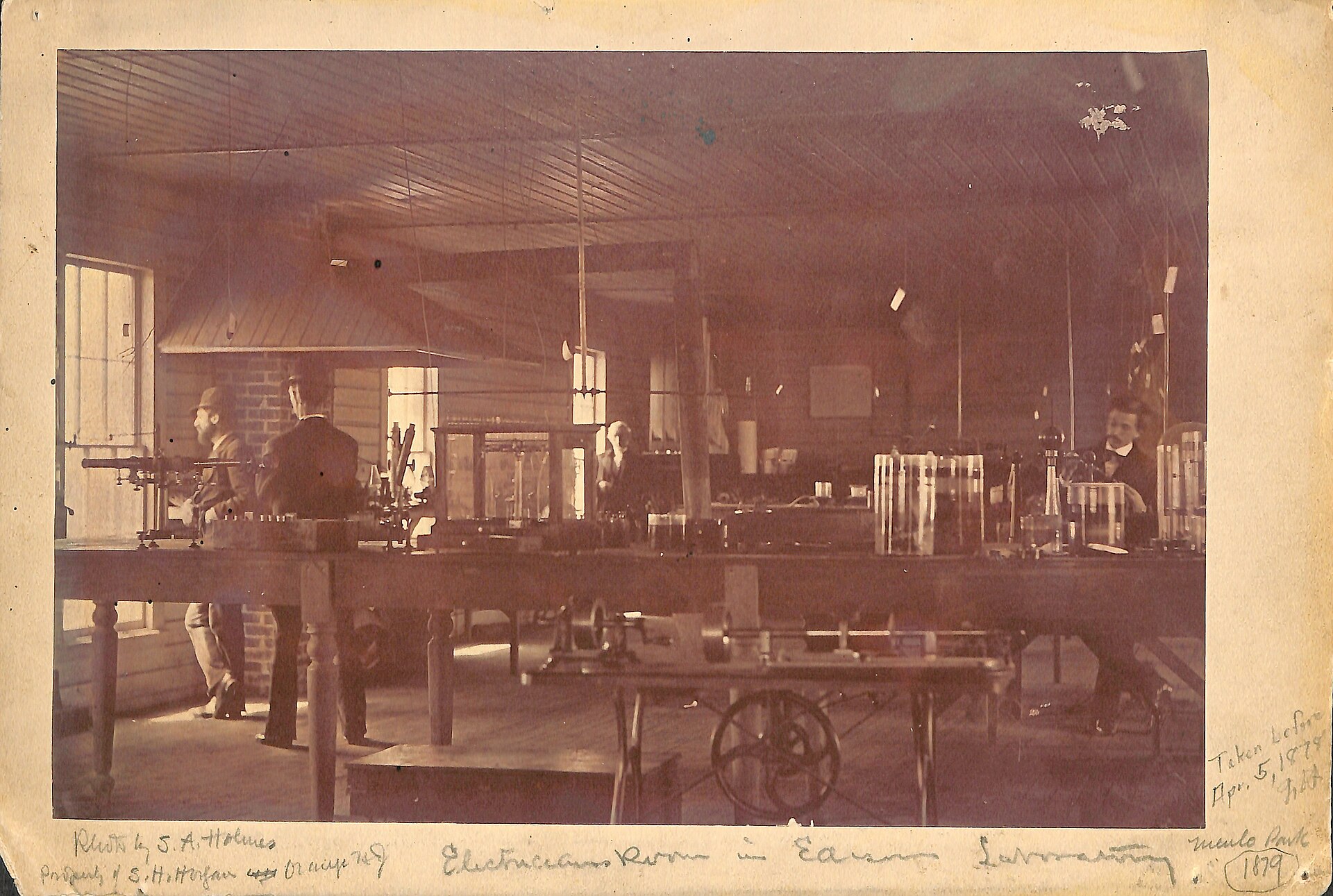
Edison’s financial supporters wanted more formal scientific expertise in the electric-light programme. Upton joined the laboratory late in 1878. He initially found Edison’s rapid, untidy habits unfamiliar. Edison sometimes dismissed calculations until an experiment made their value obvious. Upton, in turn, learned that elegant theory had to survive materials, machines and manufacturing.

The real problem was a system
Edison did not intend to make a brilliant lamp for demonstrations. He wanted to compete with gas lighting across cities. That required generators, underground conductors, branch circuits, switches, safety devices, meters and lamps. Every part affected the economics of every other part.
A low-resistance lamp demanded heavy copper conductors and made parallel distribution costly. The laboratory pursued a high-resistance lamp that could operate efficiently in the proposed system. Upton calculated resistance, current, energy loss and the copper required for networks of different dimensions.
These calculations helped turn a vague ambition into specifications. How many lamps could a generator supply? How far could a station distribute current? What conductor size balanced cost against voltage drop? An experimental filament could not answer such questions alone.
Upton and the lamp trials
The incandescent-lamp search involved carbon materials, vacuum pumps, glasswork and electrical measurement. Edison drove the programme and made the key commitment to a high-resistance system. Charles Batchelor supervised much practical experimentation. Upton supplied analysis and participated directly in tests.
In a letter to his father during the decisive autumn of 1879, Upton described intense work and Edison’s determination. The correspondence is valuable because it catches the laboratory before success had hardened into legend. Results were uncertain, money was being spent rapidly and the team understood that another inventor might reach a practical solution.
The durable carbonised-filament lamp demonstrated in October 1879 was not the end. Filaments, vacuum and production methods continued to change. Upton’s role extended from proof of principle to the discipline required for repeatability.

Designing the dynamo
Early electrical generators wasted too much energy for Edison’s proposed service. Edison and his team enlarged and altered dynamos, reducing internal resistance and improving magnetic circuits. Upton tested machines and helped calculate their performance.
The massive “Jumbo” dynamos installed at Pearl Street in New York were engineering compromises rather than enlarged laboratory toys. They had to deliver current dependably, work with steam engines and be maintained in a commercial station.
Upton prepared technical material explaining the system and defended its efficiency. At a time when electrical units and methods were still being standardised, credible measurements mattered to investors, engineers and courts.
From laboratory to lamp factory
In 1880 Edison established the Edison Lamp Company. Upton became a manager and later its general manager, supervising the difficult move from hand-built experimental lamps to mass production.
Factory yield was a scientific and financial problem. If too many filaments broke, bulbs leaked or lamps varied widely, the price rose and customers lost confidence. Upton introduced more systematic testing and kept manufacturing data. His training was applied not to a blackboard exercise but to the behaviour of thousands of objects.
The lamp works also shows why contributors disappear from popular history. A factory improvement may save more money than a dramatic experiment, but it rarely produces a famous date. Upton’s achievement lay in continuity between calculation, laboratory and production.
Writing the system into credibility
Upton prepared articles and reports that explained Edison’s electrical system to technically educated readers. Investors could be impressed by a glowing row of lamps; engineers wanted efficiencies, conductor sizes and test conditions. Public claims had to survive calculation.
This role became especially important during contests over patents and competing systems. A laboratory result might be attacked as uneconomic or irreproducible. Upton could present measurements in the language of professional physics while remaining familiar with the actual machines.
Communication did not merely publicise invention after the fact. It helped establish standards by which a new system could be compared. The engineer able to explain a result sometimes determined whether financiers and municipalities believed it.
How Upton measured success
A dramatic lamp burning through the night made excellent news. Upton needed distributions rather than anecdotes: how long did a batch last, how much current did each lamp take and what proportion failed in manufacture?
The factory’s test records converted quality into numbers. If a new process increased average life but produced more early failures, managers could compare costs. If a filament variation allowed higher resistance, the calculation extended through feeders and generating capacity.
This statistical way of seeing a product belonged to industrial research’s future. The individual object mattered, but the average and variation across thousands mattered more.
Was Edison hostile to mathematics?
Edison cultivated a practical identity and sometimes mocked academics. His quoted complaint that he could hire mathematicians but they could not hire him is memorable, though often detached from context. At the same time, he hired Upton, relied on him and retained other trained scientists.
The relationship was not science against invention. Edison resisted calculations that seemed remote from a test; Upton learned to connect theory to apparatus. Their collaboration worked because the two methods corrected one another.
It also changed over time. As Edison’s research organisation expanded, chemists, physicists and engineers became more specialised. The industrial laboratory helped make professional science useful to manufacturing while placing it under commercial direction.
After the Edison companies
Upton remained in the electric-light industry through corporate reorganisations that eventually produced General Electric. He later pursued other business and scientific interests. He never acquired Edison’s public fame, but colleagues recognised his technical authority.
Attempts to turn him into the “real inventor” of the light system miss the nature of the work. Upton did not replace Edison; he supplied abilities Edison deliberately brought into the organisation. Batchelor, John Kruesi, glassblowers, factory workers and many others supplied different ones.
The equation inside the light bulb
An incandescent lamp looks like a simple object. Its success depended upon relationships invisible to the eye: resistance, current, generating efficiency, conductor loss, production cost and service life. Upton helped make those relationships calculable.
His career corrects the idea that Menlo Park triumphed through blind persistence. The laboratory certainly tried enormous numbers of materials, but it also measured, compared and reasoned. Edison’s willingness to hire the education he lacked was one of his strengths. Upton’s ability to make that education useful at the bench and in the factory was one of the reasons the electric-light system became more than a promise.
When histories place Upton in a footnote, they repeat the visual bias of the light bulb. We see the glowing filament and forget the network behind it. His calculations belonged to that hidden network, joining physics to wire, dynamo, factory and price.

Inside a disagreement
Edison and Upton did not always agree. Edison could propose an empirical shortcut that offended a physicist’s expectation; Upton could produce an analysis too slow or abstract for the next night’s experiment. Productive collaboration included irritation.
The usual anecdote casts Edison as contemptuous of mathematics until Upton proved him wrong. The working record is less theatrical. Edison hired formal knowledge because the programme needed it, then judged it by results. Upton adapted theory to the imperfect measurements and materials available.
Neither approach was sufficient by itself. A calculation built on an unrealistic lamp would mislead; thousands of tests without a system model could consume time and copper without revealing why.
Economic calculation as invention
The cost of conductors was not an accounting detail added after a technical success. It influenced the resistance chosen for the lamp and therefore the form of the filament. Finance entered the apparatus through design requirements.
Upton’s work helped calculate whether a station district could sell enough light to recover generating and distribution investment. Each extension of a feeder changed voltage drop and customer capacity. A map of streets became an electrical problem.
This systems calculation is one reason Edison’s lighting achievement cannot be reduced to finding bamboo. The material mattered because it served values created by a network analysis in which Upton was central.
A model for the industrial physicist
Upton’s career anticipated the research physicist employed by a corporation: educated in universities, judged by practical outcomes and moving between experiment, publication and management. Later electrical companies built formal laboratories around that combination.
He did not surrender scientific identity by entering industry, but company objectives set the problems. His success helped prove that advanced training could earn a place beside the machine shop.
Sources and further reading
- Thomas A. Edison Papers, “Expanding the Laboratory” – Upton’s education, appointment and duties.
- Thomas A. Edison Papers, “Designing the Generator” – generator calculations and development.
- Thomas A. Edison Papers, “The Carbon-Filament Lamp” – Upton’s contemporary letter home and the decisive 1879 experiments.
- Thomas A. Edison Papers, “Edison Lamp Company” – Upton’s manufacturing role.