Thomas Edison entered the disc-record market late and then refused to imitate it. His Diamond Disc records were thick, expensive and technically distinctive. Played on the proper machine, they offered impressive sound and resisted wear. Played with an ordinary steel needle, they could be ruined.
The product expressed Edison’s strengths and weaknesses with unusual clarity. He invested in careful recording, vertical-cut grooves and a permanent diamond stylus. He also imposed his own musical judgement, resisted industry standards and continued to sell a complete system after customers had chosen interchangeability.
From cylinder leader to disc follower
Edison’s phonograph began with tinfoil in 1877 and returned commercially on wax cylinders in the late 1880s. Cylinders could record as well as play, and early models reproduced sound effectively. Emile Berliner’s flat gramophone disc introduced a major manufacturing advantage: a master could be pressed into large numbers of copies.
By the first decade of the twentieth century, Victor and Columbia had made the disc the dominant home format. Edison continued improving cylinders, including Blue Amberol records, but could not ignore the market.
Why the record was so thick
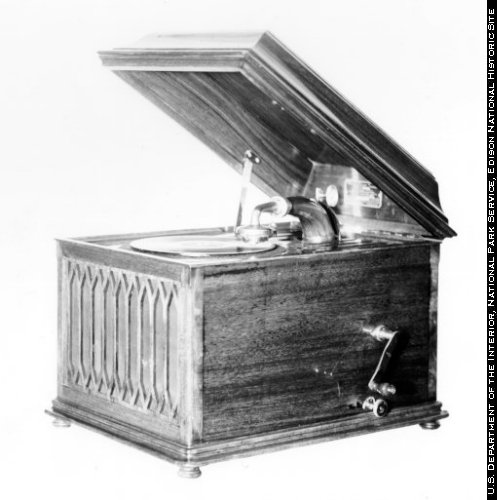
The Diamond Disc reached the market in 1912. Unlike the lateral groove used by most competitors, Edison’s groove moved the reproducer vertically—“hill and dale”. A diamond stylus followed the modulation. The record rotated at approximately eighty revolutions per minute, though exact speed could vary.
The discs were about a quarter of an inch thick because the recorded surface was bonded to a dense core. Thickness helped create a flat, stable record but made it heavy and costly. The fine vertical groove supported long playing time for the period and high recorded level.
Customers had to use an Edison machine. A conventional steel needle exerted the wrong action and could damage the surface. Edison’s reproducer likewise could not simply play ordinary lateral-cut records. The quality of the system was tied to incompatibility.
“The phonograph with a soul”
Edison advertising claimed extraordinary fidelity. Public “tone tests” placed a recording artist beside a Diamond Disc machine. The performer sang or played with the record, then sometimes stopped while the reproduction continued. Audiences were invited to decide whether they could hear the difference.
The demonstrations were clever and could be impressive. They were also controlled performances in halls chosen for the purpose, using artists trained to match their recorded sound. They should not be treated as laboratory proof that acoustic reproduction was literally indistinguishable from life.
The slogan “The phonograph with a soul” deliberately opposed Edison’s instrument to the mechanical image of recorded sound. It placed his reputation as an experimenter behind a claim about musical truth.
Edison chooses the music
Edison took an unusually personal interest in artists and repertoire. He listened to auditions despite severe hearing loss, often judging singers through tests that emphasised tone and diction. Walter Miller and other recording managers translated his preferences into a catalogue.
Edison admired certain sentimental songs, marches, light classics and clear voices. He distrusted some fashionable styles and was reluctant to make star salaries the centre of his business. Competitors advertised Enrico Caruso and other celebrities; Edison promoted the accuracy of the machine.
This policy held down costs and produced many excellent, now less remembered recordings. It also weakened the catalogue as consumers increasingly bought the artist and song rather than the technology.

How Diamond Discs were recorded
Early sessions were entirely acoustic. Performers arranged themselves around a recording horn. Loud instruments stood farther away; quiet ones crowded near. Balance was physical. There was no microphone and no electronic mixing desk.
A diaphragm drove a cutting stylus into a wax master. The master passed through moulding and pressing stages before records reached customers. Edison’s staff made test pressings and compared them with standards, guarding against distortion introduced in manufacture.
The problem of copying a master
A studio performance was only the first generation. The fragile master had to yield metal moulds capable of pressing saleable copies. Each transfer risked losing detail or introducing surface noise. A beautiful take could become a disappointing record through a fault in plating, pressing or the core.
Edison’s insistence on playback tests reflected this chain. Staff sampled moulds and pressings rather than assuming that one approved performance guaranteed every copy. The recording archive preserves tests that were never intended as entertainment but reveal the factory listening to itself.
Record wear added another variable. The permanent diamond stylus was designed to fit the vertical groove precisely. A damaged reproducer, incorrect weight or foreign needle could erase the advantage. Fidelity was a relationship maintained by the owner as well as the factory.
The catalogue in a changing America
Diamond Discs circulated during the First World War, the influenza pandemic, the growth of jazz and the arrival of radio. Music moved more quickly between cities and social groups. Dance styles and celebrity voices became part of a national consumer culture.
Edison’s catalogue was broader than caricature suggests, but his personal dislikes mattered. He could regard a commercially successful style as passing noise while listeners treated it as modern life. The laboratory’s confidence in objective tone could become deafness to cultural change.
Dealers faced the consequence. A customer comparing machines did not judge only frequency response. Cabinet design, record price, local availability and a popular artist’s latest release determined the sale. Technical superiority was one value among several.
The surviving archive includes alternate takes, test records, correspondence and spoken announcements. It reveals recording as a chain of judgement rather than a single captured performance.

The problem with a closed system
Proprietary design could protect quality. A diamond stylus did not need constant replacement, and the company controlled the relationship between groove, reproducer and cabinet. But owners could not walk into a shop and choose freely from every label.
By the 1920s radio offered entertainment without buying a record. Electrical recording, introduced commercially by competitors in 1925, captured wider frequency range and allowed more flexible studio arrangement. Edison initially resisted the new method and entered electrical recording late.
The company introduced a lateral-cut “Needle Type” record in 1929, effectively acknowledging the standard it had opposed. The recording business closed that October. The decision came before the stock-market crash had time to be the sole cause; declining sales and strategic isolation were already decisive.
Was the Diamond Disc a failure?
It was not a worthless product. The system sold for years, preserved important performances and could sound remarkably full on a well-restored machine. Collectors value its engineering and distinctive catalogue.
It failed as Edison’s bid to control the future of recorded music. Technical quality could not overcome format incompatibility, changing taste, star marketing, radio and electrical recording. The market preferred records that worked across many machines.
A beautiful answer to an old question
Edison asked how faithfully a mechanical groove could reproduce a performance. The Diamond Disc was an elaborate answer, joining recording process, record and phonograph into one controlled instrument.
Consumers were beginning to ask a different question: can I hear the artist I want, on the machine I own, in the new style everyone is discussing? Edison’s system answered that less well. Its heavy discs survive as monuments to an era in which the inventor believed the best machine could still dictate the market around it.
The records can still surprise. Played with correct equipment, they carry voices across a century with warmth and presence. That pleasure is evidence of genuine accomplishment, not proof that Edison’s business judgement was right. A format can be beautifully engineered and still lose.
Diamond Disc history is therefore not a contest between quality and stupidity. It is the story of quality defined too narrowly—and of an inventor discovering that recorded music belonged increasingly to listeners, artists and standards he did not control.

Competing with the ordinary disc
A Victor owner replaced steel needles frequently and could buy records from several labels using compatible lateral grooves. Edison considered that arrangement wasteful and technically inferior. Customers experienced it as choice.
Dealers sometimes sold adapters that allowed different records to be played on rival machines, but incorrect tracking and weight could damage grooves. The existence of adapters itself demonstrated demand for interoperability.
Format competition was fought inside households. Once a family owned a cabinet and a shelf of records, changing system meant abandoning an investment. A proprietary design had to win early or offer enough continuing value to justify the switch.
Why collectors hear more today
Modern transfer engineers can reproduce a Diamond Disc with a correctly shaped stylus and digital equalisation. Surface noise can be reduced cautiously, and a well-preserved groove reveals frequency detail hidden by a worn acoustic machine.
That does not mean contemporary listeners were foolish to choose other formats. They judged records through the equipment, prices and catalogue available then. Historical sound recovered under ideal conditions answers a different question from commercial success.
The discs also vary. Pressing quality, wear and recording date affect the result. A single spectacular transfer should not stand for the entire catalogue any more than a damaged copy should.
The final Needle Type concession
Edison’s 1929 lateral records could be played with ordinary needles, but they arrived after the company had lost momentum. Conforming to the standard removed one barrier without restoring dealer confidence or a leading artist roster.
The late change exposes the cost of identity. For years the Diamond Disc’s difference had been advertised as proof of superiority. Adopting the rival groove required the company to weaken its own argument just when electrical recording was redefining fidelity.
Sources and further reading
- Library of Congress, “Overview of the Diamond Disc Recordings” – format, catalogue and chronology.
- Library of Congress, “Is It Live or Is It Edison?” – tone-test performances and publicity.
- Thomas Edison National Historical Park, “The Recording Archives” – masters, tests and business records.
- Thomas Edison National Historical Park, “Edison Disc Master Mold Playback Tests” – manufacturing and quality control.