On 29 July 1878, Thomas Edison stood near Rawlins in Wyoming Territory while the Moon’s shadow crossed the Sun. He had travelled west with scientists, reporters and an instrument of his own invention: the tasimeter, designed to detect changes in heat too small for an ordinary thermometer.
Edison hoped the device might reveal infrared radiation from the solar corona. The eclipse expedition gave a young inventor scientific company and excellent publicity. The tasimeter responded dramatically, but the observation did not establish the measurement Edison wanted. Its story sits between instrument making, frontier spectacle and the difficult difference between sensitivity and proof.
An invitation west
The total solar eclipse of 1878 crossed the American West and attracted expeditions to Colorado, Wyoming and Texas. Astronomers hoped to study the corona, search for a possible planet inside Mercury’s orbit and take advantage of the darkened sky.
Edison was thirty-one and newly famous for the phonograph. He joined a party associated with astronomer Henry Draper and travelled by rail to Rawlins. His presence ensured newspaper attention. He brought not only the tasimeter but the personality reporters already knew: restless, informal and eager to test an idea in public.

How the tasimeter worked
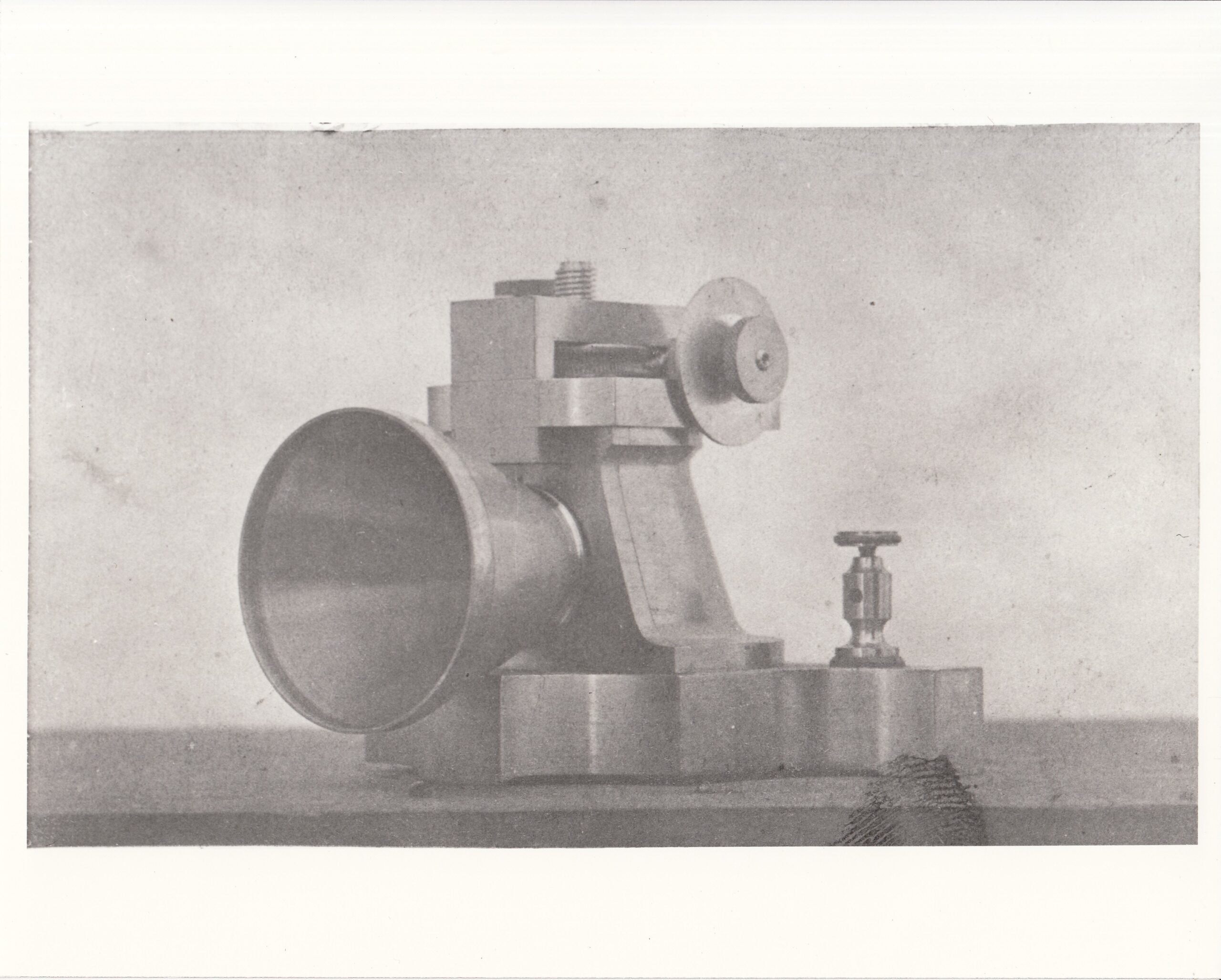
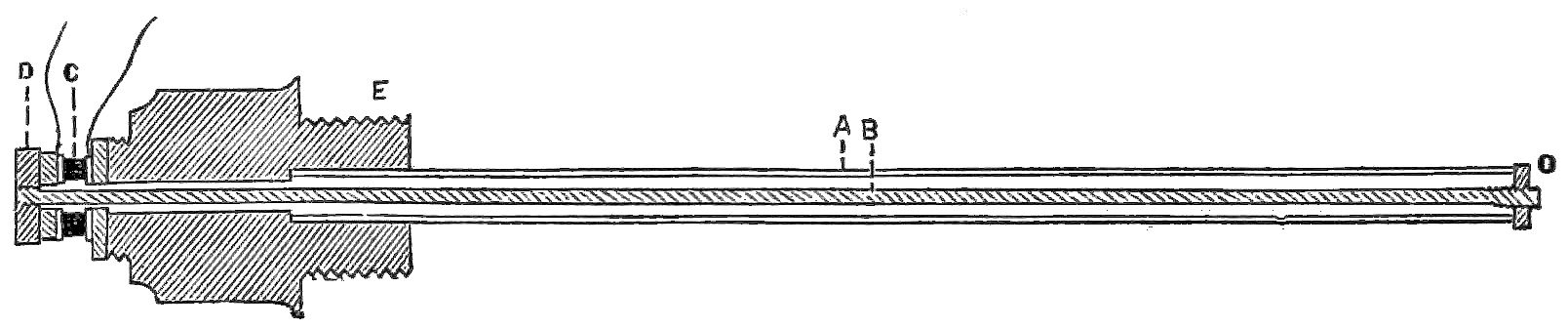
The instrument used a material whose dimensions changed slightly when heated. A carbon button formed part of an electrical circuit. Expansion altered pressure on the carbon and changed its resistance. A galvanometer converted the electrical variation into a visible needle movement.
In principle, extremely small thermal changes could create detectable electrical signals. Edison called the instrument a tasimeter, from a Greek root associated with stretching or tension. It belonged to his broader experiments with pressure-sensitive carbon, which had also contributed to telephone transmitters.
The device was not a conventional thermometer giving a direct temperature. It indicated relative change. That made calibration and interpretation crucial.
The problem of the corona
During totality the bright solar surface disappears behind the Moon and the faint corona becomes visible. Edison wanted to know whether the corona emitted heat that his instrument could detect.
A telescope or optical arrangement directed radiation towards the sensitive element. During the eclipse the galvanometer moved. The result appeared exciting, but surrounding temperature, instrument drift, pointing and the sequence of exposure complicated interpretation.
For a scientific measurement, a needle movement is only the beginning. Investigators need controls, calibration, repeatability and confidence that the signal comes from the proposed source. The eclipse provided only a short period of totality and no easy opportunity to repeat the same celestial conditions.
Did Edison detect the Sun’s corona?
Popular accounts sometimes say the tasimeter successfully measured the corona’s heat. Edison and observers certainly saw a response, and the instrument demonstrated impressive sensitivity. Historians and scientific accounts are more cautious about treating the result as a reliable measurement of coronal radiation.
Edison himself acknowledged practical difficulty. The tasimeter was extremely sensitive to nearby heat and environmental changes. A person’s body, the apparatus and changing air could affect it. Sensitivity without selectivity made the reading ambiguous.
The responsible conclusion is that the Rawlins experiment produced an apparent signal but did not establish a quantitative scientific result. This is not failure disguised. It is how experimental limits are recognised.
Science, publicity and the frontier
The trip placed Edison among professional astronomers at a moment when his public identity was expanding from telegraph inventor to universal experimenter. Newspapers enjoyed his phonograph demonstrations and western adventures as much as his measurements.
Stories accumulated around the journey, including comic encounters and improvised experiments. Their tone helped construct the Wizard of Menlo Park: a man who carried inventions into any landscape and made science entertaining.
Professional scientists could find that publicity useful and irritating. Edison attracted attention to instrumentation but moved quickly, whereas astronomy demanded patient observation and cautious claims. The eclipse exposed the productive tension between showmanship and measurement.
The company at Rawlins
Eclipse expeditions were collaborative camps. Astronomers aligned telescopes, photographers prepared plates and assistants timed the brief phases. Weather could ruin months of planning. Railways carried heavy instruments to settlements that became temporary scientific centres.
Edison was one participant among experienced observers, not the expedition’s commanding astronomer. His phonograph fame gave him disproportionate newspaper space. This is why photographs and reports must be read carefully: public attention does not measure scientific responsibility.
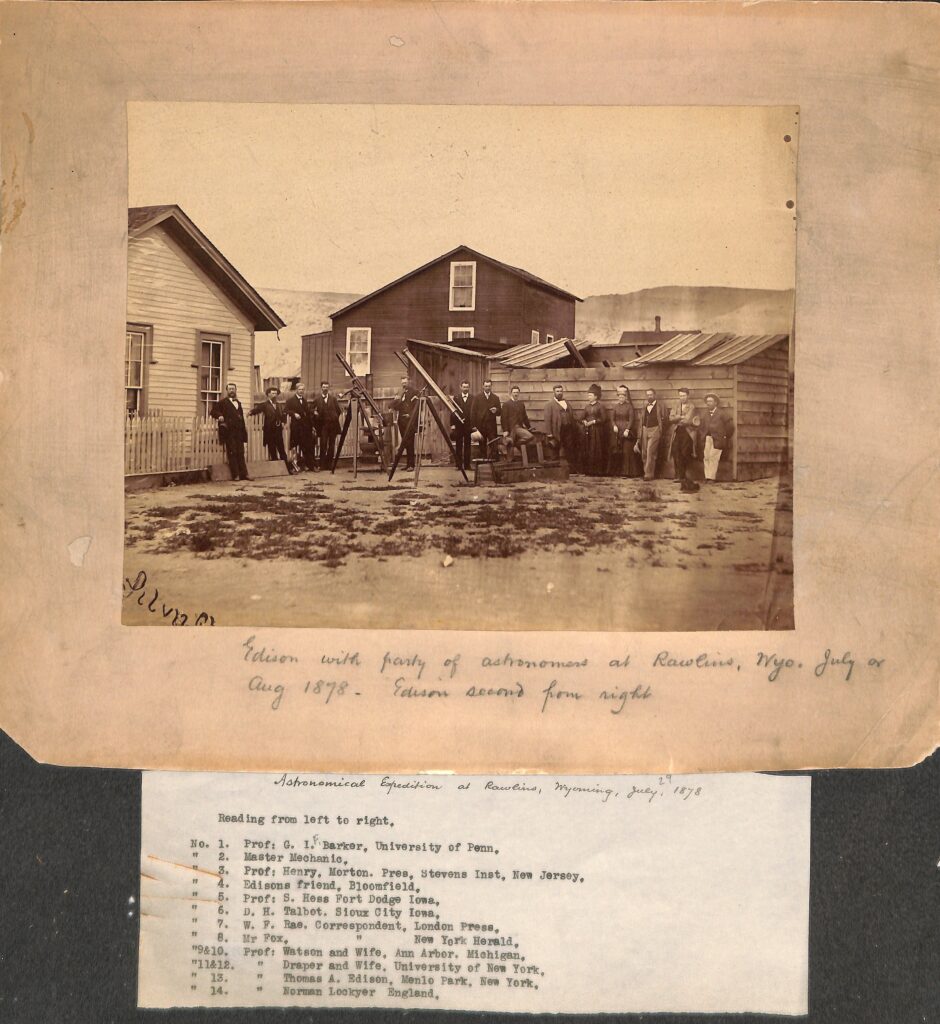
The surviving group image has itself acquired a cataloguing error, describing a transit of Venus. No Venus transit occurred at Rawlins in July 1878; the event was the total eclipse. The mistake is a useful reminder that an archive label is evidence to verify, not an infallible caption.
Calibration after the spectacle
To measure coronal heat, investigators needed to compare the tasimeter’s response with known thermal inputs and account for changes during the eclipse. The sudden fall in ordinary sunlight cooled the apparatus and surrounding air while the corona became visible. Those effects could mimic or mask the desired signal.
Directional control was equally important. Radiation from nearby objects and observers could affect a detector sensitive enough to notice a person at a distance. Shielding and a stable optical path had to separate the target from the environment.
Later instruments succeeded by combining sensitivity with calibrated response and carefully controlled observation. Edison’s trial belonged to the stage in which the detector’s dramatic movement arrived before a dependable numerical meaning.
The microtasimeter and later ideas
Edison refined the concept and described a microtasimeter capable of detecting minute expansion. Contemporary scientific publications illustrated the apparatus. He suggested applications to astronomy and precise physical measurement.
The instrument did not become a standard astronomical tool. Bolometers, developed by Samuel Pierpont Langley, offered a more successful method of measuring radiant heat. Later electrical sensors used other materials and designs.
The carbon-pressure principle nevertheless remained important in Edison’s work. The tasimeter shows how a mechanism developed for one problem could be adapted experimentally to another.
Why the instrument mattered
The tasimeter is overshadowed by inventions that reached factories and homes. It produced no large industry. Its value is intellectual. Edison recognised that a small physical change could be amplified into an electrical indication, an idea fundamental to sensors.
It also demonstrates the danger of confusing a responsive instrument with an accurate one. A needle that moves satisfies an inventor’s first question: can the effect be detected? Science then asks harder questions: what caused the movement, how large was it and would it occur again?
Four minutes under the Moon
The eclipse lasted only minutes, but it brought together railways, frontier towns, professional astronomy and Edison’s new celebrity. His tasimeter was ingenious enough to respond and imperfect enough to leave the meaning unsettled.
That ambiguity makes the episode worth remembering. Edison did not return from Wyoming having measured the corona beyond dispute. He returned with an instrument tested at the edge of its usefulness—and with a clearer example of the distance between an invention that senses something and a measurement that proves what it sensed.
He also returned with relationships and publicity that strengthened his identity as more than a telegraph mechanic. The journey placed the future Wizard beside institutional science just months before electric lighting consumed Menlo Park.
The tasimeter never lit a city. It revealed an inventor learning that nature’s faintest signals demand a stricter kind of patience than a demonstration crowd.
Carbon as an electrical sense organ
Edison’s telephone transmitter used carbon whose resistance changed under pressure from a vibrating diaphragm. The tasimeter extended the principle: heat caused expansion, expansion changed pressure and pressure altered current. One material translated different physical effects into an electrical signal.
This transduction is fundamental to modern instruments. A sensor need not display the measured phenomenon directly; it can convert temperature, pressure or light into a signal that is easier to amplify and record.
Edison’s apparatus remained delicate because carbon contacts could drift and respond nonlinearly. The same responsiveness that made them useful also complicated exact calibration.
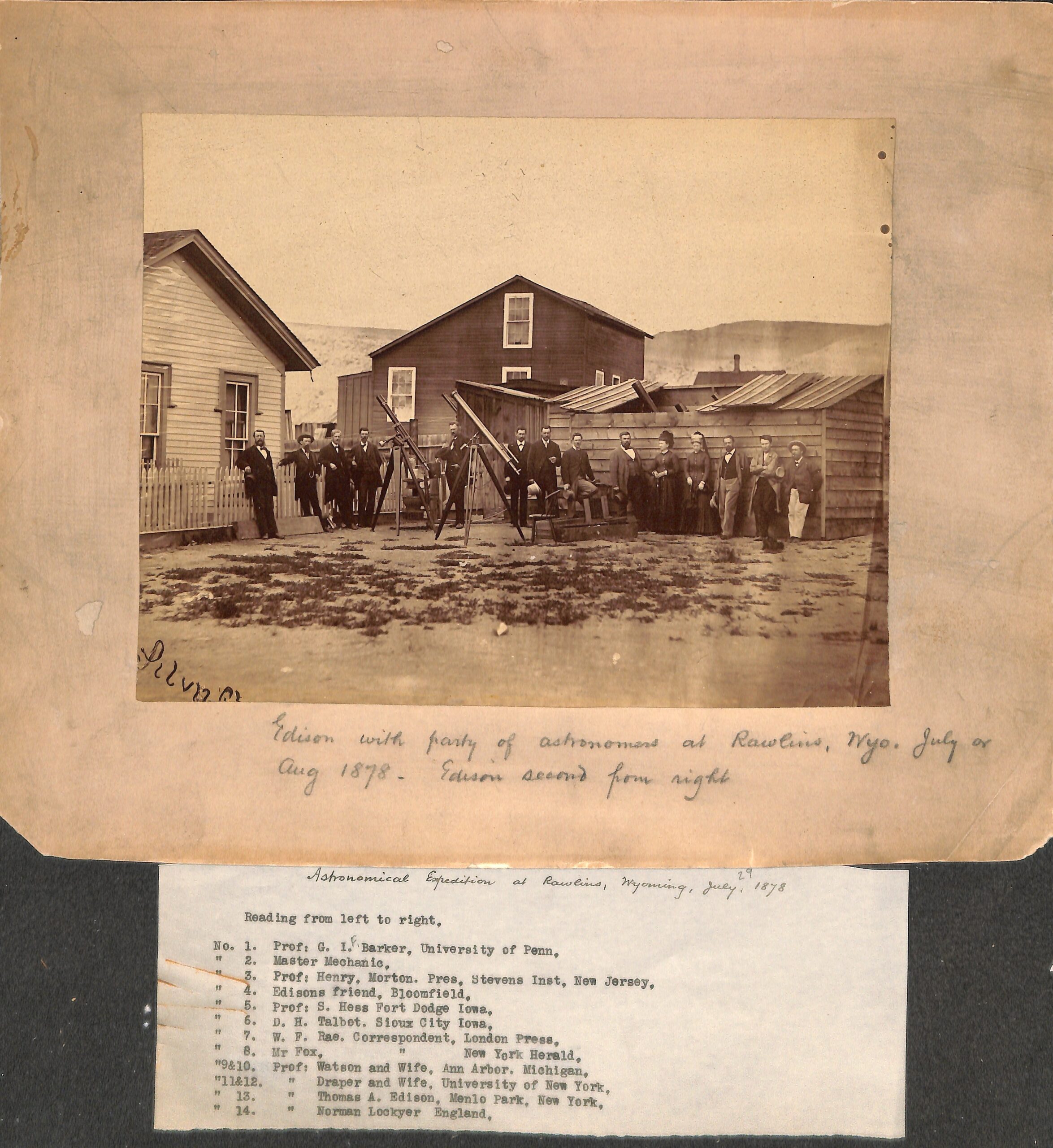 An astronomical expedition at Rawlins, Wyoming, in 1878, with Edison second from the right. Thomas Edison National Historical Park; public domain. The archive caption misidentifies the event as a transit of Venus; the date and location correspond to the total solar eclipse.
The eclipse as a deadline
A laboratory experiment can be postponed until apparatus is ready. A total eclipse occurs on its celestial timetable. Edison had to transport the tasimeter, establish it in unfamiliar conditions and accept whatever weather and mechanical state existed during totality.
Deadlines can concentrate invention, but they discourage slow validation. The expedition could observe one shadow path once. Any surprising result became a question for later experiments rather than something the eclipse itself could settle.
The publicity reward followed immediately, while scientific confirmation required years and perhaps a different instrument. That imbalance helped the apparent success travel faster than its qualifications.
What a null result would have meant
If the needle had not moved, the experiment still could not prove that the corona emitted no heat. The apparatus might have lacked sensitivity, alignment or stability. A positive movement likewise could not prove the source without controls.
This asymmetry is why the tasimeter story resists a simple triumph or failure. Edison performed a difficult observation with a new detector. The outcome justified further enquiry but not the strong conclusion popular summaries prefer.
The instrument after the headline
Once the expedition ended, the tasimeter had to compete with Edison’s other projects. Telephone litigation, phonograph demonstrations and the approaching electric-light campaign offered clearer commercial returns. Astronomical instrumentation required continuing collaboration with observatories and specialist calibration.
Edison patented and discussed refinements, but no sustained production programme followed. The instrument’s fame remained tied to the eclipse because that was the event newspapers could narrate.
This pattern separates historical visibility from technical adoption. A public test can make an object memorable even when laboratories later choose a quieter rival.
Sources and further reading
- Thomas A. Edison Papers, “1878” chronology — eclipse journey and tasimeter work.
- Smithsonian Institution, Edison tasimeter collections record — surviving instrument and construction.
- Franklin Institute, nineteenth-century reports on Edison’s tasimeter — contemporary instrument description.
- Popular Science Monthly, microtasimeter diagram (1880) — contemporary illustration.