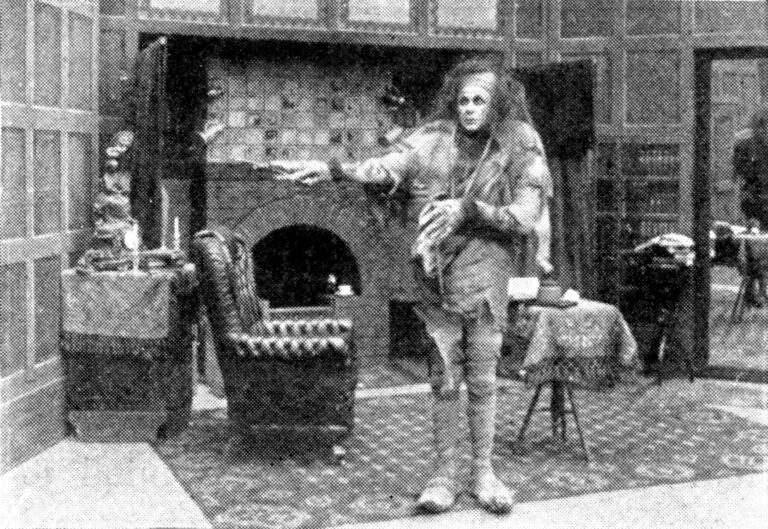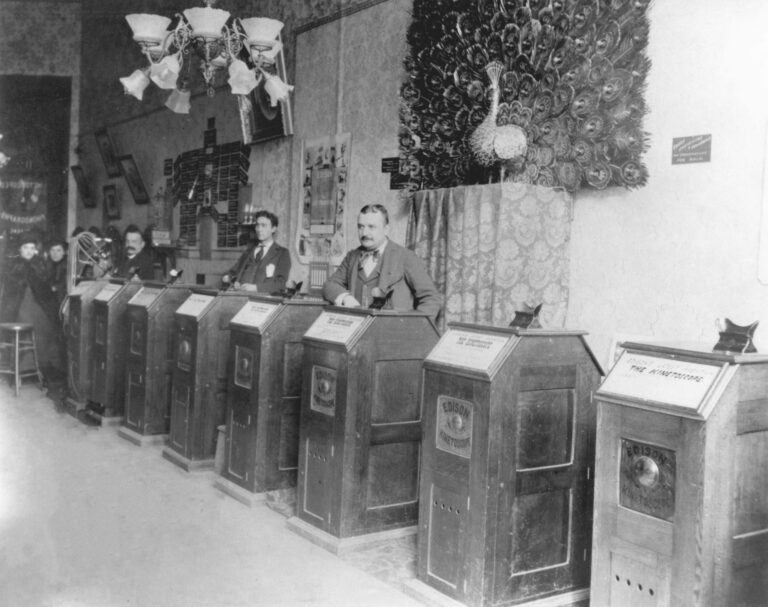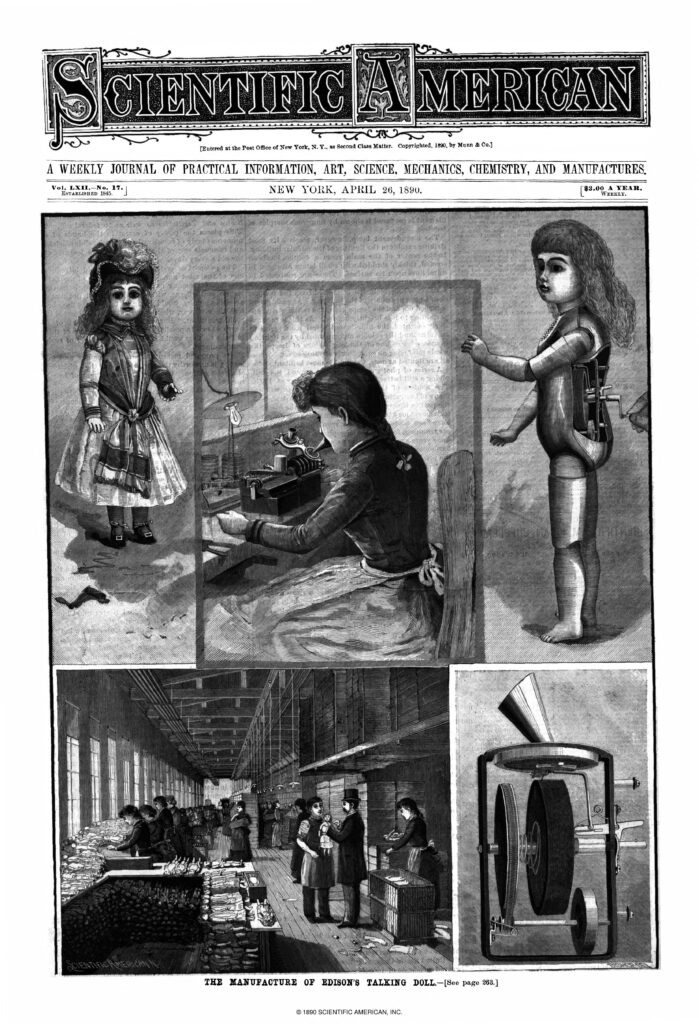
The best-known photographs of Thomas Edison’s laboratories show men gathered around machines. In the factories surrounding them, women wound coils, assembled lamps, inspected parts, made talking dolls and recorded voices. Their work helped turn experimental objects into products, yet most of their names were never attached to a patent or printed in an advertisement.
There was no single experience of “Edison’s women workers”. A young assembler at the lamp works, a female phonograph recording artist and Mina Edison in the laboratory’s social world occupied very different positions. What they shared was a history obscured by the old habit of treating invention as finished when a male inventor completed a prototype.
From laboratory result to factory routine
Edison’s businesses grew rapidly after the electric-light experiments at Menlo Park. Lamp making demanded delicate repeated operations: preparing filaments, attaching them to supports, sealing bulbs, testing and packing. Phonograph manufacture required small parts and careful assembly. Batteries, records and motion-picture products created further departments.
Factory managers recruited women because industrial employers considered them suited to nimble, repetitive work and because they could be paid less than men. That judgement was shaped by gender and wages rather than any natural division of skill. Jobs presented as “unskilled” often demanded speed, concentration and a trained touch.
The lamp works
Early carbon-filament lamps were handmade in important respects. Plant fibres or prepared material had to be carbonised, mounted and connected. Glass envelopes were evacuated and sealed. Variations that looked small could determine whether a lamp lasted or failed.
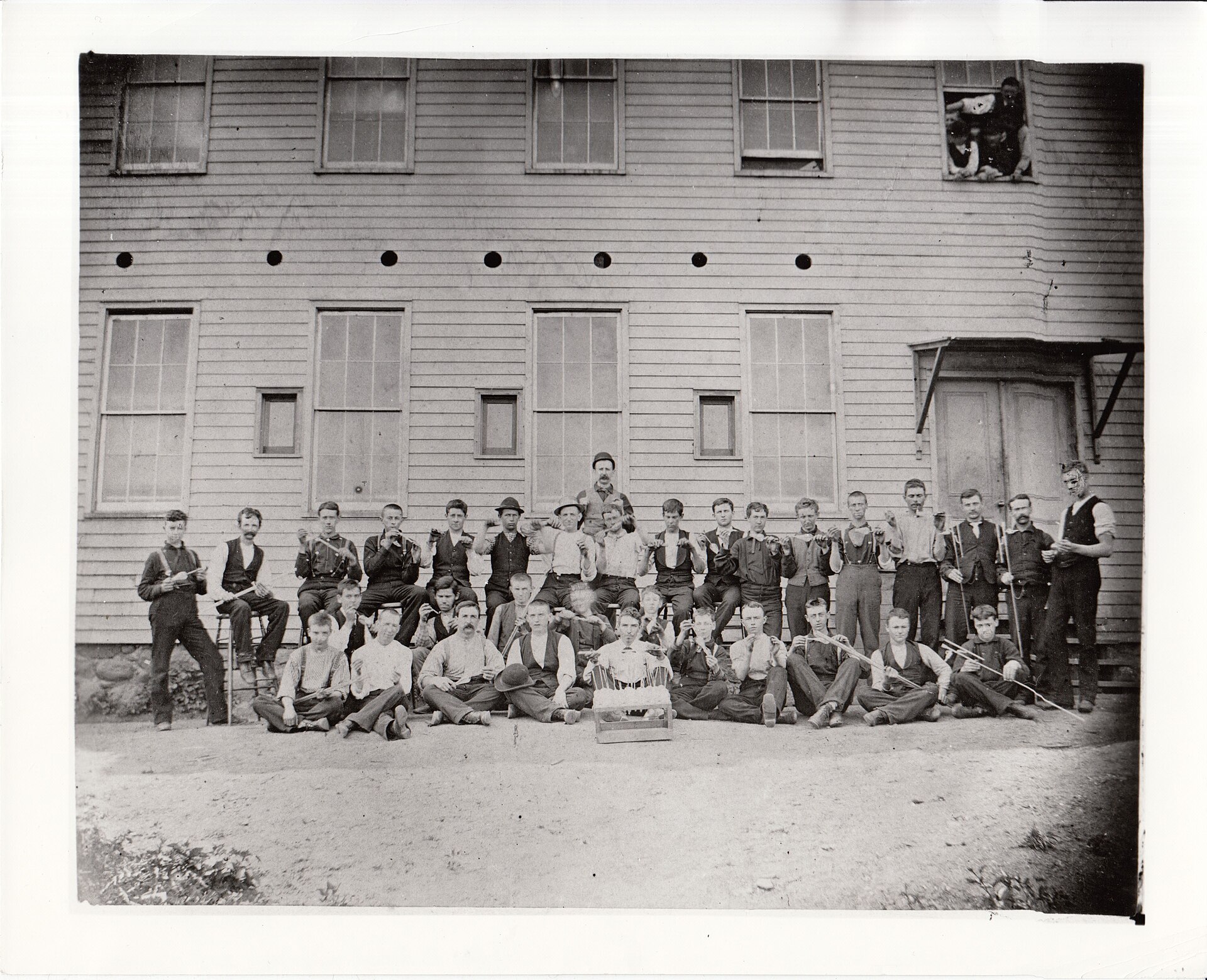
Women were employed in lamp assembly and inspection as the operation moved from Menlo Park to larger works. Their labour allowed the company to standardise a fragile laboratory achievement. An experimenter might devise a better filament, but a central lighting system required thousands of bulbs that behaved consistently.
Payrolls and factory photographs preserve groups more readily than biographies. This creates an imbalance in the record. Senior managers corresponded with Edison and appeared in company papers; an assembler might survive only as a line of wages or an unidentified face.
The voices inside the talking dolls
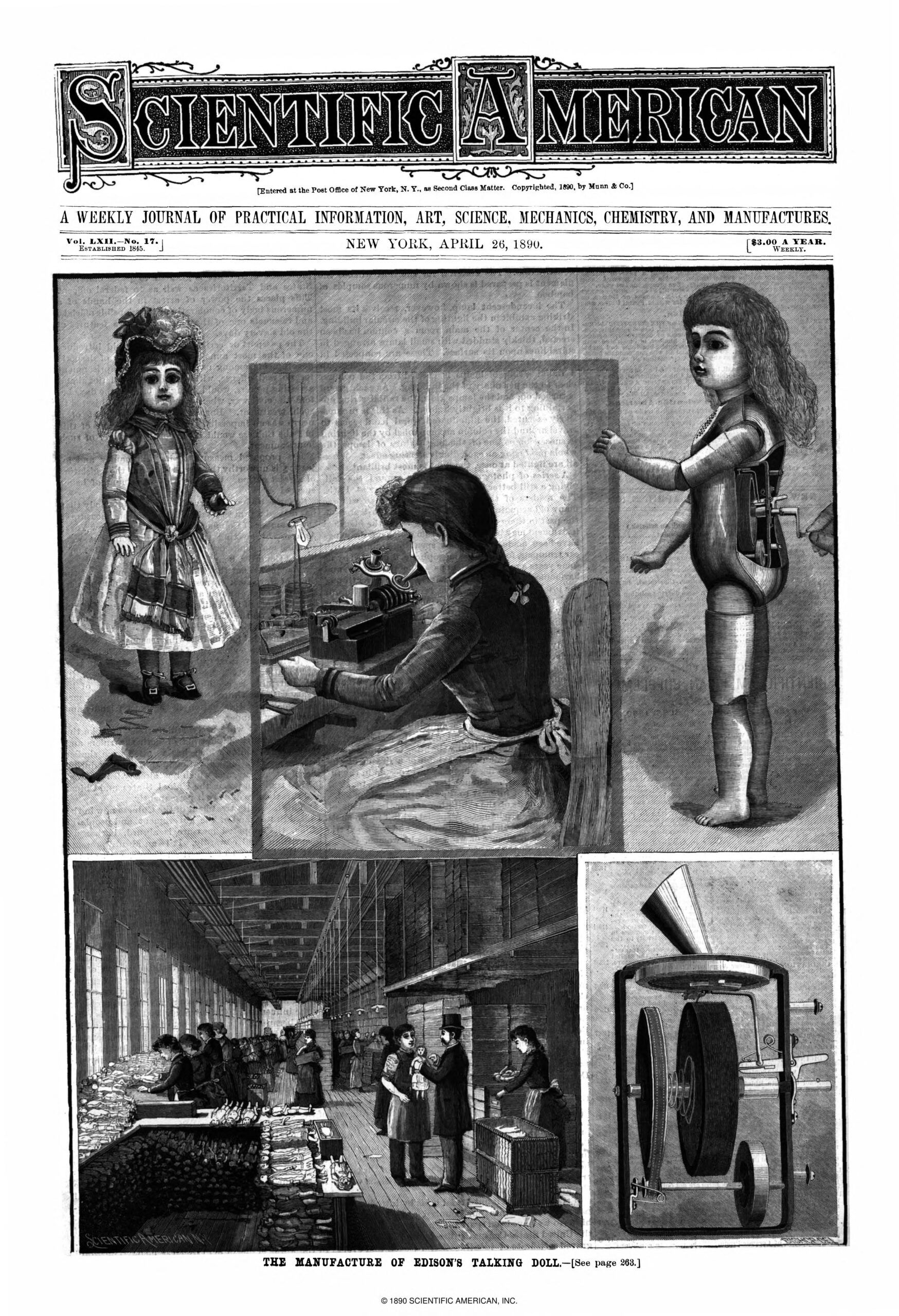
In 1890 the Edison Phonograph Toy Manufacturing Company employed young women to record nursery rhymes for talking dolls. Each tiny wax cylinder had to be recorded individually. There was no electrical microphone and no easy method of mass duplication. A woman leaned into a horn and repeated the verse again and again.
The National Park Service argues that these workers may be considered the first professional recording artists: they were paid to perform for sound recordings sold to the public. Their names were not advertised. The doll spoke “Mary Had a Little Lamb” or “Jack and Jill”, while the human performer vanished behind the product.
The work was demanding and brief. The tiny mechanisms distorted voices, cylinders were fragile and customers complained. Production stopped after only weeks. The women’s place in recording history survived almost accidentally in photographs and in the few cylinders recovered by modern audio technology.
Hours, wages and discipline
The Edison National Historical Park notes that men and women in industrial America commonly worked six days a week and around fifty-five hours. Conditions varied across departments and years, but the factory day was governed by bells, supervisors and output.
Reading a factory photograph carefully
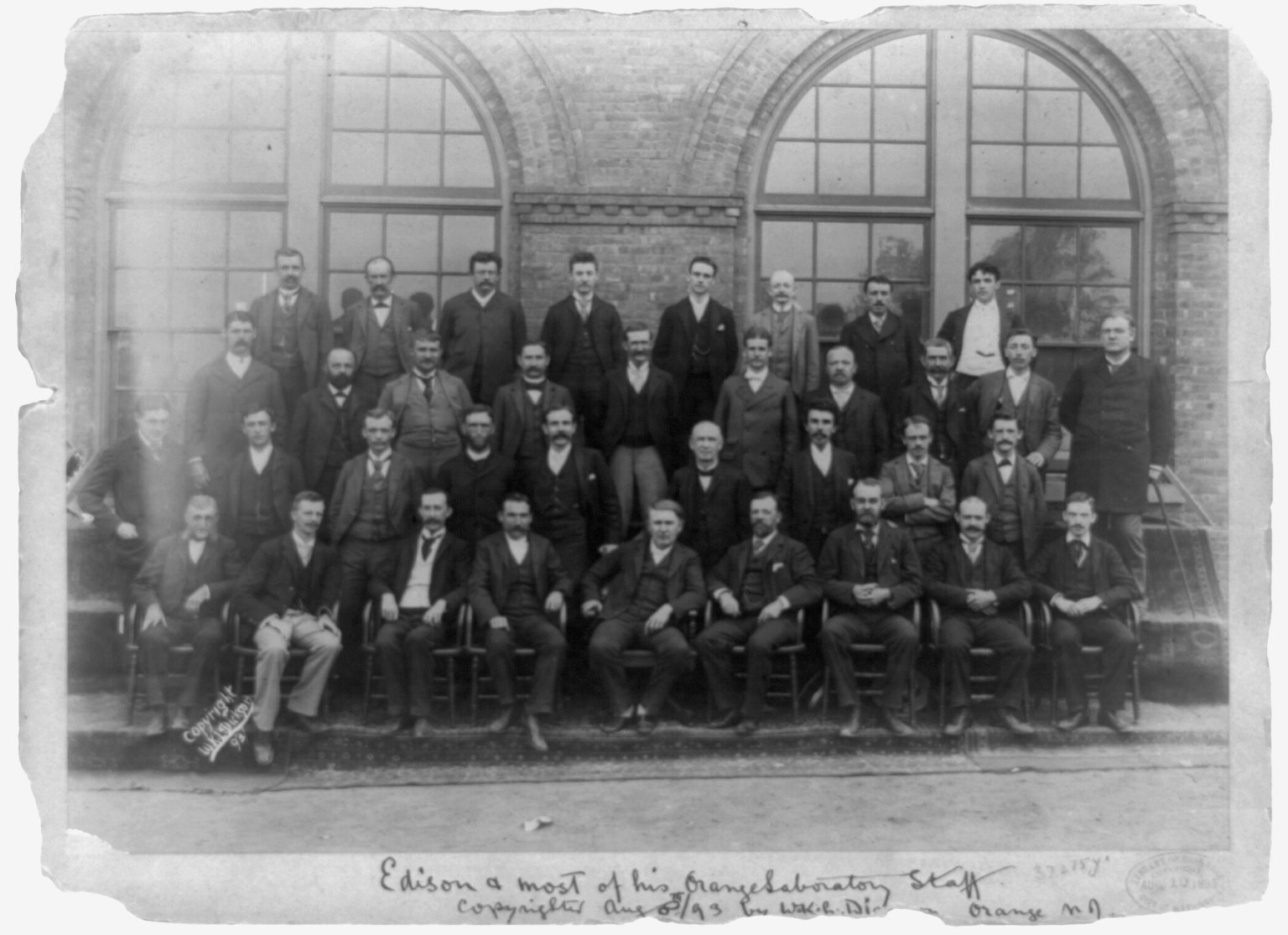
Group photographs tempt us to treat everyone in the frame as evidence of equality. Position often followed hierarchy. Owners and managers were named; workers formed rows. A posed image might display cleanliness and order while excluding heat, fumes, noise or the speed of an ordinary shift.
The talking-doll photograph is unusually informative because the tools and arrangement remain visible. Large recording horns face seated women; doll bodies and mechanisms occupy the room. Even so, it cannot tell us the recorder’s name, wage, working day or opinion of the job.
Recovering women’s history therefore requires combining images with payrolls, directories, census records and company correspondence. A face begins the enquiry rather than completing it.
Danger and the language of delicacy
Managers praised women’s supposedly delicate fingers when a task demanded precision. The same language helped classify the job as feminine and justify lower pay. Delicate work could involve sharp wire, hot materials, glass, chemicals and repetitive strain.
Industrial accidents were recorded unevenly, and chronic injury was easy to overlook. A burned hand or damaged eyesight might send a worker out of the factory without creating the documentation attached to a celebrated experimenter such as Clarence Dally.
The history of technological risk consequently favours spectacular failures. Routine exposure, fatigue and repetition belonged to the cost of production even when no single event reached a newspaper.
Women’s wages were generally lower. Employers often assumed they were temporary workers who would leave upon marriage or that a man remained the household’s primary earner. Such assumptions made women economically attractive to manufacturers and restricted their advancement.
We should avoid two equal errors: romanticising Edison employment as unusually progressive, or assuming every factory was identical to the worst sweatshop. Evidence has to be specific—payroll, rule book, accident record, testimony—rather than supplied by reputation.
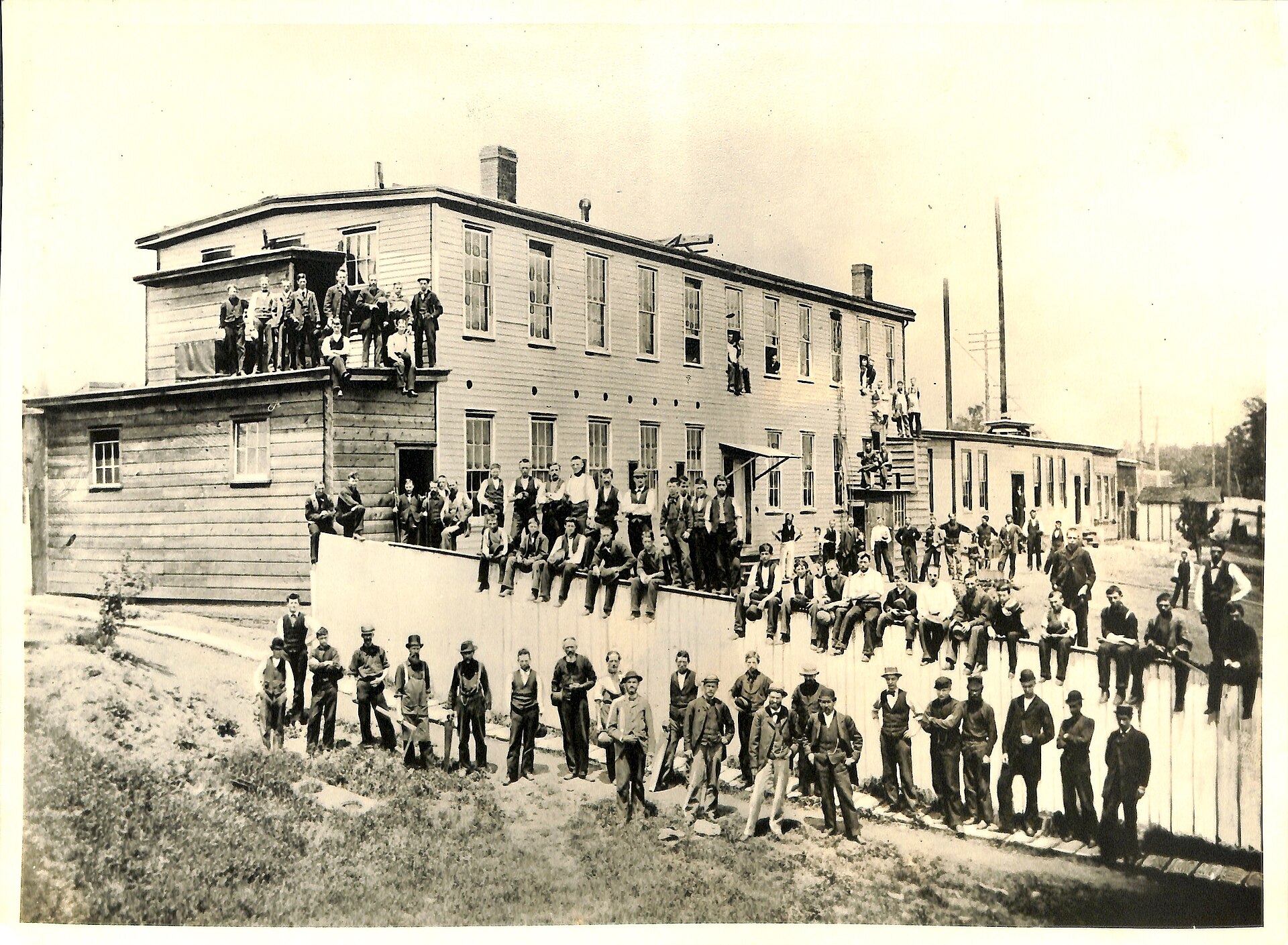 Workers at an early Edison lamp works. Mass production depended upon labour that patent histories rarely record. Thomas Edison National Historical Park; public domain.
Skill without the title of inventor
Factory knowledge travelled upward. Workers discovered which material broke, which tool slowed production and which sequence reduced waste. Their suggestions might reach a foreman or engineer without creating a patentable claim or a named document.
This does not mean every worker should be called an inventor. It means manufacture was part of technological development. A product redesigned for faster assembly, better yield or fewer failures changed through contact with the people making it.
The distinction is especially important in Edison’s system. His reputation rested not only on novel prototypes but on organising laboratories and factories so that products could be refined continuously. The boundary between experiment and production was porous, while status and recognition were not.
Office and professional work
Women also worked as clerks, typists and secretaries as Edison’s businesses accumulated correspondence, orders and financial records. The expansion of office machinery created new employment while confining many women to supporting grades.
A small number entered scientific and technical roles during Edison’s later years, though the research staff remained overwhelmingly male. Educational exclusion, hiring custom and expectations about physical shop work limited the pool from which companies recruited.
Visitors and family members shaped the organisation’s public culture. Mina Edison managed Glenmont, hosted business and civic guests and protected her husband’s time. Her influence was substantial but should not be confused with factory employment or used to stand in for wage workers whose lives were very different.
Why so few names survive
Historical collections inherit the priorities of the institutions that created them. Patent files preserve inventors; executive correspondence preserves managers; publicity photographs preserve the famous. Time cards, personnel files and group photographs are harder to turn into individual stories.
The silence is not permission to invent names or experiences. It is a reason to describe the surviving evidence honestly and to keep searching. The Edison archives include payroll records, factory files and photographs capable of recovering departments and patterns even when a complete biography remains impossible.
Seeing the workforce again
The talking-doll photograph is powerful because it reverses the familiar image. Edison is absent. Rows of women sit among horns, doll bodies and recording apparatus, performing the labour that gave the product its defining feature.
They did not secretly invent every object on the benches. They did something equally necessary: they made, tested, voiced and repeated it until a laboratory idea could enter a customer’s home. Edison’s industrial achievement cannot be understood without that hidden workforce. Restoring women to the factory floor does not diminish invention. It shows what invention required.
It also changes the meaning of “Edison’s factories”. The possessive identifies the employer and public brand; it does not describe whose days were spent inside. Thousands of working lives gave the name its material reach.
Home, marriage and the factory gate
Women’s employment was shaped by life outside the plant. Domestic work did not disappear when a wage shift ended. Marriage, pregnancy or responsibility for relatives could remove a worker from payroll without making her industrial experience temporary or insignificant.
Company records may list a maiden name that becomes difficult to trace after marriage. City directories often privilege a male head of household. These ordinary archival practices help explain why individual biographies vanish even when a department’s female workforce is visible.
Age also mattered. Some factory employees were young women living with parents and contributing to household income. Their pay cannot be treated as pocket money simply because employers imagined a male provider.
Who moved into supervision?
A largely female production department could still have male foremen, engineers and executives. Promotion followed assumptions about authority as well as technical ability. Supervisory credit then entered correspondence under the manager’s name.
Some experienced women trained newcomers and informally controlled quality without receiving a managerial title. Such roles are difficult to reconstruct unless a payroll grade, oral history or internal report survives.
The absence of women from Edison’s senior laboratory photographs is therefore not proof that production required no female expertise. It shows where the company drew the public and organisational boundary around “technical” work.
That boundary also shaped memory. A man who adjusted a machine could be described as an experimental assistant; a woman who detected defective output might be described only as an inspector. Both acts involved judgement, but the title determined whose judgement appeared inventive.
Sources and further reading
- Thomas Edison National Historical Park, “Talking Doll FAQ: Historical and Cultural Value” – women recorders and their importance.
- Thomas Edison National Historical Park, “Edison and His Era” – industrial working hours and social context.
- Thomas Edison National Historical Park Archives, “About the Collection” – factory, payroll and photographic records.
- Thomas A. Edison Papers, “Expanding the Laboratory” – growth of Edison’s industrial research organisation.