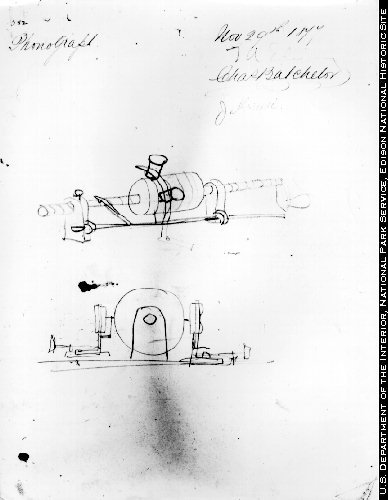
Late in 1877, Thomas Edison handed his chief machinist a sketch of an unlikely machine. A cylinder wrapped in tinfoil would turn beneath a stylus, which would press the vibrations of speech into its surface and then retrace them. John Kruesi built the apparatus. When Edison spoke into it and the machine repeated his words, the phonograph entered history.
The story is sometimes told to prove that Kruesi, not Edison, invented recorded sound. That gives the machinist overdue attention by misdescribing what he did. Edison conceived the first successful tinfoil arrangement; Kruesi transformed a compressed drawing into a precise working object. At Menlo Park, that transformation was not secondary labour. It was one of the essential acts of invention.
A Swiss mechanic in America
John Kruesi was born in Switzerland in 1843 and trained as a machinist. He emigrated to the United States and joined Edison’s Newark operation in the early 1870s. The shops were producing telegraph apparatus, stock tickers and experimental machinery that demanded speed and accuracy.
Kruesi became foreman of the machine shop. He could read Edison’s rough sketches, infer missing dimensions and decide how parts should be made. That ability created trust. Edison did not need to provide a finished engineering drawing; Kruesi understood the intended action and built towards it.
Machinists in an experimental shop were not factory operatives repeating a settled task. They selected materials, altered fits, solved interference and sometimes recognised that a proposed arrangement could not work. Their knowledge existed in the hands as well as on paper.
Building the first phonograph
Between 1 and 6 December 1877, according to the Edison Papers chronology, the Menlo Park team produced the first successful tinfoil phonograph. Edison’s sketch showed a grooved cylinder, a hand crank and diaphragms carrying styli. Kruesi machined the components and assembled them.
Later accounts say Kruesi doubted the idea and wagered a cigar that it would not work. The anecdote fits the surprise produced by the machine, but its polished details come from recollection and should not carry more weight than the contemporary sketch and apparatus.
Edison recited “Mary Had a Little Lamb”. The stylus indented the foil; repositioned for playback, it vibrated the diaphragm and reproduced a faint voice. No existing machine had recorded and replayed arbitrary sound so directly.
Whose invention was it?
Construction and conception cannot be divided as if one mattered and the other did not. Edison identified the principle and drew the arrangement. Kruesi’s machine made the test possible. Charles Batchelor joined improvements and demonstrations. A successful phonograph required all three kinds of work.
The patent named Edison because the claimed inventive conception was his. The surviving evidence does not support the claim that he stole the phonograph from Kruesi. Nor does “built to Edison’s sketch” mean Kruesi acted like an automatic tool. A sketch becomes a machine only through choices, and his speed allowed Edison to test ideas while they were still alive.
The more accurate conclusion is not a winner’s name. It is that Edison’s method depended upon men capable of completing an incomplete instruction.
The machine shop at Menlo Park
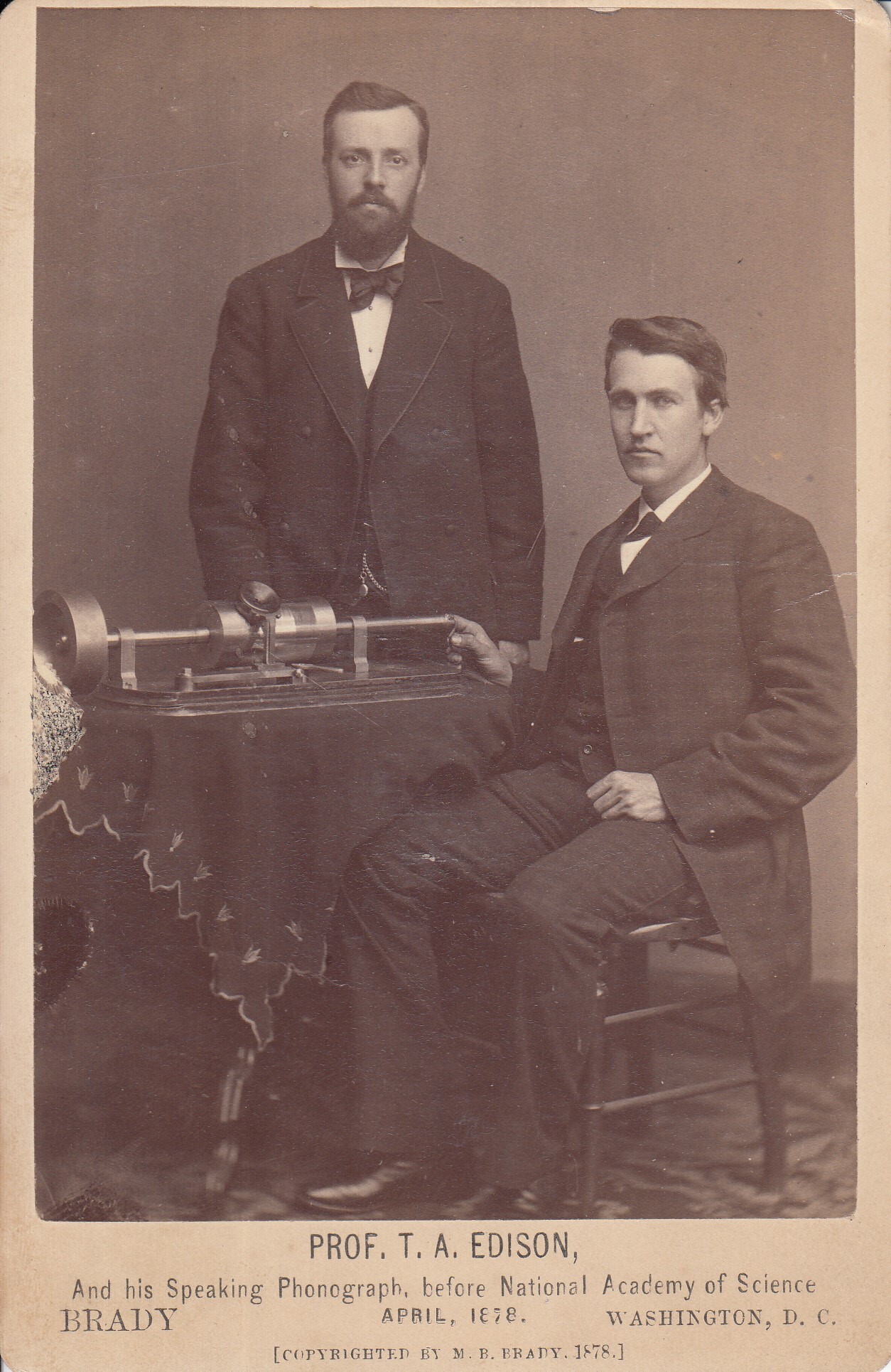
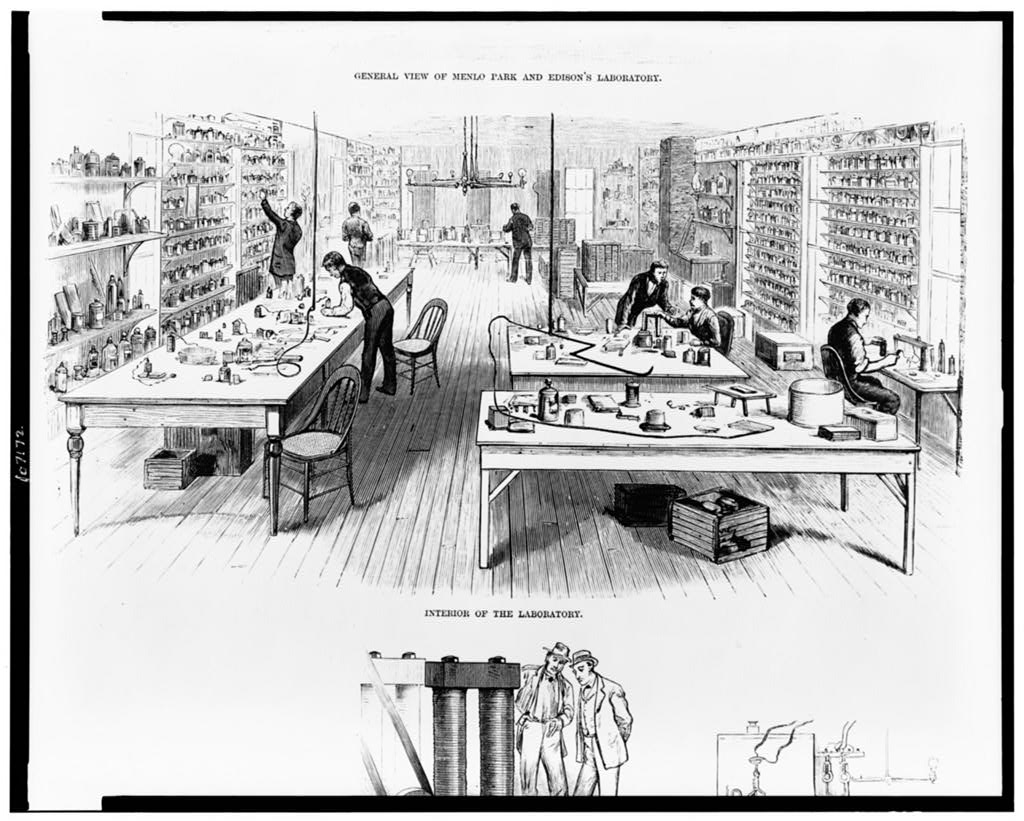
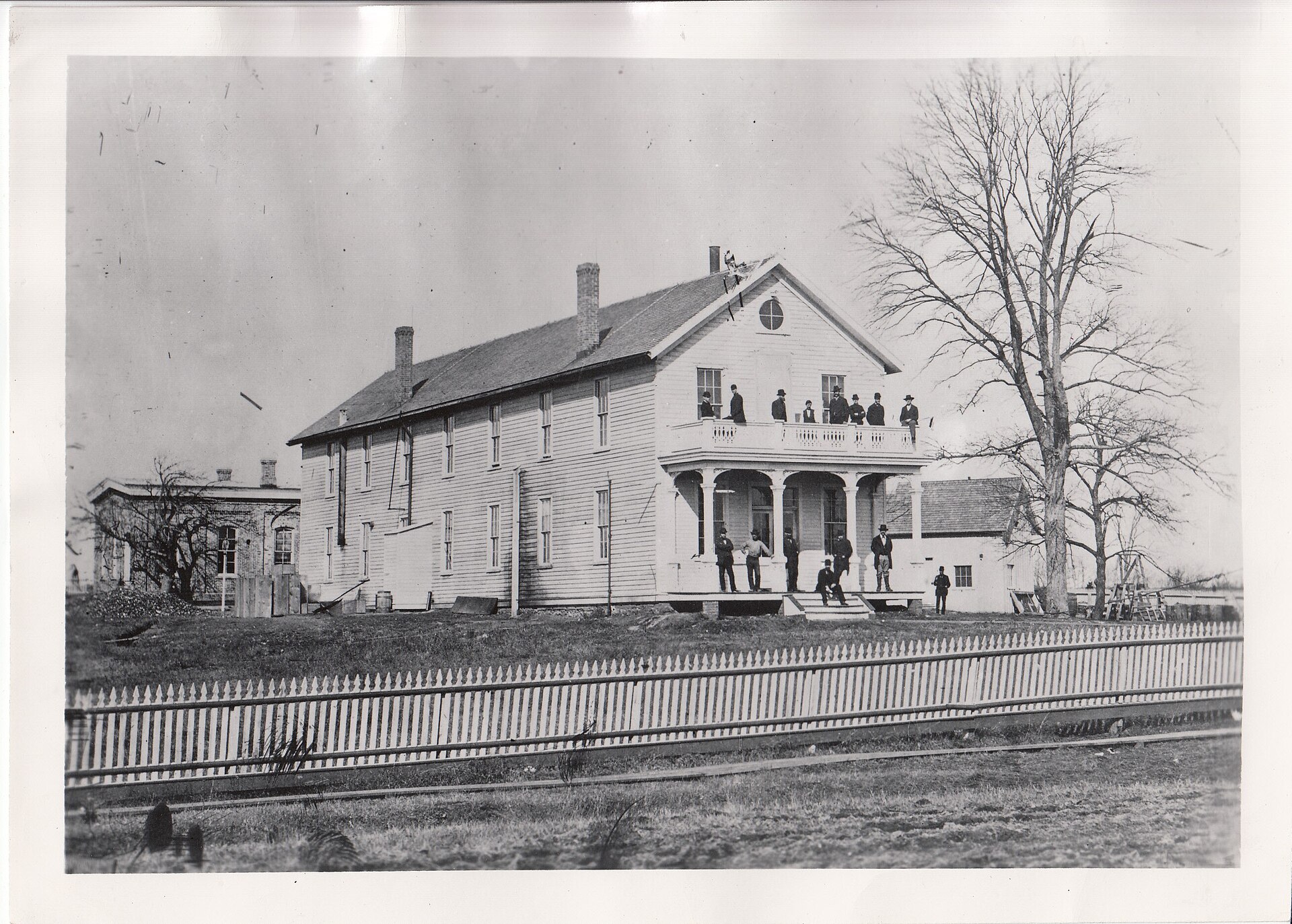
When Edison established Menlo Park in 1876, the machine shop stood at the centre of the invention factory. Experiments in telephones, electric lighting and sound required custom apparatus unavailable from catalogues. Kruesi supervised lathes, drills and skilled mechanics who turned drawings into tests.
The laboratory’s famous long hours were possible partly because the means of construction were on site. A failed test could lead immediately to a modified cam, contact, bearing or frame. Kruesi coordinated that material rhythm.
How to read an Edison sketch
Edison’s experimental drawings could be energetic rather than complete. A line indicated motion, a note named a material and an overall proportion suggested scale. A production draftsman would later require dimensions and tolerances; the first model required interpretation.
Kruesi knew Edison’s mechanical vocabulary. He could distinguish the part essential to the idea from the form that could be altered for convenience. If a shaft needed support or a tool could not reach a proposed surface, he supplied a workable arrangement without waiting for a formal revision.
This tacit collaboration leaves uneven documentary traces. The sketch survives under Edison’s name; the finished machine survives as an object. The small decisions joining them may never have been written. Attribution based only on paper will naturally undervalue the machinist.
Precision and speed
Experimental speed did not mean carelessness. The tinfoil phonograph depended upon a stylus following a helical groove while the cylinder turned steadily. Misalignment could make a promising principle appear false. The first model had to be accurate enough for a sound groove measured in tiny movements.
Kruesi’s reputation rested on producing that accuracy quickly. A laboratory director might generate many ideas; only a limited number could occupy lathes and skilled men. The foreman helped decide how ambition became a queue of buildable work.
His shop was therefore part of the laboratory’s thinking apparatus. It converted speculation into objects that could fail definitely rather than remain plausible on paper.
His responsibilities reached beyond the bench. As foreman he allocated work, watched costs and ensured that experimental urgency did not destroy every standard of workmanship. Edison demanded haste; a mechanism still had to run.
Telephones and electric light
Kruesi helped make apparatus for Edison’s carbon telephone transmitter and telegraph systems. During electric-light development he constructed experimental generators, regulators and distribution equipment. The visible lamp was only one piece of a mechanical and electrical network.
Edison’s early dynamos had to be enlarged and improved. Heavy armatures, magnets, shafts and commutators made generator work a machinist’s problem as well as an electrical one. Kruesi’s shop produced the physical forms on which measurements and calculations depended.
At Pearl Street, where Edison opened his New York central station in 1882, Kruesi took responsibility for installing underground conductors. Streets had to be opened, pipes joined and feeders connected into an operating system. The assignment demonstrates how far his authority extended from a laboratory sketch.
From foreman to manufacturing executive
As Edison enterprises expanded, Kruesi moved into management. He became associated with the Edison Machine Works and later corporate organisations that fed into General Electric. Experimental machinery had become an industry, and the foreman became an executive responsible for production.
The transition was logical. Kruesi understood how a unique model differed from a repeatable machine. Manufacturing demanded drawings, tolerances, supply chains and inspectors. The judgement learned while correcting Edison’s sketches could be applied across a factory.
His rise also contradicts the image of an exploited unknown. Kruesi held authority and enjoyed a substantial career. Yet prosperity did not guarantee public remembrance. The Edison name remained attached to the products, while the builder’s name lived mainly in specialist histories.
The limits of the “mucker” label
Edison’s close workers are often called muckers, a term suggesting informal loyalty and a willingness to tackle dirty jobs. Kruesi fitted the culture of effort but deserves the more precise title he held: master machinist and shop foreman.
Precision machining was a recognised trade with its own discipline. Describing him only as a loyal assistant risks preserving the same hierarchy that made him obscure. Edison trusted Kruesi because he possessed knowledge Edison needed.
The line on the sketch
John Kruesi died in 1899, before the phonograph had reached its mature disc era and before cinema had fully developed from the laboratory apparatus he helped build. His best-known object survives as a small, almost improvised-looking machine.
Its importance is easy to see but hard to assign to one pair of hands. Edison’s drawing carried the recorded-sound idea. Kruesi supplied dimensions, metal and motion. When the cylinder spoke, it vindicated a partnership between imaginative direction and practical construction.
Kruesi’s career reminds us that an experimental sketch is a question. The master machinist is the person who gives it a form in which nature can answer.
Calling him the “man who made Edison’s ideas real” should not imply that ideas belonged to one side and reality to the other. Construction changed the question. Material, friction and fit answered back, and Kruesi’s judgement shaped the next sketch.
The phonograph’s first voice was therefore also the sound of a machine shop succeeding.
Kruesi beyond the famous cylinder
One dramatic object can shrink a career. Kruesi’s daily responsibility included apparatus that never received a name, repairs that prevented interruption and experimental models discarded after giving a useful answer. Menlo Park’s productivity depended upon this ordinary continuity.
Telegraph devices required fine contacts and reliable paper movement. Generators demanded large, accurately aligned parts. Underground distribution required field organisation. Moving between those scales was a managerial and technical achievement.
When Edison trusted Kruesi with the Pearl Street conductor installation, he entrusted part of the public lighting system’s reputation. A laboratory error could be hidden or repeated; a street opened in Manhattan had schedules, contractors and customers waiting.
The builder’s signature
Experimental objects seldom carry a machinist’s signature. Their form can nevertheless reveal decisions: a bracket made adjustable because the best position was unknown, an oversized bearing because failure would end a test, or a part shaped for the tools available.
Curators studying the first phonograph treat it as evidence alongside the sketch and patent. Tool marks and construction show how rapidly a theoretical arrangement became workable apparatus.
Kruesi’s authorship resides in those decisions even when the legal invention remained Edison’s. Historical credit becomes richer once different verbs—conceived, drew, built, tested, managed—are allowed to stand beside one another.
Sources and further reading
- Thomas Edison National Historical Park, “Origins of Sound Recording” – Edison’s sketch and Kruesi’s construction.
- Thomas Edison National Historical Park, “Edison’s Path to the Phonograph” – the experiments preceding December 1877.
- Thomas A. Edison Papers, “1871–1880” – Kruesi’s employment and the first phonograph.
- Thomas Edison National Historical Park, “The Gifted Men Who Worked for Edison” – Kruesi’s role among Edison’s staff.