Thomas Edison received 1,093 United States patents. The number is repeated so often that it can sound like a sporting record: evidence that he simply invented more things than anyone else. It is an impressive total, but it is also easily misunderstood.
The patents range from famous machines to small alterations in switches, batteries, telegraph circuits, lamps, record manufacture, ore processing and cement equipment. Some protected a central principle; others divided a large technical programme into several legal claims. Many arose from collaborative laboratory work. Hundreds of applications failed or were abandoned, and a patent did not prove that the protected device became useful or profitable.
The real story is better than the record-book version. Edison treated patents as technical documents, weapons in commercial negotiations, evidence in disputes and assets that could attract capital. To understand his 1,093 patents is to see how invention became a business.
What the figure actually counts
The Thomas A. Edison Papers identifies 1,093 successful United States patent applications signed by Edison. His first was executed on 13 October 1868, when he was twenty-one. It covered an electrographic vote recorder. His last patents were issued after decades of work across electrical, chemical, mechanical and recording industries.
The word “successful” is important. Rutgers estimates that Edison also filed roughly 500 to 600 applications that were abandoned or refused. The familiar total is therefore not a count of every idea he asked the Patent Office to consider. It is the number that emerged as granted patents.

Foreign totals are even less tidy. A compilation published by Frank Lewis Dyer and Thomas Commerford Martin in 1910 listed 1,239 non-American patents in thirty-four countries, but the Edison Papers warns that no complete list exists. Adding American and foreign documents can produce a worldwide number, but it does not produce the same number of distinct inventions. One device could be protected separately in several countries.
A patent is not an invention certificate
A patent grants a temporary legal right over defined claims. It does not declare that the holder created an entire technology from nothing. An application must describe an invention and persuade examiners that its claims are new and sufficiently distinct, but those claims may cover an improvement within an already crowded field.
Edison’s electric lamp is a good example. Incandescent lighting existed before his work. His patent protected particular features of a high-resistance carbon-filament lamp. The commercial achievement also depended upon generators, wiring, meters, sockets, switches and a central-station system. Several of these produced separate patents.
Counting every document as a wholly independent invention exaggerates novelty. Ignoring the patents because earlier lamps existed makes the opposite error. The documents show where Edison and his organisation claimed a specific technical advance.
The first patent and an early lesson
Edison’s vote recorder was designed to let legislators register “yes” or “no” electrically and obtain a rapid total. Patent No. 90,646 was granted on 1 June 1869. The mechanism worked, but politicians showed no desire to speed a process in which delay could be tactically useful.
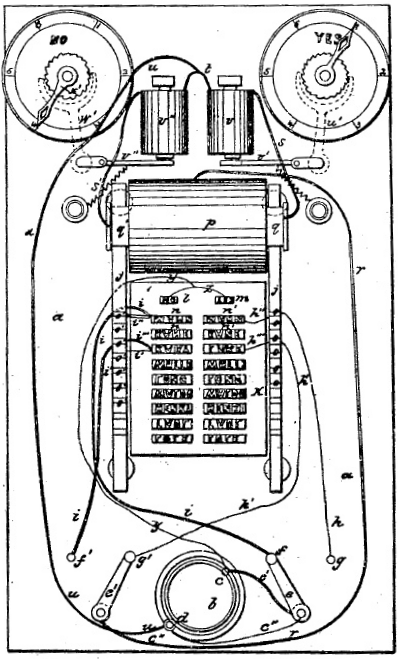
The experience supplied a lasting lesson: a patentable machine was not necessarily a saleable one. Edison later recalled resolving to work on inventions for which a market already existed. The recollection was polished in hindsight, but it accurately describes the commercial direction of his telegraph career.
Stock printers, automatic telegraphs and multiplex systems served companies already paying heavily for communication. A patent in that environment could be licensed, assigned or used to strengthen a negotiating position.
Patents as business property
Young Edison learned that the language of a patent mattered almost as much as the apparatus. Investors were not buying only a machine on a bench. They wanted control over a protected market. Telegraph companies commissioned improvements partly to secure freedom from competitors and partly to prevent rivals from obtaining blocking rights.
Applications could therefore become assets before a product was finished. Edison assigned rights to companies or financial backers, retained interests in other cases and worked through patent attorneys who translated experimental notes into claims. Interference proceedings occurred when applications appeared to cover the same invention. Litigation could continue for years after the original experiment.
This system encouraged multiple filings around a large project. An inventor might protect the central device, then seek additional patents for a transmitter, receiver, manufacturing process or circuit. The 1,093 total records both creative range and an increasingly sophisticated legal strategy.
The patent factory at Menlo Park
At Menlo Park, patent work became inseparable from organised research. Edison employed machinists, experimental assistants, chemists and mathematicians. Notebooks were dated, signed and sometimes witnessed because they might later help establish priority.
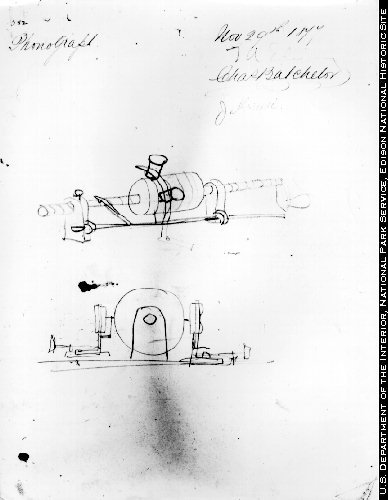
The phonograph shows the process at unusual speed. Edison’s drawing gave machinist John Kruesi enough direction to construct an experimental machine. The apparatus recorded and reproduced sound, and Edison moved quickly to secure protection. Patent No. 200,521 was granted on 19 February 1878.
The drawing carries Edison’s name, but the working object belonged to a chain of labour: telegraph and telephone experiments suggested the principle; Edison formulated the design; Kruesi built it; Charles Batchelor and others tested and improved it; attorneys framed the legal application. Patent authorship captures one part of that history.
Who invented work done by a team?
Most Edison patents named Edison alone because the law required inventors rather than employers to apply, and because he directed the programme and claimed the inventive conception. That does not mean employees merely followed orders. Laboratory notebooks reveal assistants proposing changes, conducting long test series and solving practical problems.
Modern readers sometimes respond by declaring that Edison “stole” every team invention. The record is more complicated. Employees were hired to conduct inventive work, understood that company projects were being patented and sometimes appeared as joint inventors or obtained patents of their own. Credit, authority and reward were unequal, but collaboration was real.
The sound historical question is not whether one name on a patent makes every other contribution disappear. It is what the claims covered, who conceived them, who carried out the experiments and how the resulting right was assigned and used.
The busiest year: 1882
The Edison Papers calculates that Edison executed 106 successful applications in 1882, the peak year of his career. This was the period when his electric-light interests were moving from experimental lamps towards generating stations and urban distribution.
A complete lighting system required solutions to many linked problems. The legal portfolio reflected the engineering architecture: dynamos, conductors, regulating devices, meters, fixtures and methods of distribution. The large number did not mean Edison woke each morning with a wholly unrelated invention. It meant an expanding system generated numerous protectable components.
That concentration also shows why raw totals can mislead. A field surrounded by fierce investment and litigation produced more filings than an equally difficult experiment with no immediate commercial value.
Patents that led nowhere
Some Edison patents protected devices that failed in the market. The vote recorder found no buyer. The electric pen sold for office copying but never became a lasting business, although its reciprocating needle helped inspire later tattooing machines. Ore-separation patents supported a New Jersey mining venture that consumed years and a large amount of money without delivering the expected profit.
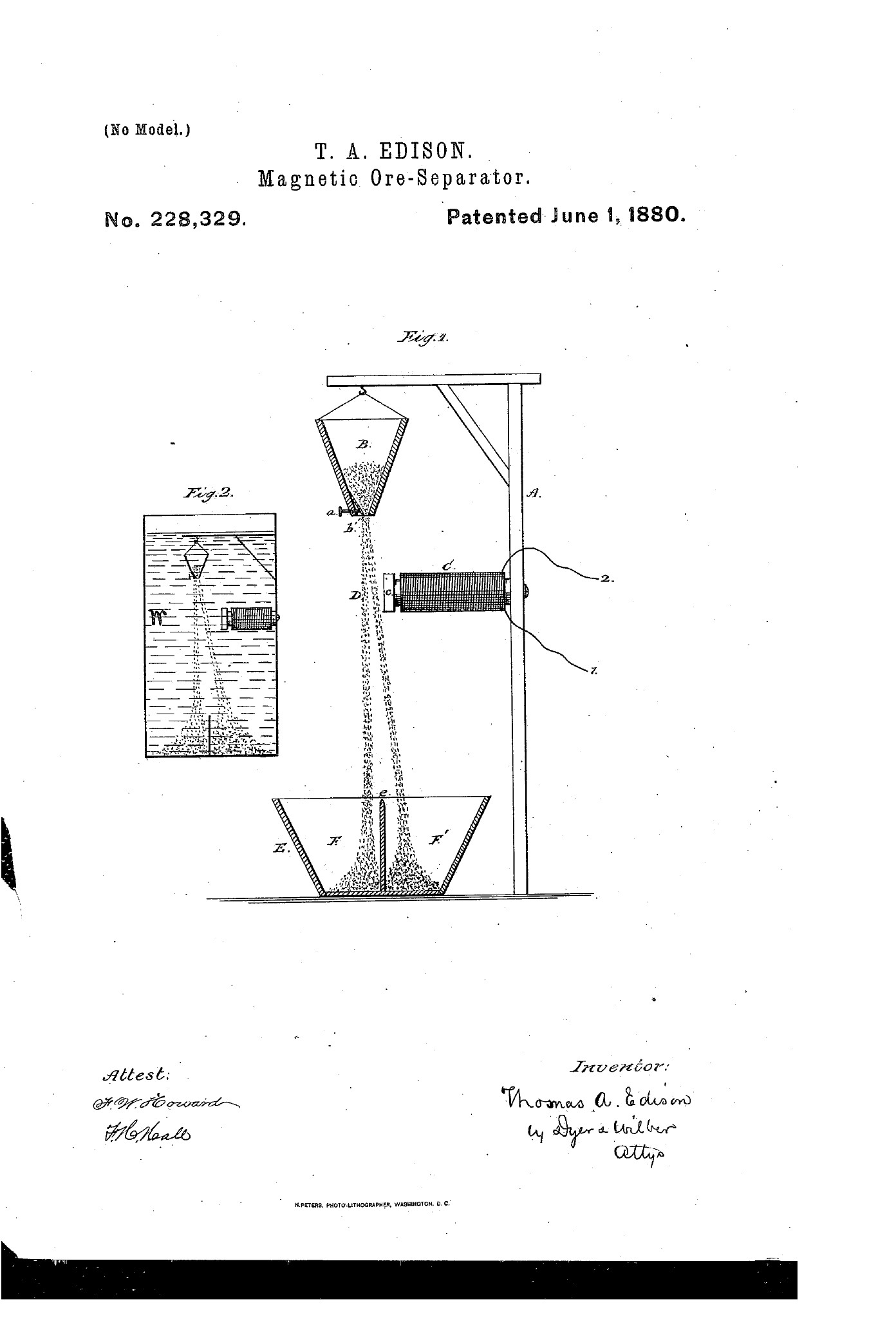
Failure does not make those patents fraudulent. It demonstrates that legal novelty, engineering feasibility and commercial success are different tests. A machine may satisfy one and fail the others.
Conversely, some of Edison’s most important contributions were organisational and cannot be reduced to one certificate. The industrial research laboratory, the integration of electric-light components and the creation of manufacturing and distribution organisations were systems assembled through contracts, people and capital as well as patents.
Why the titles are difficult to search
Patent titles are not a clean catalogue of familiar inventions. Rutgers warns that inconsistent naming makes simple keyword searches unreliable. A document relevant to a telephone may be titled “speaking telegraph”; a component may be classified under a broader electrical term. The same patent can reasonably belong to more than one modern subject category.
Dates also require care. The execution date marks when Edison signed an application and is often closer to the inventive work. The filing date records its arrival in the Patent Office. The issue date may come months or years later, especially when claims were amended or contested. Saying that Edison “invented” something on the grant date can therefore create a false chronology.
What 1,093 tells us—and what it does not
The number proves extraordinary persistence within the patent system. For more than sixty years Edison and his legal organisation converted experiments into formal claims across a remarkable range of technologies. Few inventors combined that duration, industrial reach and appetite for documentation.
It does not prove that Edison personally fashioned 1,093 complete products, that every patent was equally important or that no employee made an inventive contribution. It should not be used as a league table against inventors working in different periods, industries or legal systems.
The patents are most valuable when the total is broken apart. They reveal the young telegrapher learning to sell improvements, the Menlo Park director protecting a programme of research, the electrical industrialist building a system and the older experimenter continuing to file claims in batteries, recordings, cement and rubber.
Edison’s famous number is not a count of lightning bolts from a solitary genius. It is the paper trail of an invention business.
Sources and further reading
- Thomas A. Edison Papers, “Edison’s Patents” – totals, application dates, unsuccessful filings, foreign patents and annual distribution.
- Thomas A. Edison Papers, Patent Listing – searchable record of the 1,093 United States patents.
- Thomas A. Edison Papers, “The American Patent System” – application, examination, assignment and interference procedures.
- National Archives, Thomas Edison’s electric-lamp patent drawing – federal patent record and unrestricted-use statement.
- Thomas A. Edison Papers, “Thomas Edison and His Papers” – notebooks, patent files and evidence preserved for litigation.
- Thomas Edison National Historical Park, Edison biography – overview of the laboratories and principal technologies.