Before radio operators sent messages across the Atlantic, Thomas Edison tried to communicate with a moving train and a ship without a connecting wire. His system used induction between large conductors rather than radio waves. It worked over modest distances, earned a patent and found little commercial use.
The experiment occupies an awkward place in history. It is sometimes advertised as wireless radio before Marconi and sometimes ignored because it was not radio at all. Both reactions miss its interest. Edison identified a real problem—communication with moving vehicles—and produced a distinct wireless solution whose limitations reveal why later electromagnetic radio prevailed.
What “wireless” meant in the 1880s
Telegraphy normally required a conductive path: a wire out and often the earth as return. Ships beyond harbour cables and trains moving along a line could not remain physically connected in the ordinary way.
“Wireless” was a broad description before it became nearly synonymous with radio. Induction, conduction through earth or water, optical signalling and electromagnetic waves were all investigated. A system could transmit without a joining wire while relying on physics quite different from broadcasting.
Edison’s work grew from a phenomenon observed around telegraph lines. Changing current in one conductor could induce a signal in another nearby conductor. If a long wire ran along a train and another beside the track, messages might cross the gap.
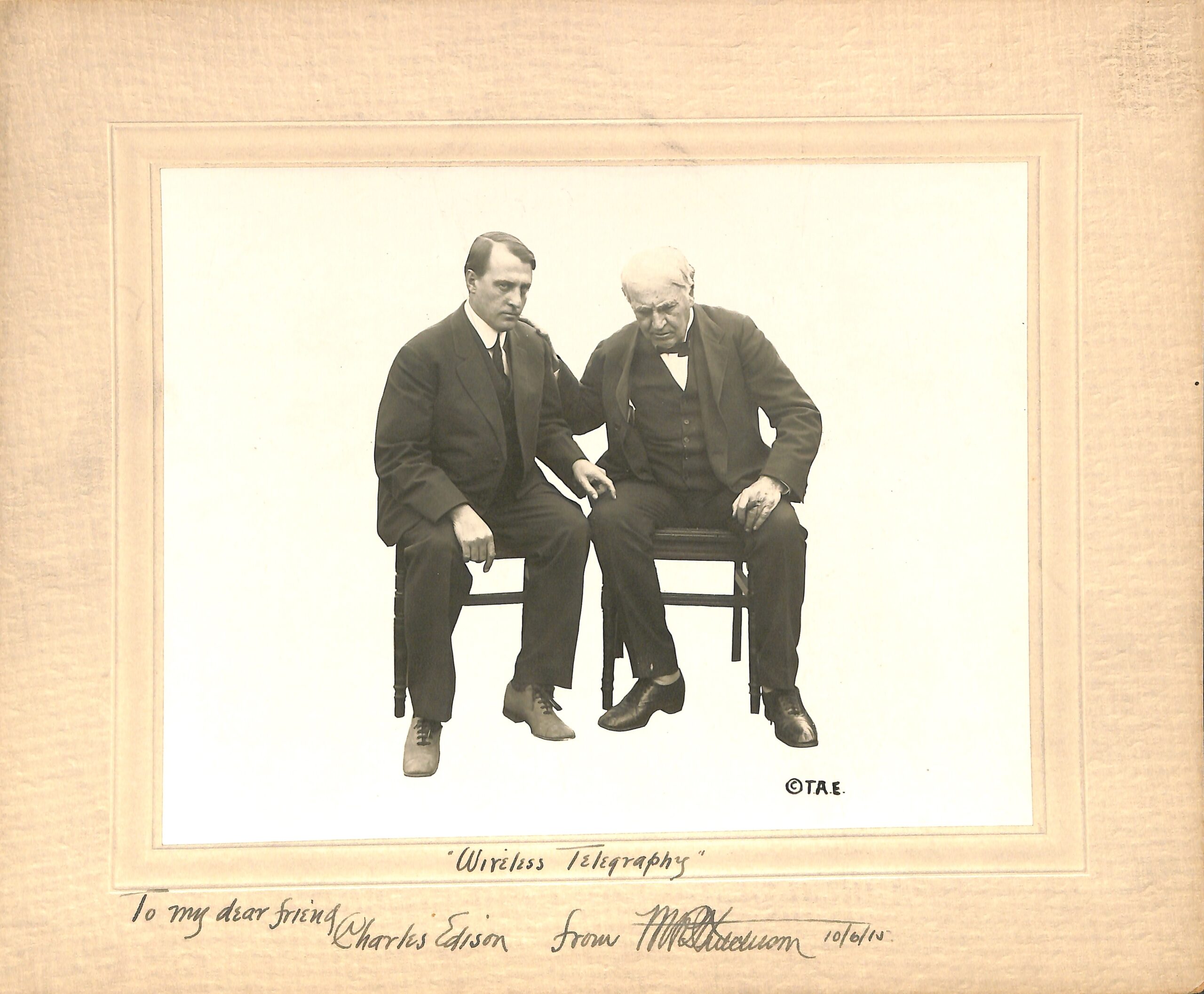 Edison with chief engineer Miller Reese Hutchison and wireless apparatus in 1915. His interest in communication at sea continued long after the induction experiments. Thomas Edison National Historical Park; public domain.
A phenomenon noticed in the wires
Telegraph operators knew that neighbouring circuits could interfere with one another. A signal sent on one line appeared faintly on another, an effect engineers usually treated as crosstalk. Edison asked whether the nuisance could be turned into a communication method.
That reversal was characteristic of his experimental practice. Instead of eliminating an unwanted effect, the laboratory enlarged it, arranged conductors deliberately and tested how far an intelligible signal could be recovered.
The receiving instrument still belonged to telegraphy. Pulses represented dots and dashes; an operator heard or recorded them. “Wireless” described the gap in the circuit, not a new language of communication.
Shipboard need before radio
A vessel approaching port carried information valuable before docking: cargo, passenger needs, weather and emergencies. Lighthouses and lightships also needed reliable contact. Flags and lamps depended on visibility, while carrier pigeons and boats were slow.
An induction system promised privacy and electrical speed without laying a cable to a moving hull. Its long elevated wires, however, were difficult on rigged ships and effective only within a limited zone. Salt water and metal structure altered the electrical environment.
Marconi’s early installations faced their own failures, but increasing power, tuning and aerial design extended the range. Distress communication, especially after famous maritime disasters, made radio’s public value impossible to ignore.
The Lehigh Valley experiments
In 1885 Edison tested induction telegraphy on the Lehigh Valley Railroad. Conductors mounted on a train coupled electrically with telegraph wires running alongside the route. Operators transmitted messages while the train moved.
The arrangement did not send a beam through open country. It depended on large, extended conductors kept within useful range. Telegraph wires already present beside the track formed part of the system. Noise, changing distance and the cost of installation limited performance.
Even so, communicating with a moving train was a striking accomplishment. Railway dispatchers could imagine contacting trains without waiting for the next station. The problem would later be solved more effectively by radio.
From railway to ship
Edison also tested the method between ships and shore. A conductor raised on a vessel could couple with a long shore wire or another ship’s aerial-like conductor. In 1891 he received US Patent 465,971 for “Means for Transmitting Signals Electrically”.
The patent described signalling between separated elevated conductors through electrostatic induction. Its drawings resembled later wireless installations because wires were raised into the air. Similar appearance does not make the underlying system a Hertzian radio transmitter.
Induction is not radio
Heinrich Hertz demonstrated electromagnetic waves experimentally in the late 1880s. Guglielmo Marconi then developed tuned wireless telegraphy that radiated signals capable of crossing progressively larger distances.
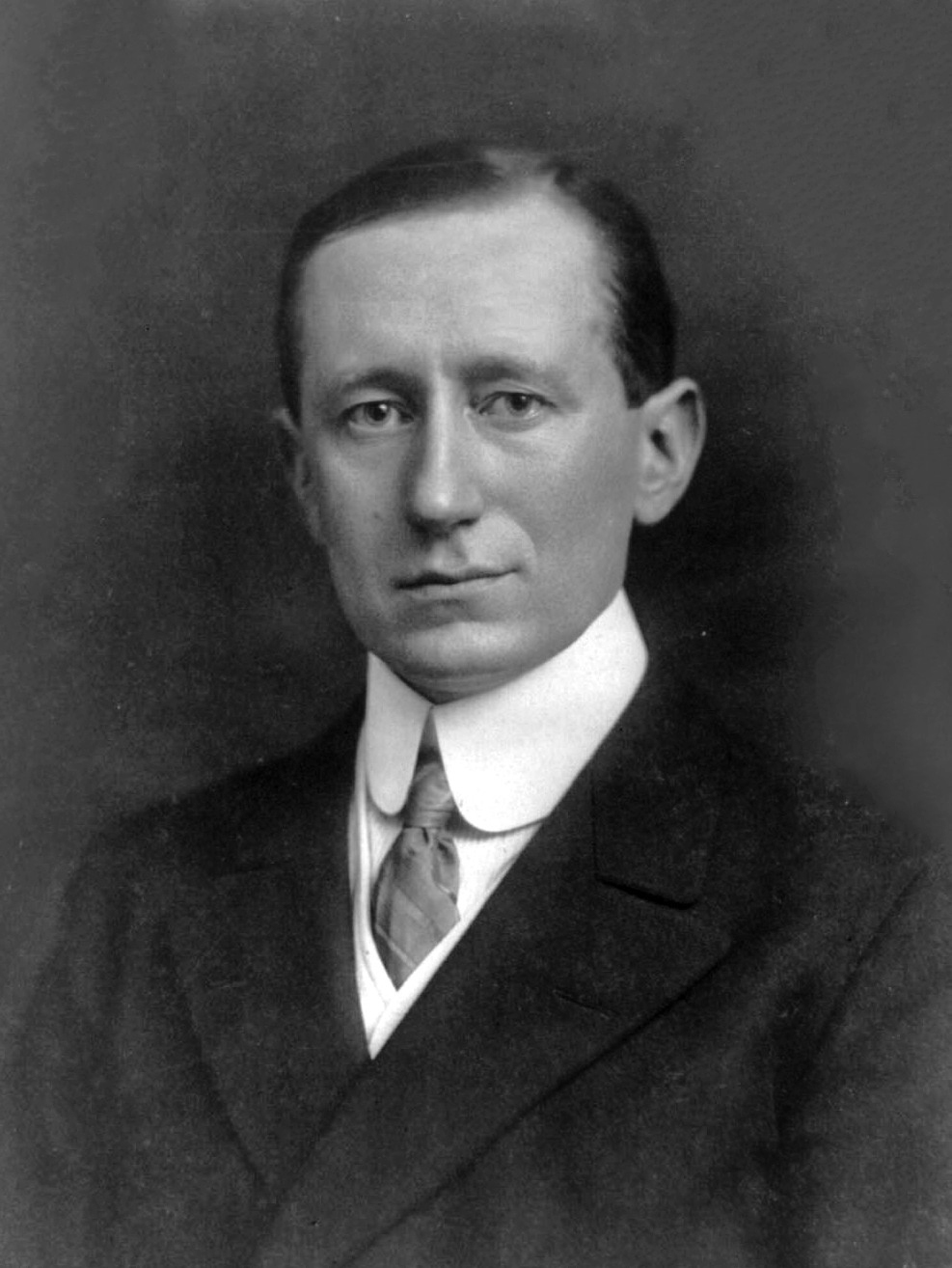
Edison’s induction apparatus relied on near-field coupling between conductors. Signal strength fell rapidly with separation, and effective operation required unwieldy wires. Marconi’s system exploited propagating waves and could develop towards ship-to-shore and transoceanic service.
It is therefore inaccurate to say Edison invented radio and sold it to Marconi. He patented a different form of wireless signalling. Marconi later acquired rights connected with Edison’s patent portfolio because a broad early claim could have legal value, but patent strategy is not proof of technical identity.
Why the system did not spread
Railway and maritime communication demanded range, reliability and manageable equipment. Edison’s system was sensitive to geometry. Trains changed their relationship to line wires; ships rolled and moved beyond the most effective distance. Large elevated conductors were inconvenient.
The existing telegraph network also created an economic question. Railway companies already communicated from fixed stations and might not pay heavily for an imperfect moving link. At sea, flags, lamps and later radio offered alternatives.
A technically successful demonstration can therefore remain commercially weak. Like Edison’s vote recorder, induction telegraphy solved the visible problem without fully matching institutional cost and performance.
Edison returns to naval communications
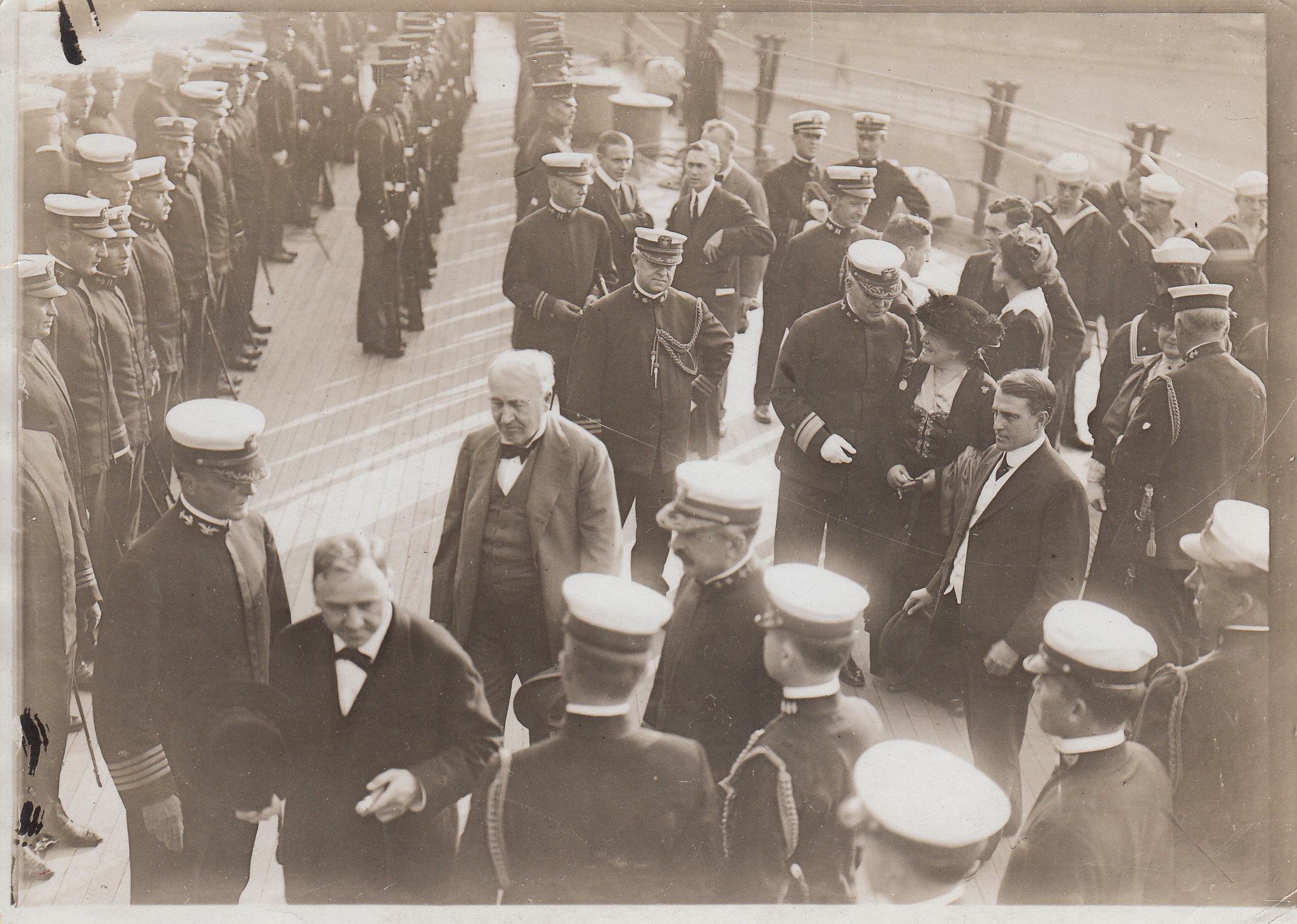
During the First World War Edison chaired the Naval Consulting Board and investigated problems of detection, signalling and submarine warfare. Miller Reese Hutchison, his chief engineer, had worked with wireless and telephone apparatus.
By then radio was established. Edison did not insist that the Navy revive his induction patent. His laboratory considered practical military needs within a technology transformed by other inventors and companies.
This later work demonstrates a feature of Edison’s career: an unsuccessful line did not disappear from his interests. Communication with ships remained strategically important even when the appropriate physics changed.
Did Edison anticipate broadcasting?
No. His system transmitted telegraph signals between particular stations. It was not conceived for speech or music sent to a mass audience, and it did not provide the range later broadcasting required.
What he anticipated was mobility. A message need not wait for a vehicle to stop and attach to a wire. That objective now seems obvious because radio solved it so completely. In the 1880s it demanded an imaginative break from the wired network.
A branch that did not become the trunk
Histories of technology often look backwards from the winning system. Radio makes induction telegraphy seem like a mistaken approach. At the time, engineers did not yet know which method would prove scalable. Testing near-field coupling was rational.
Edison’s wireless experiments deserve neither the crown of “radio before Marconi” nor dismissal as a trick. They were a serious answer to a difficult problem. Their modest range showed the boundary of that answer, while Marconi’s radiated waves opened another route across the sea.
The patent still matters because it records an inventive branch that lost. Technology advances not only through direct ancestors of the winning machine but through alternatives that clarify the problem. Edison showed that a moving station could exchange electrical signals without contact. Radio showed how to remove the nearby companion wire.
Between those achievements lies the difference between crossing a gap and crossing an ocean.
The patent’s later commercial life
A patent can remain valuable after its intended machine has failed. Broad wording may appear to cover part of a later industry, encouraging purchase or litigation. Edison’s wireless-related rights attracted attention as radio companies assembled defensive portfolios.
That later transaction has encouraged the claim that Marconi bought Edison’s invention and therefore owed radio to him. Patent acquisition can buy peace or bargaining power without acknowledging technical descent. Companies frequently purchase doubtful or overlapping claims because a lawsuit costs more.
The correct comparison belongs in the specifications and apparatus. Edison arranged induction between nearby conductors. Marconi developed transmitters, receivers, tuning and aerial systems for radiated waves. The objectives overlapped more than the means.
From Morse clicks to a human voice
Edison’s tests sent coded pulses. An operator supplied intelligence by converting letters to Morse and back. Early radio did the same; voice transmission required continuous modulation and more sensitive detection.
This distinction explains why wireless telegraphy transformed shipping before broadcasting transformed homes. A distress call or position report could be valuable in a few coded words. Music demanded fidelity, power and an audience equipped with receivers.
Edison’s induction system belonged wholly to the first problem. Describing it as “before broadcasting” locates it chronologically, not as an embryonic radio station.
An inventor beside an emerging science
Electromagnetic theory was developing rapidly while Edison pursued practical telegraphy. He was often impatient with theory, but commercial wireless could not mature through workshop intuition alone. Wave propagation, resonance and tuning required closer relations between physics and engineering.
The victory of radio was therefore also a victory of a different experimental scale: measured wavelengths, tuned circuits and long-distance field tests. Edison’s near conductors answered to geometry that no increase of mechanical ingenuity could remove.
What Edison’s experiment can legitimately claim
It transmitted telegraphic signals across a physical gap to a moving railway vehicle and explored comparable ship communication. It produced a patent and demonstrated that useful messages could be carried by electrical coupling without contact.
It did not radiate and receive radio waves in the later practical sense, establish long-distance maritime service or anticipate broadcast programming. Those limits do not reduce the experiment to failure; they locate its achievement accurately.
Precision also restores the other pioneers. Hertz demonstrated the waves, Marconi organised a radio system and many naval and commercial operators made it dependable at sea.
Sources and further reading
- US Patent 465,971, “Means for Transmitting Signals Electrically” – Edison’s induction system and drawings.
- Thomas H. White, “Alternatives to Radio” – technical distinction between induction systems and radio.
- National Park Service, “Radio Goes to Sea” – maritime wireless context.
- Thomas A. Edison Papers, telegraphy and telephony patents – Edison’s wider communications work.