Thomas Edison entered the cement business through the wreckage of another enterprise. His magnetic iron-ore works had left him with giant rock crushers, engineering knowledge and an urgent need to find value in failure. Cement seemed a natural rescue. Limestone could be crushed, mixed and burned on an industrial scale, and America’s cities were consuming concrete at unprecedented speed.
The Edison Portland Cement Company became famous for two claims: that Edison built exceptionally long rotary kilns and that his cement formed Yankee Stadium. Both are true in outline. Neither turned the company into an easy triumph. The plant at New Village, New Jersey, struggled with breakdowns, competition and chronic overcapacity. Its history is the connecting passage between the ore disaster, Edison’s one-piece concrete house and one of the most celebrated sports grounds in America.
From iron powder to limestone
At Ogdensburg Edison had attempted to concentrate low-grade magnetic ore. Rock passed through crushers and rollers until it was fine enough for magnets to separate iron-bearing particles from waste. The scheme failed when rich, cheaply transported ore from Minnesota undercut it.
Much of the crushing technology remained valuable. Ordinary cement manufacture begins by reducing limestone and clay to controlled sizes, blending them and firing the mixture into hard clinker. Edison believed the machinery and process discipline developed for ore could make cement more efficiently.
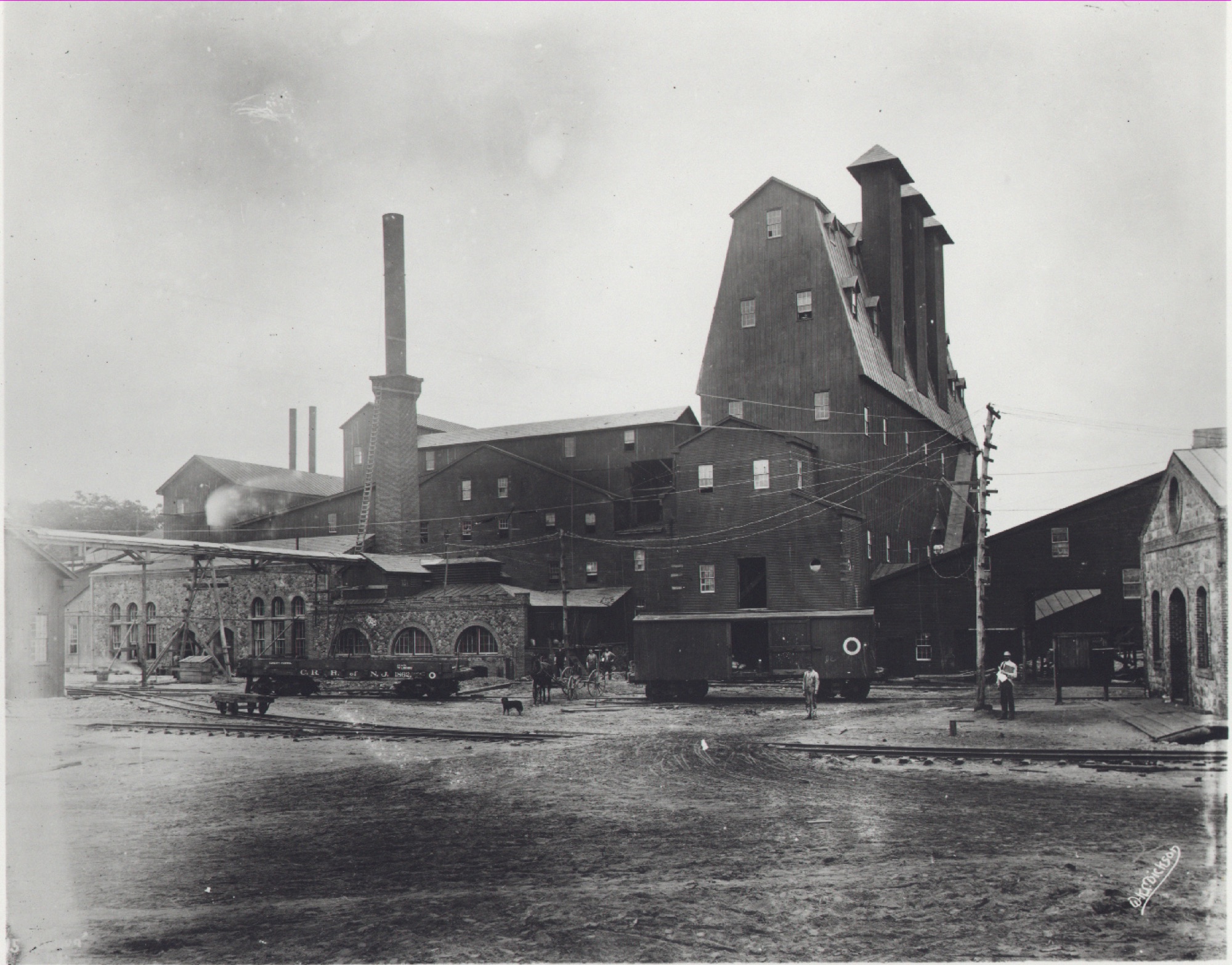
He incorporated the Edison Portland Cement Company on 7 June 1899. The works were built near New Village in Warren County, where limestone deposits and rail connections offered promise. “Portland” described the type of cement, not a location in Oregon or Maine; the finished material resembled Portland stone when set.
Edison’s long rotary kilns
Rotary kilns were already transforming cement manufacture. A slightly inclined steel cylinder revolved while powdered raw material moved towards a flame. Heat drove off carbon dioxide and produced clinker, which was cooled and ground with gypsum.
Edison’s most conspicuous innovation was scale. Contemporary kilns were often about sixty feet long. His plant adopted cylinders approximately 150 feet in length and nine feet in diameter. The greater residence time and output promised more uniform burning and lower labour costs.
A long kiln was not simply a short kiln with extra steel. It required reliable supports, gearing, fuel control, refractory lining and a steady feed. Distortion or damaged brickwork could halt production. Edison’s organisation patented machinery and arrangements around crushing, kilns and handling, but operating them continuously proved harder than demonstrating the concept.
The New Village works
The factory was laid out for volume. Limestone and other materials arrived from quarries, passed through crushers and dryers, were proportioned and ground, then entered the kilns. Finished clinker required further grinding before cement was packed for shipment.
Edison approached the plant as a complete material-flow system. Gravity reduced unnecessary handling, conveyors linked operations and fine grinding was supposed to improve uniformity. The aim resembled his electric-light programme: every component had to support economical output.
The difficulty was that cement is a low-value, heavy product. Transport costs matter greatly. A technically efficient works can lose money if it is too far from customers, runs below capacity or competes against established producers with better distribution. Edison’s brand could attract attention, but engineers and contractors bought on specifications and price.
A difficult business
The company did not immediately reward Edison’s confidence. Construction and machinery cost heavily, the kilns encountered operating difficulties and the market could not always absorb the volume the plant was designed to make. Cement prices were competitive, and economic downturns reduced building.
Production improved over time. Edison cement developed a reputation for quality and found significant contracts. The Thomas A. Edison Papers nevertheless describes the concern as never very profitable until 1922. That qualification is essential. A plant can be technically influential without returning the fortune its founder expected.
Edison himself persisted. The ore venture had taught him that crushing and separation required relentless attention to wear, dust and flow. Cement supplied a more suitable raw material and market, but it did not repeal industrial economics.
The concrete-house dream
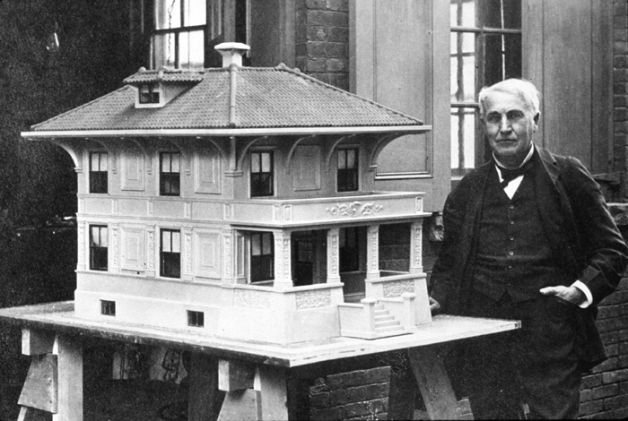
Cement led Edison towards a larger social claim. He proposed pouring the walls, floors, stairs, roof and decorative features of a house as one continuous concrete structure. Reusable iron moulds would make dwellings durable, sanitary and inexpensive.
The mould system contained more than two thousand parts and weighed hundreds of thousands of pounds. The cost made sense only if a builder poured many houses from the same forms. A few developers constructed concrete houses using Edison-related methods, including a surviving group in Union, New Jersey, but mass adoption never followed.
For the cement company, the proposal was also market creation. Edison spoke of better working-class housing, yet every concrete house would consume large quantities of the product his works sold. Social reform and commercial interest were intertwined.

Yankee Stadium
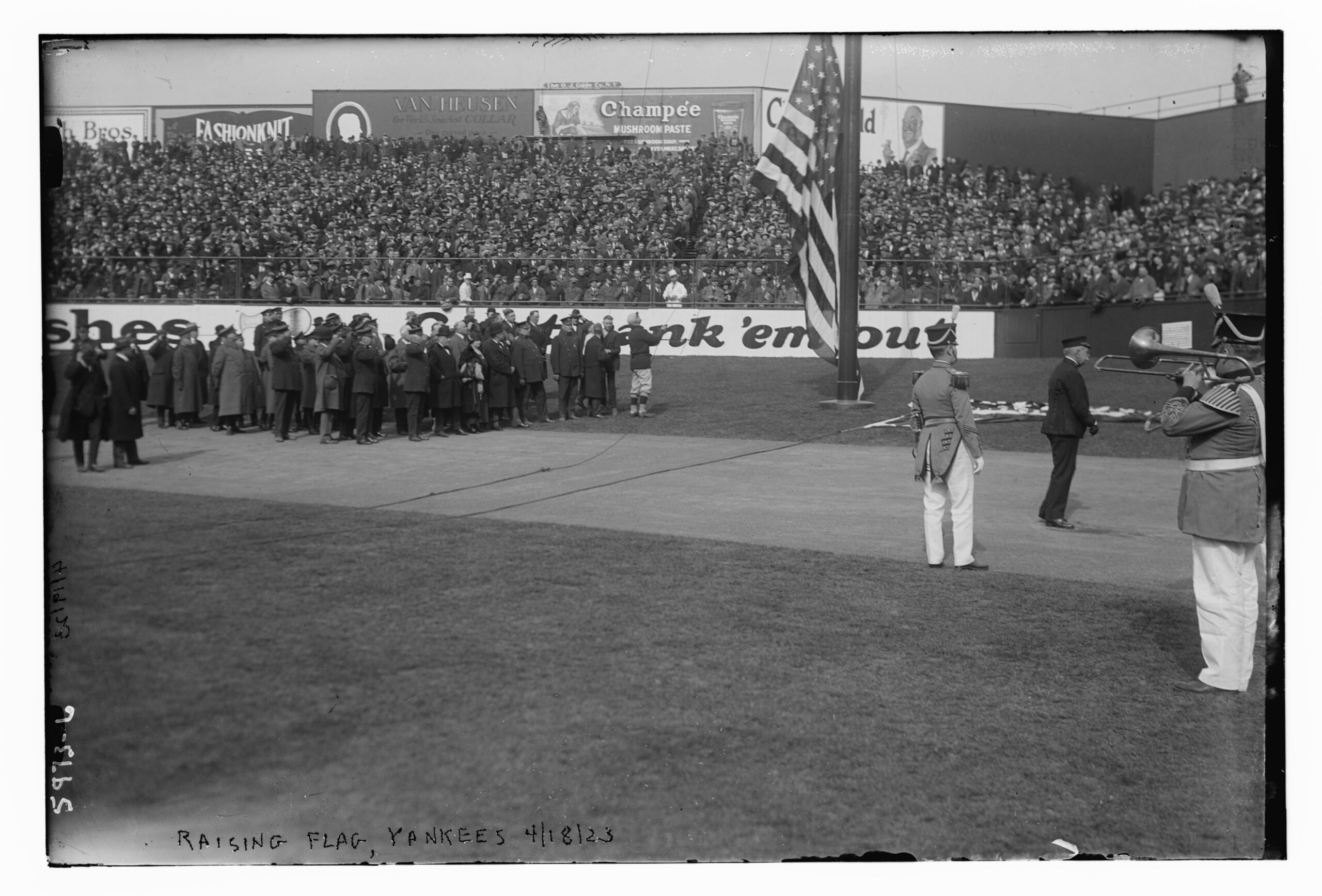
The contract that fixed Edison cement in public memory came after the First World War. The New York Yankees, newly powerful through Babe Ruth, began building a vast stadium in the Bronx. It opened on 18 April 1923 before a crowd officially reported above 74,000.
The Edison company supplied cement for the concrete. A contemporary company account reproduced by the Edison Papers gave figures of about 30,000 cubic yards of concrete containing approximately 45,000 barrels of cement, along with vast quantities of stone and sand. These numbers should be understood as period project figures rather than modern independent measurements.
It is often said that the entire stadium was “made of Edison cement”. Cement was one ingredient in concrete, which also contained aggregate and water; structural steel was equally fundamental. The wording also risks implying that Edison designed the stadium. He did not. Osborn Engineering provided the design and White Construction carried out the work.
Even with those corrections, the achievement was substantial. A supplier had to meet specifications and deliver consistently during a rapid construction programme. The contract demonstrated that Edison’s plant could serve a major modern structure, not merely an experimental house.
Did Edison cement last?
The original Yankee Stadium underwent extensive alteration in the 1970s and was demolished between 2009 and 2010. Its disappearance does not prove that the 1923 concrete failed; stadium requirements and economics had changed. Other structures made with Edison cement survived, although identifying the exact cement source in every claimed building requires documentary evidence.
Claims that the material was uniquely indestructible belong more to advertising than chemistry. Portland cement from different makers had to meet standards. Edison’s competitive advantage lay in production methods, quality control and scale, not a mysterious formula.
The company’s name also outlived Edison’s daily involvement. Charles Edison assumed increasing responsibility across the family businesses during the 1920s as his father’s health declined.
Concrete contracts were won through testing as well as reputation. Cement fineness, setting time and strength could be measured, and public works increasingly specified performance. The Edison company maintained chemical and physical control because variation in limestone or burning would reach the building site as weak or unpredictable concrete. This was a field in which a famous signature on the sack mattered less than a reliable laboratory result.
Closure and afterlife
The Edison Portland Cement Company was dissolved in December 1931, shortly after Edison’s death. A successor continued the New Village operation under other ownership until the early 1940s. The Depression devastated construction and exposed plants with high fixed costs.
Remains of the works survived as industrial ruins, while the quarry landscape and local memory preserved the company’s presence in Warren County. The long-kiln principle spread throughout cement manufacture, although later designs, fuels and process controls changed the industry beyond Edison’s machinery.
The business never approached the cultural importance of electric light or recorded sound. It mattered because it shows Edison carrying knowledge from failure into another field. The ore mills did not simply vanish; their crushers, personnel and habits of large-scale process engineering found a second life.
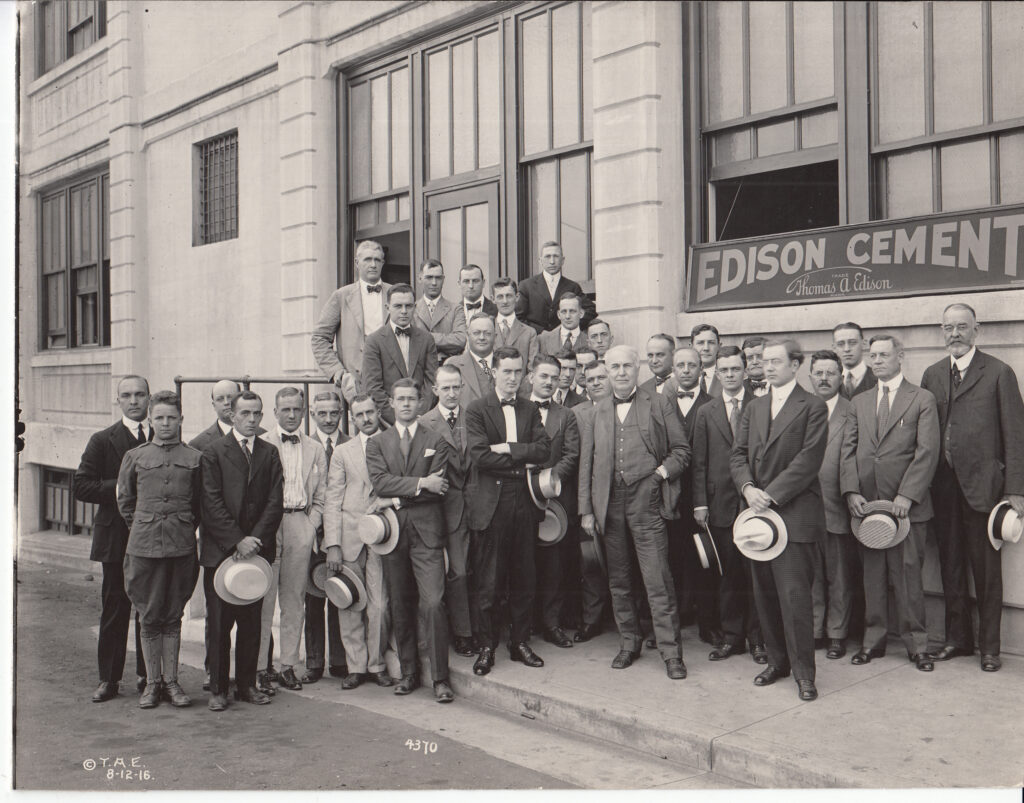
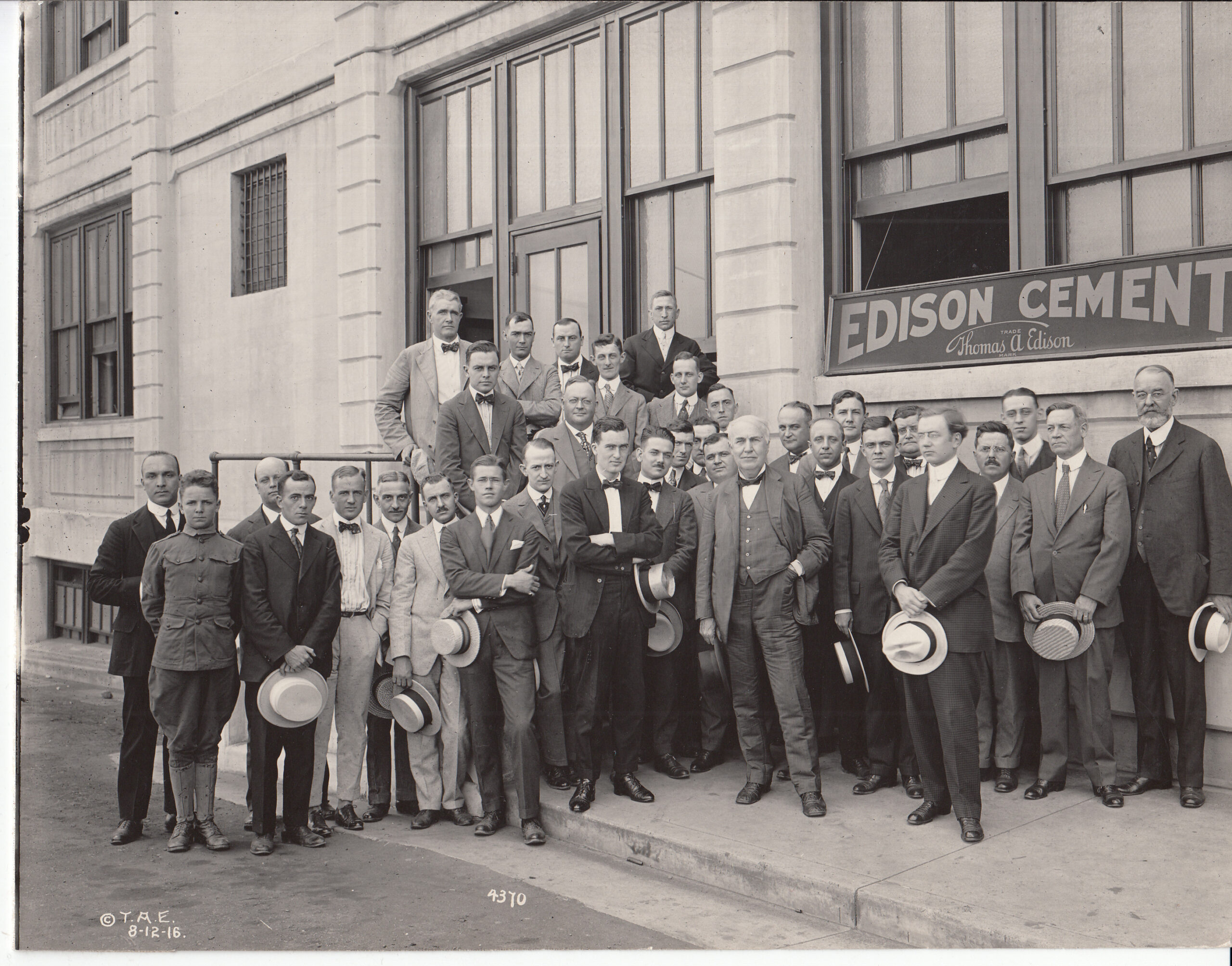
The works also altered the community around it. Quarrying consumed land, kilns and crushers produced dust and noise, and the company supported jobs, railway traffic and local commerce. Industrial ruins can look romantic after machinery stops, but the operating plant was a demanding neighbour and a dangerous workplace. The men in the 1916 employee photograph, not Edison alone, kept stone moving through the system.
Environmental costs were little discussed in Edison’s publicity. Cement manufacture releases carbon dioxide from fuel and from limestone itself, while quarrying permanently reshapes a landscape. Those consequences are central to the industry today. They do not make Edison uniquely careless, but they remind us that efficiency in one part of a process can conceal costs imposed elsewhere.
Failure, reinvention and a famous stadium
Edison’s cement career resists a clean verdict. The company struggled and for many years earned little. The one-piece house did not transform American housing. Yet the plant introduced exceptionally long kilns, sold a respected product and supplied one of the most recognisable buildings of the twentieth century.
Its origin is the important part. Edison responded to an expensive mining disaster by identifying what the failed system had taught him. He did not recover every dollar, but he refused to treat the machinery and knowledge as worthless.
Yankee Stadium became the perfect public monument to that stubbornness. Beneath the crowds, championships and mythology stood concrete made with cement from an enterprise born among the dust and broken expectations of Ogdensburg.
Sources and further reading
- Thomas A. Edison Papers, “Cement” – plant, long kilns, profitability and major projects.
- Thomas A. Edison Papers, “Edison Portland Cement Company” – incorporation, corporate history and dissolution.
- Thomas Edison National Historical Park, “Edison Portland Cement Company” – relationship to ore milling and industrial process.
- Society of Architectural Historians, “Edison Concrete Houses” – concrete-house system and surviving New Jersey examples.
- Library of Congress, Yankee Stadium photographs – visual record of the original stadium.